‘Ready to go’: Trump threatens Iran over protest crackdown
SOURCE:Sydney Morning Herald|BY:Elwely Elwelly
The president and top Iranian officials have exchanged threats as widening protests sweep across parts of the Islamic Republic, further escalating tensions between the countries.
Dubai: US President Donald Trump and top Iranian officials have exchanged threats as widening protests swept across parts of the Islamic Republic, further escalating tensions between the countries after America bombed Iranian nuclear sites in June.
At least eight people have been killed so far in violence surrounding the demonstrations, which were sparked in part by the collapse of Iran’s rial currency but have increasingly seen crowds chanting anti-government slogans.
Trump and Iran’s National Security Council chief Ali Larijani traded threats over the latest developments,Credit: AP
The protests, now in their sixth day, have become the biggest in Iran since 2022, when the death of 22-year-old Mahsa Amini in police custody triggered nationwide demonstrations. However, the protests have yet to be as widespread and intense as those surrounding the death of Amini, who was detained over not wearing her hijab, or headscarf, to the liking of authorities.
Trump initially wrote on his Truth Social platform, warning Iran that if it “violently kills peaceful protesters”, the United States “will come to their rescue”.
“We are locked and loaded and ready to go,” Trump wrote, without elaborating.
In return, Iran’s Foreign Minister Abbas Araghchi wrote on X: “Given President Trump’s deployment of the National Guard within US borders, he of all people should know that criminal attacks on public property cannot be tolerated.”
The people of Iran would “forcefully reject any interference in their internal affairs”, he added.
‘The Iranian government [is] likely to use Trump’s statement as proof that the unrest is driven by external actors.’
Naysan Rafati, International Crisis Group analyst
Meanwhile, Ali Larijani, a former parliament Speaker who serves as the secretary of Iran’s Supreme National Security Council, alleged that Israel and the US were stoking the demonstrations. He offered no evidence to support the allegation, which Iranian officials have repeatedly made during waves of previous protests.
“Trump should know that intervention by the US in the domestic problem corresponds to chaos in the entire region and the destruction of the US interests,” Larijani wrote on X, which the Iranian government blocks.
“The people of the US should know that Trump began the adventurism. They should take care of their own soldiers.”
Larijani’s remarks likely referenced America’s wide military footprint in the region. Iran in June attacked Al Udeid Air Base in Qatar after the American strikes on three nuclear sites during Israel’s 12-day war on the Islamic Republic. No one was injured, though a missile did hit a structure there.
2009: A demonstrator holds a placard as hundreds of thousands of Iranians rally in support of Iranian opposition leader Mir Hossein Mousavi.Credit: Ben Curtis
As of Friday, no major changes had been made to US troop levels in the Middle East or their preparations following Trump’s social media posts, said a US official, who spoke on condition of anonymity to discuss sensitive military plans.
Trump’s online message marked a direct sign of support for the demonstrators, something other American presidents have avoided out of concern that activists would be accused of working with the West. During Iran’s 2009 Green Movement demonstrations, president Barack Obama held back from publicly backing the protests – something he said in 2022 “was a mistake”.
But such White House support still carries a risk.
“Though the grievances that fuel these and past protests are due to the Iranian government’s own policies, they are likely to use President Trump’s statement as proof that the unrest is driven by external actors,” said Naysan Rafati, an analyst at the International Crisis Group.
“But using that as a justification to crack down more violently risks inviting the very US involvement Trump has hinted at,” he added.
Days of unrest
The most intense recent unrest has taken place in the Iranian city of Azna, about 300 kilometres south-west of Tehran, where online videos purported to show objects in the street ablaze and gunfire echoing as people shouted: “Shameless! Shameless!”
The semi-official Fars news agency reported three protesters had been killed and 17 injured during what it said was an attack on a police station in Lorestan province.
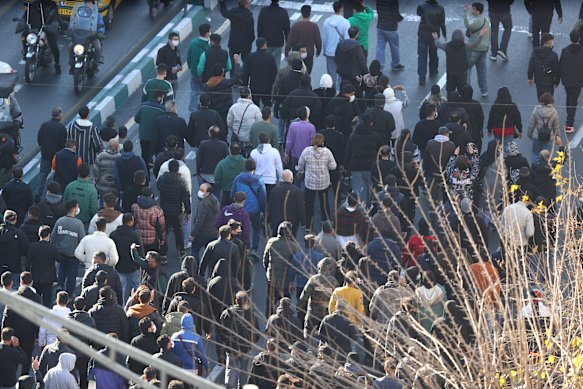
Protesters march in downtown Tehran on Monday.Credit: AP
“The rioters entered the police headquarters ... they clashed with police forces and set fire to several police cars,” Fars reported.
On Friday, Fars said two people had been killed in Lordegan, in the country’s Charmahal and Bakhtiari province, in clashes between security services and what it called armed protesters.
Loading
Online videos showed demonstrators gathered on a Lordegan street, with the sound of gunfire in the background. The footage matched known features of the city about 470 kilometres south of Tehran.
The Revolutionary Guards said one member of its affiliated Basij volunteer paramilitary unit had been killed in Kuhdasht and another 13 wounded, blaming demonstrators.
Rights group Hengaw reported that a protester was shot dead on Wednesday in Isfahan province in central Iran.
Reuters could not immediately verify the reports.
The clashes mark a significant escalation in the unrest that has spread across the country since shopkeepers began protesting last Sunday. What started with merchant anger over the government’s handling of the economy soon morphed into broader anti-regime demonstrations, with students from a number of Iranian universities joining in.
As the protests entered their fifth day, clashes intensified in several locations, London’s Telegraph reported. Protesters in more than a dozen cities chanted, “this year is a year of blood, Seyyed Ali will be overthrown” and “death to the dictator” – a reference to Supreme Leader Ali Khamenei.
The government shut down much of the country on Wednesday, declaring a holiday due to cold weather.
Protests also took place on Thursday in Marvdasht in the southern Fars province, activist news site HRANA reported, while Hengaw said demonstrators had been detained the previous day in the western provinces of Kermanshah, Khuzestan and Hamedan.
Workers from Tehran’s massive fruits market joined the protests on Thursday, the Telegraph reported, citing footage online showing crowds demonstrating against rising prices. The market has been particularly hard hit by currency fluctuations that have driven up the cost of imported goods.
‘Most of us understand the risks, yet we still go because we are tired of the regime’
Houman, Iranian student protester
Residents in multiple cities told the Telegraph that security forces had blocked roads and maintained a heavy armed presence on the streets.
Siamak, a boutique owner in Nahavand, told the Telegraph that riot squads and protesters clashed on Wednesday night and Thursday morning
“They were shooting pellets without any regard for whether they would kill or blind people. I saw two people soaked in blood,” he said.
Iran’s clerical rulers are grappling with Western sanctions that have battered an economy already reeling from more than 40 per cent inflation, compounded by Israeli and US airstrikes in June targeting the country’s nuclear and ballistic missile infrastructure and military leadership.
Loading
The Iranian rial lost about half its value against the US dollar in 2025, with official inflation reaching 42.5 per cent in December. Young people also face high unemployment, even after years of study.
Tehran has in recent years responded violently to protests over issues ranging from high prices, droughts, women’s rights and political freedoms.
Government spokesperson Fatemeh Mohajerani said on Thursday that the authorities would hold a direct dialogue with representatives of trade unions and merchants, without giving details.
Protesters, however, have vowed not to back down. Houman, an arts student at a university in Tehran, told the Telegraph that he had joined the protests on Tuesday night – knowing he could be killed.
“Most of us understand the risks, yet we still go because we are tired of the regime,” he said.