Samsung Galaxy phones may soon respond to a new “Hey Plex” voice command
We've also spotted more clues of Perplexity being preinstalled on Samsung devices in the future.
Calvin Wankhede / Android Authority
TL;DR
- Samsung is preparing to further integrate Perplexity AI into its devices, possibly including the new “Hey Plex” wake word for easier activation.
- Perplexity’s latest app release includes code that builds support for Samsung-specific hotword services, indicating device optimization tailored for Galaxy phones and tablets.
- Perplexity could also potentially arrive as a preinstalled assistant on upcoming Galaxy devices, likely the Galaxy S26 series.
Samsung has been collaborating with Perplexity for some time now. Samsung users in the US can already redeem a year’s worth of Perplexity Pro through the Galaxy Store. The company has also integrated Perplexity within Bixby on some of its smart home appliances. Samsung Galaxy phones are also expected to get a Perplexity-powered Bixby experience with One UI 8.5, and the Galaxy S26 series could even come with pre-installed Perplexity. Samsung’s partnership with Perplexity could go even deeper, as we’ve now spotted hints of an exclusive “Hey Plex” hotword for invoking the digital assistant on Galaxy devices.
“Hey Plex” hotword for Samsung Galaxy devices
Within Perplexity’s latest v2.69.3 app release, we’ve spotted hints of a “Hey Plex” hotword trigger for invoking the digital assistant. This would seemingly allow Perplexity to operate similarly to Gemini, utilizing its “Hey Google” hotword, which would enable the digital assistant to be invoked even when the screen is off.
Expectedly, you will have to agree to have your voiceprints collected and processed to set up the hotword:
Code
<string name="assistant_speaker_verification_voiceprint_agreement">I agree to collection and processing of my voiceprints</string>
<string name="assistant_speaker_verification_voiceprint_agreement_required">By continuing, you agree to the registration and processing of your wake-up command.</string>
Users will have to give microphone permission to allow Perplexity to record audio to detect their voice:
Code
<string name="assistant_speaker_verification_no_permission">Please grant permission for audio recording so I can detect your voice</string>
The setup will not continue if you have external mics connected to your phone:
Code
<string name="assistant_speaker_verification_external_mic_subtitle">"Please disconnect your Bluetooth headphones or other external microphone and use your device's built-in microphone for voice enrollment."</string>
Once the setup is complete, users will be able to delete the hotword and re-record their voiceprint if needed.
So far, none of these clues indicates a Samsung partnership. However, we did spot new services added to Perplexity that explicitly call in actions like samsung.hotword.service and request permissions through samsung.hotword.service.permission.ACCESS_HOTWORD_SERVICE.
Perplexity also features a new WakeWordDetectionService, a foreground service designed to handle voice activation and wake word detection. The catch here is that the implementation appears to be heavily optimized for Samsung Galaxy devices, as it relies on a handshake with Samsung’s proprietary Hotword SDK (com.samsung.android.hotword.sdk.IHotwordSdk) rather than just standard Android microphone access.
Preinstalled Perplexity on some Samsung Galaxy devices
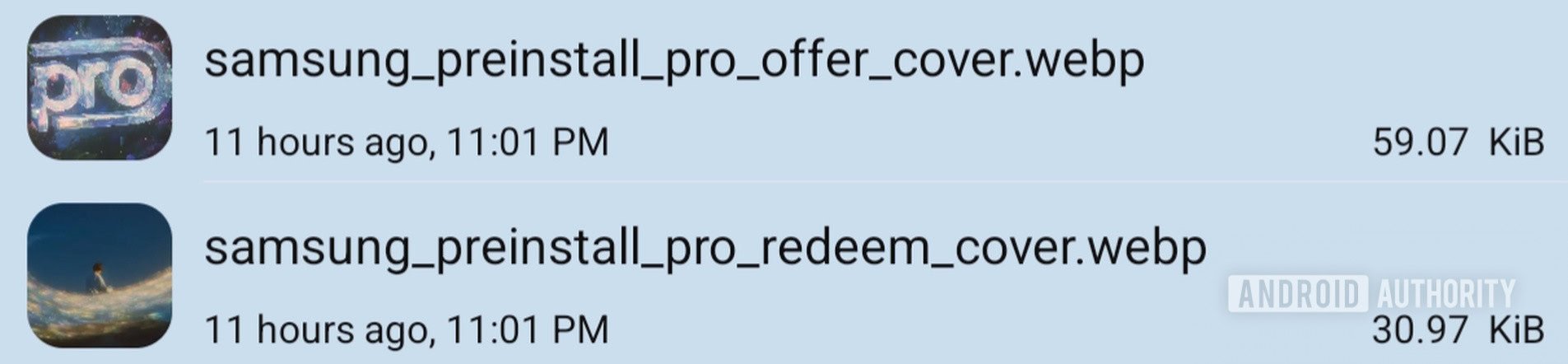
We’ve also spotted two new image files, the names of which are further clues that corroborate Samsung’s intention to pre-install Perplexity on some Galaxy devices.
AssembleDebug / Android Authority
Here are the images mentioned above, just for reference:
The clues do not specifically point to the upcoming Galaxy S26 series as the target for pre-installation. But given that the Galaxy S26 series will be the most high-profile Samsung launch in the first half of the year, the timing is ripe for a correlation. We’ll have to wait for either Samsung or Perplexity to confirm these decisions through an official announcement.
⚠️ An APK teardown helps predict features that may arrive on a service in the future based on work-in-progress code. However, it is possible that such predicted features may not make it to a public release.
Follow
Thank you for being part of our community. Read our Comment Policy before posting.