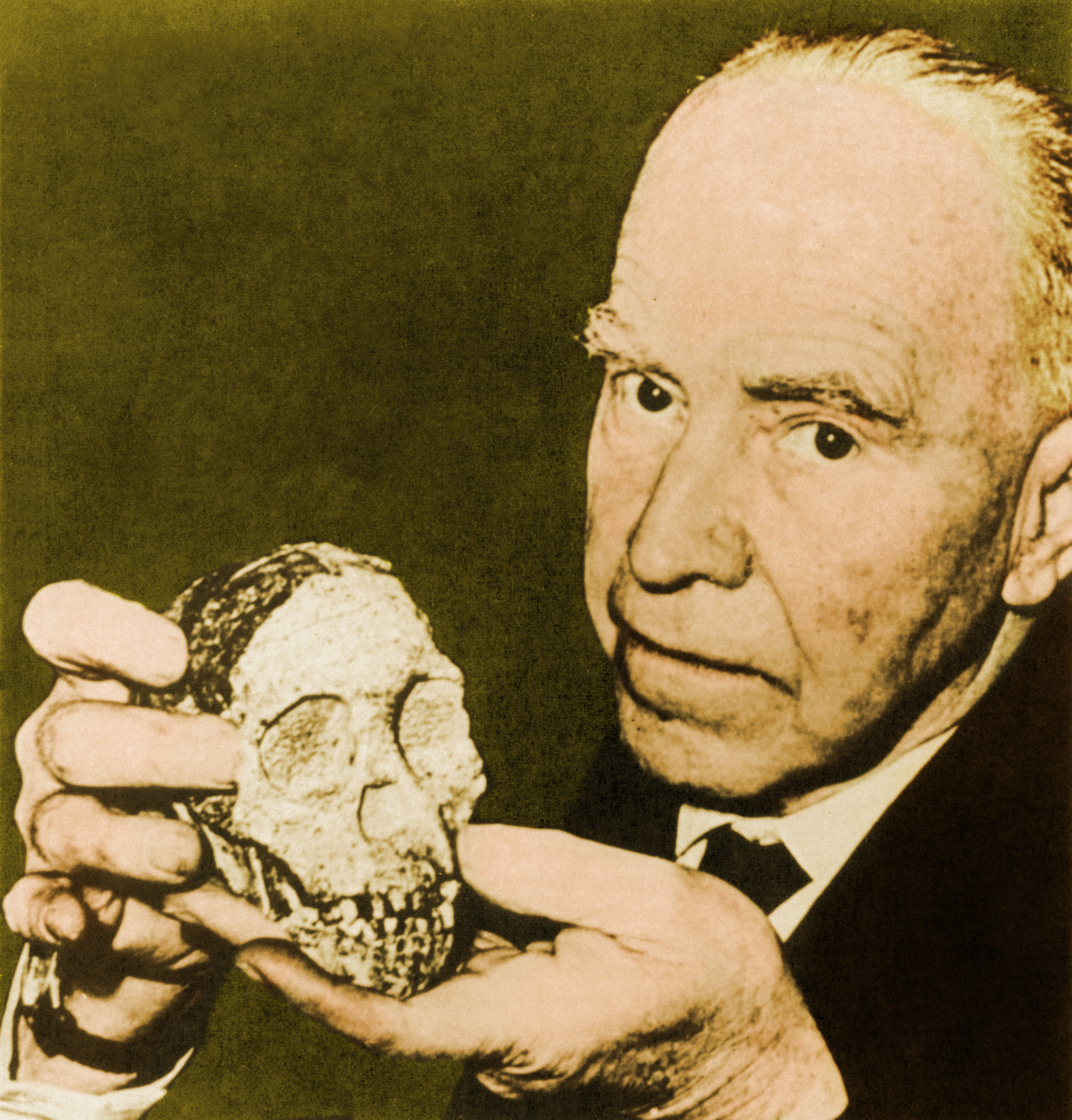
Science history: Anthropologist sees the face of the 'Taung Child' — and proves that Africa was the cradle of humanity — Dec. 23, 1924
Over a century ago, anthropologist Raymond Dart chipped an ancient skull out of some rock from an ancient quarry — and revealed the face of an ancient human relative.

The Taung Child skull was unearthed in what is now South Africa in 1924. It helped redefine our human family tree. (Image credit: By Didier Descouens - Own work, CC BY-SA 4.0)
Milestone: "Taung Child" skull revealed
Date: Dec. 23, 1924
Where: Taung, South Africa
Who: Raymond Dart's anthropological team
At the end of 1924, an anthropologist began chipping away rock around an old primate skull — and rewrote the story of human evolution.
The diminutive skull — about the size of a coffee mug — clearly belonged to a creature very different from us and yet also quite distinct from other apes and monkeys.
But the man credited with its discovery, Raymond Dart, a professor of anatomy and anthropology at the University of Witwatersrand in Johannesburg, hadn't actually excavated the skull.
Rather, it came to Dart because his student had brought another skull from a quarry to his class. Local workers at the Buxton Limeworks in Taung had previously blasted a baboon skull out of the rock and had brought it to the attention of the company. From there, the baboon skull landed with Dart's student, Josephine Salmons. She recognized it for what it was and brought it to his class.
Dart was excited about the possibility that other ancient primate fossils would be embedded in the same sediments, and he showed the baboon skull to his geologist colleague Robert Young. Young knew the quarry and made contact with the quarryman, a Mr. de Bruyn, and asked him to keep an eye out for more skulls. In late November, de Bruyn identified a brain cast in a piece of rock and set it aside for Young, who then hand-delivered the cranium to Dart.
In his 1959 memoir, "Adventures with the Missing Link," Dart makes no mention of Young hand-delivering the skull. Instead, he implies that he had pulled the skull out of rubble in crates that were delivered from Buxton Limeworks.
In Dart's telling, he immediately recognized what he had found.
Get the world’s most fascinating discoveries delivered straight to your inbox.
"As soon as I removed the lid a thrill of excitement shot through me. On the very top of the rock heap was what was undoubtedly an endocranial cast or mold of the interior of the skull," Dart recounted in his memoir. "I stood in the shade holding the brain as greedily as any miser hugs his gold … Here, I was certain, was one of the most significant finds ever made in the history of anthropology."