Science history: Marie Curie discovers a strange radioactive substance that would eventually kill her — Dec. 26, 1898
Scientists in Paris discovered two new substances with incredible radioactivity. It earned them the Nobel Prize in Physics but would ultimately kill one of them.
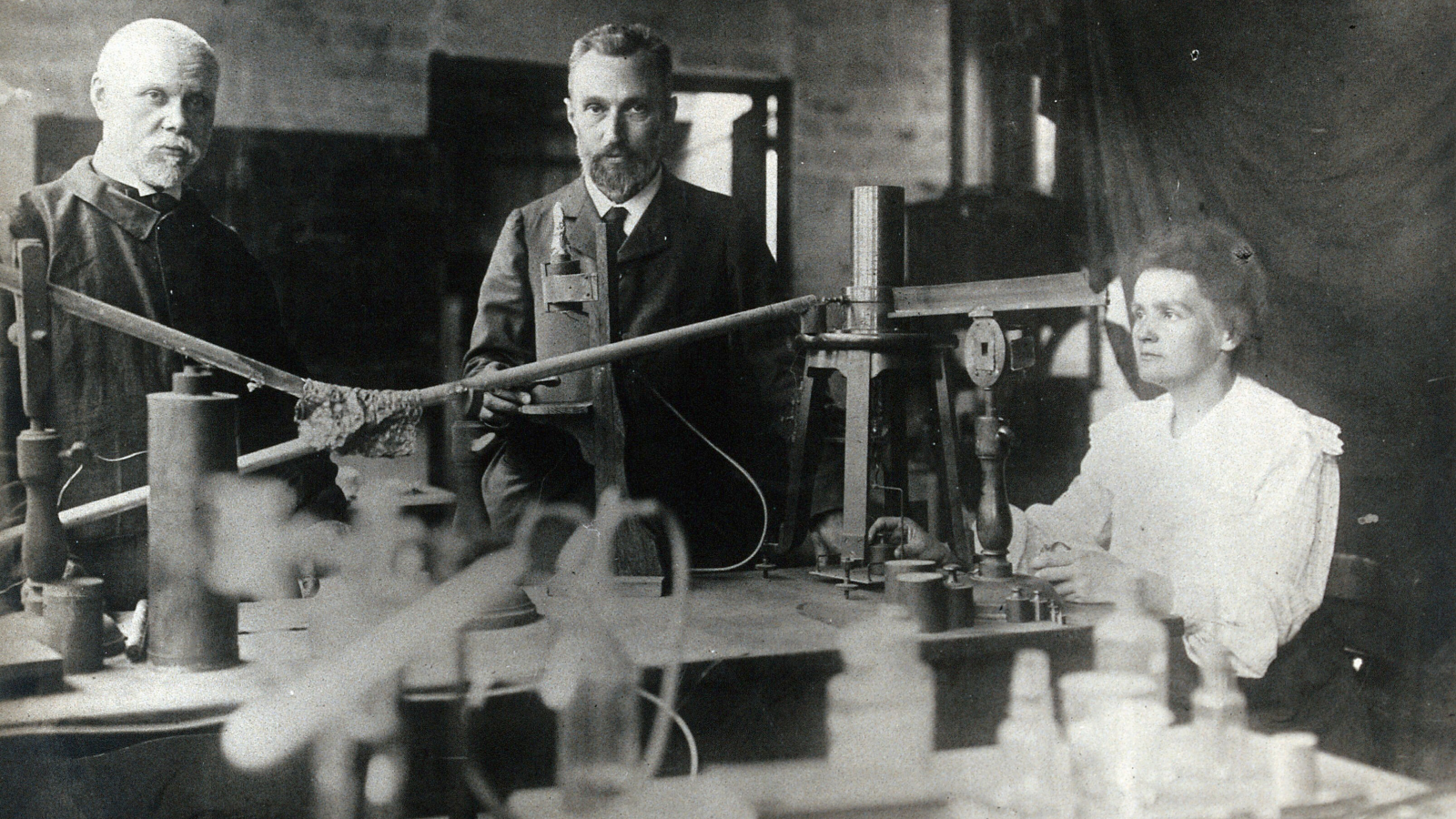
Marie and Pierre Curie (center and right) in their lab with another unidentified man. (Image credit: Marie and Pierre Curie (centre) with a man, using equipment in their laboratory, Paris. Photograph, ca. 1900. Wellcome Collection. Source: Wellcome Collection.)
QUICK FACTS
Milestone: Discovery of radium and polonium
Date: Dec. 26, 1898
Where: Paris
Who: Marie and Pierre Curie, Gustave Bémont
On this day, chemists discovered a substance 900 times more radioactive than uranium. Their research led to unprecedented medical breakthroughs and worldwide fame — but it would also kill one of them.
Marie Curie was a medical student at the Sorbonne, a university in Paris, when she decided to study the new field of radiation for her thesis. In 1895, Wilhelm Röntgen discovered powerful "Röntgen rays," which would eventually be dubbed X-rays. The following year, Henri Becquerel accidentally discovered much weaker rays emitted by uranium salts would fog up photographic plates just like light rays did — even in the absence of light.
Curie realized that she wouldn't have to read a long list of prior papers on the newfangled subject before diving into experimental work, according to the American Institute of Physics. Curie's husband, Pierre, found her a workspace in a musty, crowded storeroom at his institution, the Paris Municipal School of Industrial Physics and Chemistry. He soon became so fascinated with her research that he abandoned his own to pursue hers.
Key to Marie Curie's research was the piezoelectric quartz electrometer. The device, invented by her brother-in-law, Jacques Curie, measured the weak electrical currents produced by radioactivity.
"Instead of making these bodies act upon photographic plates, I preferred to determine the intensity of their radiation by measuring the conductivity of the air exposed to the action of the rays," Curie wrote in a 1904 article for Century magazine.
The damp storeroom messed with her results, but she ultimately discovered that the intensity of this radiation depended on the concentration of uranium in the minerals she studied. She speculated that something intrinsic to the atomic structure of uranium must be at play.