‘Second fiddle’ fantasy? Sorry, Beijing - US and India won't settle for silver
SOURCE:Times of India|BY:TOI NEWS DESK
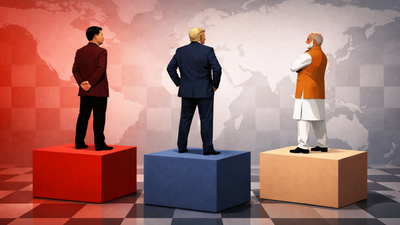
A new narrative suggests China will lead, with the US and India vying for second. Analyst Keji Mao argues US "strategic altruism" towards India has ended due to American decline anxiety. However, the article counters that US decline is exaggerated, China's economic rise faces headwinds, and India is forging an independent path, leading to a complex, contested global order.
TL;DR: Driving the newsA new narrative about upcoming geopolitical upheaval is taking shape in a section of strategic analysts. As per this: China is destined for the top spot, while the United States and India slide into a “battle for second place.
”The argument is gaining traction among Chinese strategists and analysts, including Keji Mao, who says Washington’s long bet on India has soured and US decline anxiety is reshaping alliances.Why it matters: No more US “Strategic altruism” for India
The core claim of Mao, an analyst at China’s International Cooperation Center and founder of the South Asia Research Brief, starts with history. Since the late 1990s, he argues, Washington practiced what many Chinese scholars label “strategic altruism” toward India-absorbing real diplomatic costs to integrate New Delhi into the global order. The most visible example was the civil nuclear deal that carved out an exception to global nonproliferation norms. The logic: A rising democratic India would eventually help balance China in Asia.
That logic, Mao says, has broken down. During Donald Trump’s second term, the US imposed steep tariffs on Indian goods, raised visa fees, tightened outsourcing rules, and adopted rhetoric towards New Delhi that often sounded dismissive. Many Western observers, Mao notes, wave this away as a “Trump anomaly.” He rejects that view.
For Mao, the driver is structural. “The root driver is US anxiety over its declining strength, which now outweighs concern about external geopolitical threats.” In this frame, Washington is cautious with hard retaliators like China and Russia, but tougher on allies. His most vivid line captures the shift: Allies become “blood bags”, with the US preferring to squeeze partners for immediate gains over paying uncertain costs for long-run strategic contests.”
India, Mao argues, is especially exposed. It “has enjoyed US indulgence but lacks the industrial/economic heft of Japan, Europe or Korea to make major concessions-and is less willing to bend-so it is cast as ‘conspicuously ungrateful’.” Over time, he suggests, this friction could reduce tensions between Beijing and both Washington and New Delhi, paving the way for a realignment favorable to China.
The big pictureMao’s logic is coherent-and comforting for Beijing. It fits a long-running Chinese conviction that American decline is destined and China’s rise is inevitable and durable.
But it rests on assumptions that are far more fragile than they appear.However, the nature of power in the twenty-first century is not one-dimensional. It is a mosaic of capabilities-technological, financial, military, demographic, institutional-spread across domains and regions. In some, China will lead. In others, the US remains preeminent. India is carving out a distinct pole that neither mirrors China nor fully aligns with Washington.
Framing the future as a simple race for first and second place flatters hierarchy but obscures how influence actually accumulates-and how constraints bite.Zoom in: American decline, exaggeratedThe first weak link in Mao’s thesis is its linear view of US decline. History suggests a more cyclical pattern.From the Sputnik shock of the 1950s to Vietnam, from Japan’s rise in the 1980s to the 2008 financial crisis, predictions of American eclipse have been routine.
Each time, internal dysfunction and polarization produced dire forecasts. Each time, scale, innovation, institutions, and alliances enabled adaptation.Trump can be read less as proof of terminal decline than as a backlash phase-an ugly but familiar spasm in democratic systems under stress. Democracies and market economies are messy, but they self-correct in ways centralized systems struggle to replicate.Nor does current evidence show a US retreat from Asia. Even amid trade disputes, Washington has deepened security cooperation with Japan, Australia, and the Philippines; reinforced ties with South Korea; expanded technology controls aimed squarely at China; and maintained a robust Indo-Pacific military posture. These are not the actions of a power resigning itself to second place.Also read: India–US ties: US embassy shares key moments of 2025; eyes stronger year ahead China’s numbersMao’s confidence also leans heavily on assumptions about China’s economic trajectory.
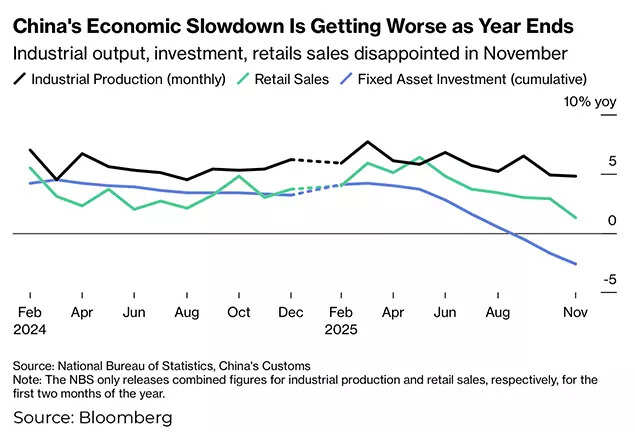
Recent data complicate that story.
As Bloomberg has reported, China’s economy looked resilient on the surface in 2025. Exports surged, growth hovered near the official target, and Beijing avoided a “bazooka” stimulus. Manufacturers moved up the value chain, and the trade surplus widened.Beneath the headlines, however, momentum has softened. Investment is heading for its first annual contraction since 1998.
Retail sales growth has slowed to its weakest pace outside the pandemic. New home prices continue to fall, extending a property crisis with no clear end. To stabilize growth, Beijing has pledged broader fiscal support in 2026-targeting advanced manufacturing, technology innovation, and human capital.None of this signals collapse. But it does question the notion of effortless, linear ascent-and highlights the difficulty of rebalancing an economy while demographics worsen and political control tightens.Between the lines: Political turbulence in BeijingEconomic stress is compounded by political anxiety. Bloomberg reports that Xi Jinping probed a record number of senior officials for corruption in 2025, following earlier purges of top generals. With jockeying intensifying ahead of the next Communist Party congress, questions are emerging about governance quality and elite cohesion.As Alfred Wu of the National University of Singapore told Bloomberg, “For China, there is much more turbulence domestically.”
Anti-corruption drives consolidate control, but they also raise uncomfortable questions about military readiness and decision-making in a system increasingly centered on a single leader.These internal stresses matter because they constrain how aggressively China can translate ambition into action abroad.Geography still mattersGDP is not destiny. Geography and geopolitics remain powerful constraints-and here, China faces enduring disadvantages.China shares land borders with 14 countries and maritime boundaries with several more. It has unresolved disputes or strained relations with many of them, from India and Japan to the Philippines and Vietnam. That creates a neighborhood defined less by deference than by hedging and quiet balancing.Former Singaporean diplomat Bilahari Kausikan captured this reality in Foreign Policy: “No country will ever shun China.
Every country wants as good a relationship with China as possible. But China’s overall geopolitical situation is not favorable.” He asks which states would “meekly acquiesce to China occupying the apex of a regional hierarchy.”For Japan, the Koreas, and Vietnam, national identities have long been defined in opposition to China’s civilizational pull. Subordination would require a wrenching redefinition of identity-making almost any alternative more attractive.This limits Beijing’s ability to convert economic weight into political dominance, a lesson the Soviet Union learned at great cost.
Why India won’t stay in China’s shadowMao is right that India is not China in manufacturing-yet. But the leap from that observation to a future of permanent second place misses the dynamics of India’s rise.India’s strengths lie in demographics, services, digital public infrastructure, and strategic geography.
Unlike China, India does not face the same pace of demographic aging. Its market size and political pluralism make it attractive to firms and governments seeking diversification away from China.India’s geography matters too. Sitting astride key Indian Ocean sea lanes and bordering China, it cannot be sidelined by Washington or easily coerced by Beijing. This gives New Delhi leverage-even when relations with the US are tense.US–India frictions under Trump are real. But friction is not rupture. Structural interests-balancing China, securing supply chains, cooperating on defense and technology-continue to pull the relationship back together. India’s rise does not depend solely on American indulgence; it rests on domestic reform, market scale, and a global environment eager for alternatives to China.
What nextFor Beijing, the danger lies in mistaking temporary US–India strains for a permanent realignment.
Overconfidence risks miscalculation-especially at a moment when domestic headwinds are rising and neighbors are wary.Then as the Economist wrote, "hubris haunts the Communist Party and in 2026 Mr Xi will be tempted to assert China’s interests more aggressively. That creates a risk of dangerous overreach in three areas: trade, Taiwan and new Chinese-run global rules." If Xi decides to invade Taiwan, whether in 2026 or 2027, China may get entangled in a protracted and unwinnable war.
According to some calculations, even a blockade of Taiwan would lead to 7-9% decline in Chinese GDP. This may severely impact China's superpower aspirations.For Washington and New Delhi, the path ahead will be uneven. Trade disputes, immigration politics, and industrial competition will generate friction. But shared strategic interests and mutual leverage argue against a clean break.The more likely future is prolonged, contested coexistence: China rising but constrained; the US adapting rather than fading; India carving out a larger, more independent role.Bottom lineAmerican decline is not destiny. India’s limitations are not permanent. And China’s rise-while real-is neither frictionless nor uncontested. The world they inhabit is too complex, too crowded, and too dynamic for any single power to conduct the orchestra alone.