After almost eight years running Thornbury Picture House, the boutique cinema they built in the shell of a 1919 garage, Gus and Lou Berger felt they knew what they were in for with their sibling venue on Sydney Road, the Brunswick Picture House. But, says Gus, nothing could have prepared them for the challenges of turning a Victorian-era stable into a bespoke 81-seat modern cinema.
“I almost got broken by that build,” he says. “That was the toughest 12 months I’ve ever had. I’m still recovering emotionally and physically from the year.”
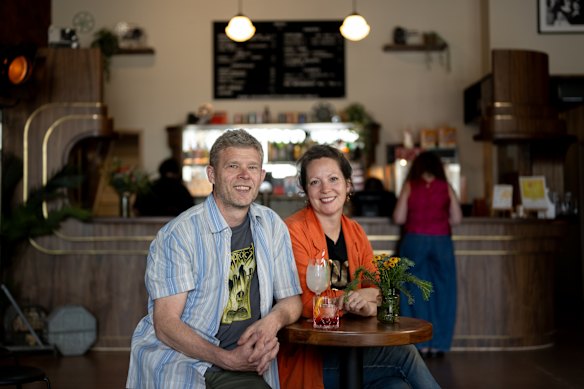
Gus and Lou Berger at their recently opened Brunswick Picture House.Credit: Penny Stephens
Three weeks after opening, though, the business is thriving, proof of the couple’s hunch that the model they had pioneered in Thornbury – a local cinema, for local people – could work in the suburb they call home.
“Brunswick is a very similar demographic – it’s just bigger,” says Berger. “We’re operating at about 70 per cent occupancy, which is really high. I appreciate we’re probably in a honeymoon period of people hearing about us and wanting to come down and check us out, but if we can stick to about 40 or 50 per cent occupancy, that’s what we’re aiming for long term.”
In a world in which everything is about scale, the Bergers are committed to a model that moves in the opposite direction. And they’re not alone: a handful of other venues are showing that micro-cinemas can be a viable alternative to the multiplex.
Thornbury Picture House (57 seats), Eclipse Cinema in Collingwood (64 seats), The Pivotonian in Geelong (71 seats) and the Golden Age cinema in Sydney’s Surry Hills (52 seats) are all single-screen offerings that have won loyal followings by taking a different approach to the business: small, hands-on, personalised.
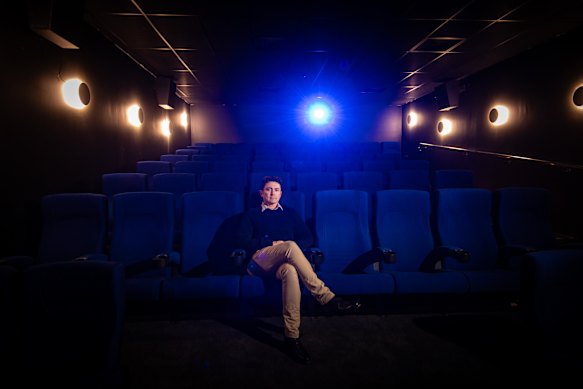
Barrie Barton, CEO of Golden Age Cinema in Surry Hills, Sydney. Credit: Louise Kennerley
The selection of films is, of course, important – a mix of new and classic, tailored to the local audience’s tastes. But so is the sense that customers are being offered something like a hand-crafted experience, an antidote to the anonymous world of mass-market, corporatised entertainment.
Every year, Berger attends the movie convention on the Gold Coast, where distributors showcase their slate for the year ahead, and try to get the exhibitors excited about it. But there are also presentations from the big cinema operators and technical providers, he says, “and they’re all talking about bigger screens, big reclining seats, seats that vibrate, contactless concession stands so you can scan a QR code and order your popcorn or drinks and collect them down the counter somewhere.
“And I sit through this and think, ‘well, none of this is something we are trying to emulate’. A lot of people are interested in that, but that’s not our business model at all.”
Running a small cinema isn’t without its difficulties – distributors are reluctant to provide new releases in the first few weeks, for instance, because they typically demand a minimum number of sessions that a single-screen operator cannot guarantee. But the cinema sector as a whole clearly needs to look at a range of business models if it is to survive.
Mark Walker, who established the Pivotonian in Geelong, at his new boutique Eclipse Cinema in Collingwood.Credit: Justin McManus
For 11 straight years from 2009, the Australian box office topped $1 billion, peaking at just under $1.26 billion in 2016. But hopes that it would again top $1 billion this year for the first time since COVID are unlikely to be realised, with the haul likely to end up about 20 per cent lower than it was in 2019 ($1.3 billion).
Perhaps more tellingly, admissions, which peaked at 92.5 million in 2002 and were regularly north of 85 million a year over the past 20 years, have yet to pass the 60 million mark in the post-COVID era. This year, they will likely finish somewhere between 55 and 60 million.
“Our enemies are not other cinemas,” says Barrie Barton, who runs the Golden Age in Sydney. “It is people sitting on their couch, people’s attention spans, their palates, their level of patience. We have to synthesise all of that and try and come up with an experience that still has film at its heart, but is nonetheless nuanced and responsive to the way people are now. We need to have a better product and experience than the couch will ever provide.”
Loading
Barton and his partners at Right Angle cut their teeth on the exhibition business, running the Rooftop Cinema at Curtin House in Melbourne. And they also learnt the hard way that man(agers) cannot live on bread from ticket sales alone.
Though there was a bar attached to that cinema, they didn’t run it. And they soon discovered “it was just too hard to make it stack up financially without the hospitality component bolted into your model”.
In Sydney, they initially planned to operate a cinema on the rooftop of the former Paramount headquarters, but the proposal was knocked back at the planning stage. So instead, they turned their attention to the former screening room in the building’s basement.
“Looking back, I’m kind of relieved,” says Barton. “Because the rooftop would have required 200-plus seats, and it would have needed 100 people to look busy, and that’s really hard in this day and age.”
And not being outside, of course, also means not having to constantly have one eye on the weather forecast, “wondering whether we were going to go bankrupt or not”.
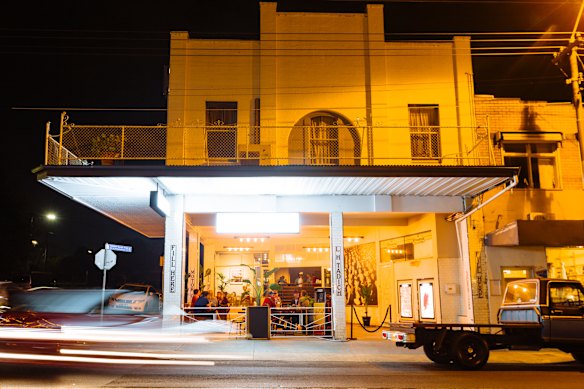
Formerly a garage, the Thornbury Picture House has become a popular meeting place for locals since its opening in 2018.
Berger’s business model relies on a split of roughly 50-50 between ticket sales and the concession stand; making the environment an attractive place to meet for a movie-themed cocktail before the film, or hang around to discuss the movie afterwards, is key.
At Golden Age, Barton and co have taken it one step further. “We have three income streams: cinema tickets, food and beverages, and functions and events. It’s pretty evenly split across the three.”
Loading
Occupancy in the cinema from Thursday to Sunday is typically 80-90 per cent, “but we also have a lot of people who just come to our bar and don’t go to a film.”
Making a micro-cinema work takes time and a lot of effort. And, critically, it means focusing on more than just movies.
“We’re not only competing against the fact people can consume content at home with potentially big screens,” says Berger. “We’re also competing for people who are choosing between going out for dinner with their friends or going out to see a band. You’ve really got to give people an experience that’s more immersive and better than watching something at home.”