Space debris: will it take a catastrophe for nations to take the issue seriously?
When a piece of debris hits another object in space, it can also create more space debris, adding to the problem.
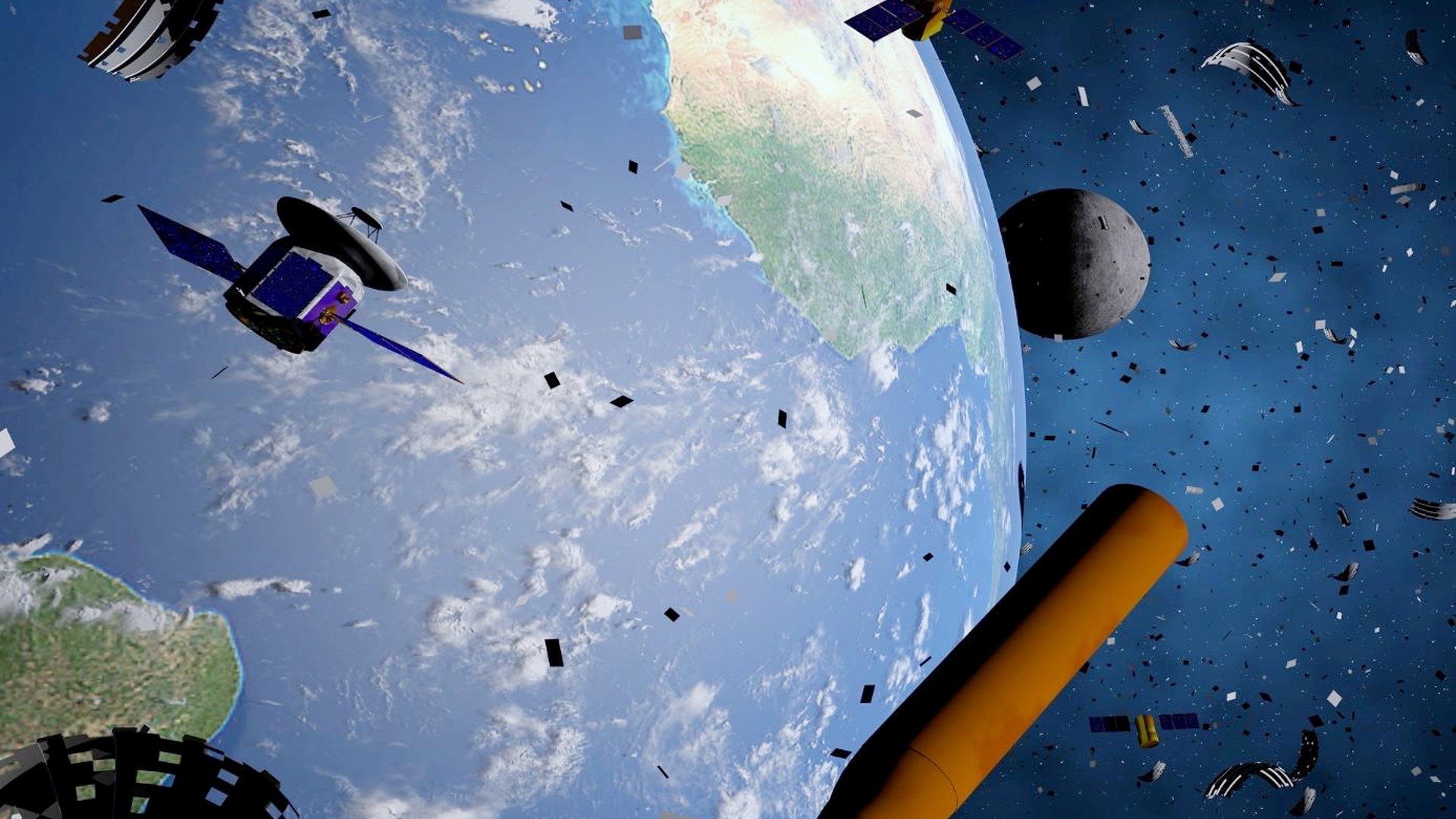
Artist's illustration of space junk orbiting Earth. (Image credit: NASA)
This article was originally published at The Conversation. The publication contributed the article to Space.com's Expert Voices: Op-Ed & Insights.
China routinely sends astronauts to and from its space station Tiangong. A crew capsule is about to undock from the station and return to Earth, but there's nothing routine about its journey home.
Space journalist Andrew Jones explained how experts on the ground had studied images of the damage and concluded that a piece of debris smaller than 1mm (roughly 1/25th of an inch) had penetrated from the outer to inner layers of the glass.
Simulations and tests confirmed a low probability that the window could fail during the high-temperature re-entry through Earth's atmosphere. Although a worst-case scenario, it was one that officials deemed unacceptable. A rescue mission – Shenzhou-22 – was launched to bring the astronauts back from the station.
A tiny crack in a spacecraft window triggered China’s first-ever emergency launch to Tiangong space station. A CCTV article reveals what happened over 20 intense days, and why a piece of space debris smaller than 1 mm forced the emergency response. https://t.co/w8BqnhkH6MDecember 1, 2025
Experts have been warning about the threat posed by space debris for years. The ever-growing number of space programmes by states and private entities is now contributing to an increasingly congested environment in orbit.
The European Space Agency estimates that there are more than 15,100 tonnes of material in space that has been launched from Earth. There are 1.2 million debris objects between 1cm and 10cm, and 140 million debris objects between 1mm and 1cm.
Breaking space news, the latest updates on rocket launches, skywatching events and more!
In low orbit they will be travelling around 7.6 km/s (roughly 17,000 miles per hour), damaging anything they hit. This is how a piece less than 1mm in size was able to penetrate the thick glass of Shenzhou-20’s capsule.
Given the mounting number of objects in orbit, this is likely to be a more regular occurrence. It's costly in terms of damage to equipment, and increasingly a threat to life. When a piece of debris hits another object in space, it can also create more space debris, adding to the problem.