'Super star' being shredded by black hole releases as much energy as 400 billion suns
"This was many times more energetic than any similar event and more than any known explosion powered by the collapse of a star."
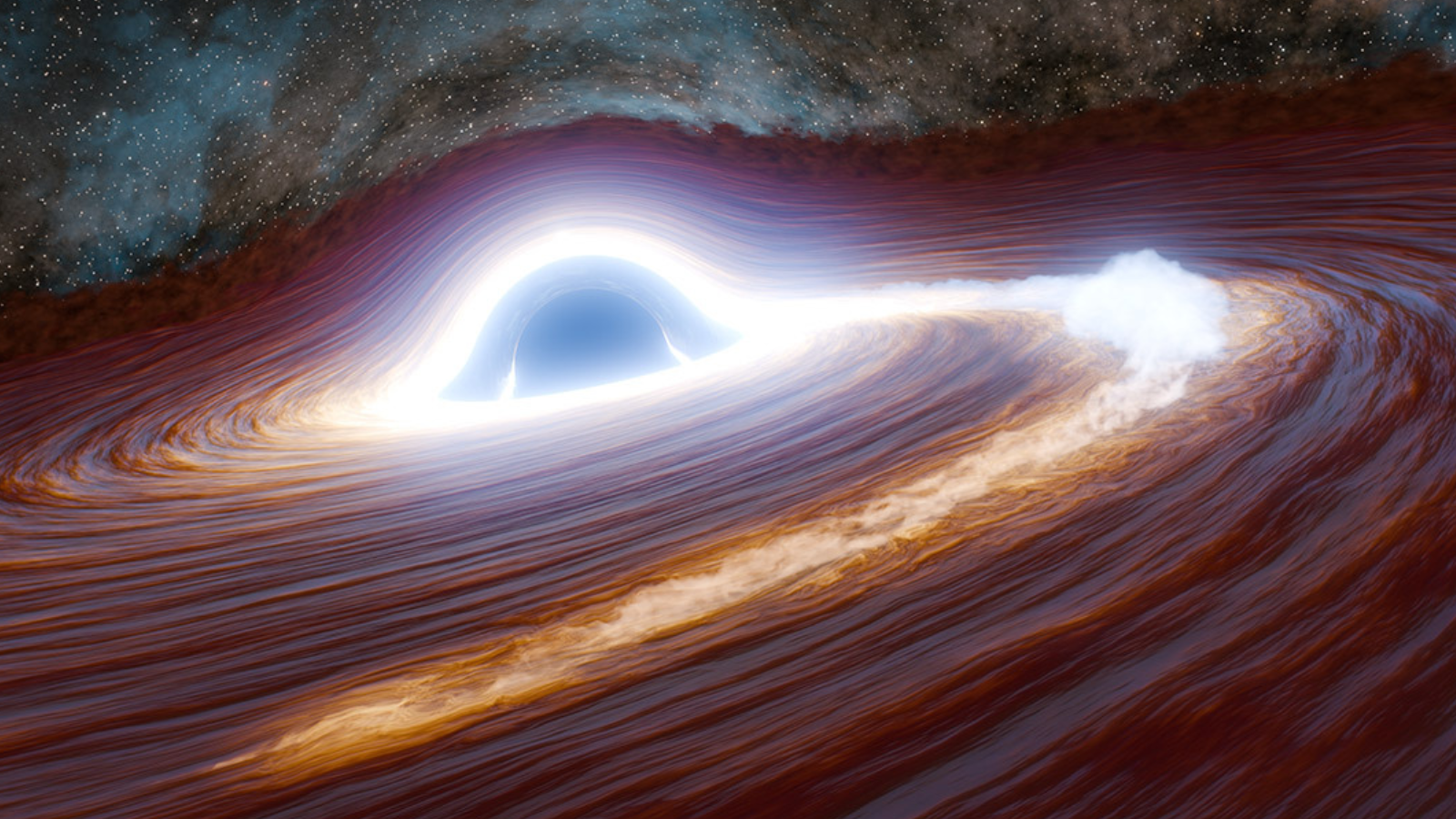
An illustration of the biggest and most distant black hole flare ever seen (Image credit: Caltech/R. Hurt (IPAC) )
Astronomers have witnessed a cosmic explosion that emitted as much energy as 400 billion suns. The event, which has been nicknamed "the Whippet," is a staggeringly powerful example of a Tidal Disruption Event (TDE) and is the result of a super-sized star being shredded and devoured by a black hole.
TDEs occur when stars wander too close to black holes. The immense gravity surrounding black holes generates strong tidal forces that simultaneously squash and stretch these stars, creating strands of "stellar spaghetti." This stellar pasta twists around the black hole like spaghetti around a fork, forming a swirling flow of gas and dust known as an accretion disk that gradually feeds the cosmic titan. However, black holes are messy eaters, and some of this ex-stellar matter is blasted out from around them in parallel jets.
"We discovered what we think is a black hole merging with a massive companion star, shredding it into a disk that feeds the black hole. It's a rare and awe-inspiring phenomenon," team leader Daniel Perley, of Liverpool John Moores University in the UK, said in a statement.
"Even though we suspected what it was, it was still extraordinary. This was many times more energetic than any similar event and more than any known explosion powered by the collapse of a star. Not only do these events help us identify black holes, they provide a new way to identify where black holes occur and how they form and grow, and the physics of how this happens."
Tracking the Whippet
AT2024wpp was first discovered by astronomers using the Zwicky Transient Facility at Palomar Observatory in California. It was immediately remarkable for its resemblance to the cosmic explosion AT 2018cow, a stellar explosion that was between 10 and 100 times as bright as the average supernova.
The Whippet also resembled a Luminous Fast Blue Optical Transient (LFBOT), an incredibly bright burst of light visible at distances up to billions of light-years that typically last a few days and shine high-energy radiation ranging from the blue end of the optical region of the electromagnetic spectrum through ultraviolet and X-ray wavelengths. Though dozens of these events have been detected, LFBOTs are still poorly understood, though scientists have linked them to the destruction of stars.