Ten years ago the Herald examined how Sydney would house its population in 2026. But the future poses an even bigger challenge.
A decade ago the Herald examined what Sydney would look like and how it would function in 2026. Here is what did get done - and what needs to be done next.
Where in Sydney will more than 6 million residents call home a decade from now? Perhaps the better question is – where won’t they?
That’s the view of NSW’s top planning bureaucrat who is among those responsible for determining where sorely needed homes are built, and how people will live, in the 10 years to 2036 and beyond.
“We’ll be living everywhere in Sydney,” Department of Planning, Housing and Infrastructure secretary, Kiersten Fishburn, said. “And I think that’s fantastic.
“We’ve got such different and diverse suburbs, and so many interesting cultures, that being able to continue that is important. It’s part of what makes Sydney one of the greatest cities in the world.”
Ten years ago, senior figures in the then-Baird Coalition state government predicted an overhaul of the Great Australian Dream that for decades emphasised owning a detached home on a quarter-acre block in the suburbs – alongside a breakdown in its long love affair with the motor car – by 2026.
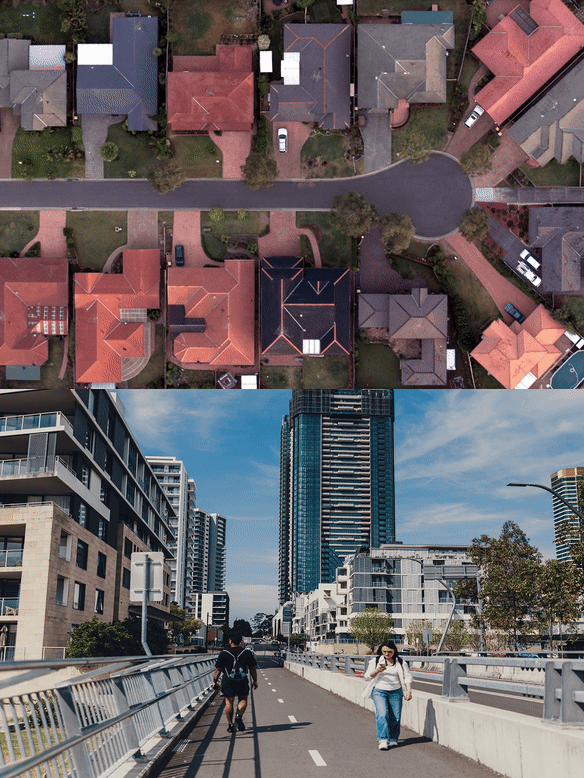
Detached homes in Lalor Park and, 27 kilometres east, apartments in Rhodes. Credit: SMH
Faced with a shortage of homes to accommodate the NSW capital’s growing population, as well as the federal government’s target to build 377,000 dwellings by mid-2029, Premier Chris Minns’ administration has since 2023 overhauled planning rules to boost housing density and diversity.
The changes to encourage more apartment blocks, terraces and townhouses around train and metro stations and in established areas – rather than relying on the march of development on the city’s outskirts – mean vast swaths of Sydney suburbia will gradually be remade in the next 10 years.
But Fishburn is among experts who say more apartment blocks scattered throughout the city won’t come at the cost of more detached houses on the fringe – they will be a necessary addition to them.
“It’s everything, everywhere, all at once,” she says of the state’s approach to boost housing.
Loading
She also believes – despite backlash from some residents who worry the changes will destroy the character of their suburbs – that different pockets of the city will still be recognisable in a decade’s time.
“I don’t think our suburbs and our streets are going to feel significantly different. I do think they’ll feel more vibrant as a result of some of the density reforms.”
The government’s reforms to encourage more apartment blocks along public transport routes will accelerate the city’s gradual shift away from sprawling suburbs of detached homes radiating from one major CBD in the east, to a metropolis of mini-cities scattered along public transport routes.
Its transport oriented development (TOD) scheme aims to create capacity for more than 185,000 homes around 39 transport hubs and urban centres in Sydney and surrounds in the next 15 years.
Eight of those zones are being prioritised to create capacity for 47,800 homes in taller residential developments within 1200 metres of train and metro stations in Greater Sydney. They are Homebush, Crows Nest, Bankstown, Hornsby, Macquarie Park, Bays West, Kellyville and Bella Vista.
Loading
About 20 other Sydney sites, from Kogarah and Turrella to Lakemba and Roseville, will be rezoned for mid-rise residential buildings within 400 metres of stations. At the same time, the fledgling low- and mid-rise (LMR) housing reforms will enable duplexes, terrace homes and unit blocks up to six storeys within 800 metres of town centres, train stations, big bus interchanges and light rail stops.
Fishburn said the changes were a more deliberate approach to ensure developers were building homes alongside existing infrastructure and services needed to support the influx of residents.
“In the past, attempts to join up infrastructure and development haven’t been as successful as we would have hoped, and you end up with development occurring out of sequence with infrastructure.
“The TOD and LMR reforms are a way of saying development should occur here because infrastructure is here, and these are places that are well-located, and they have great amenity.”
The changes are underscored by the government’s draft Sydney Plan, released in December, to guide development for the two decades to 2045, when the city’s population is forecast to pass 6.5 million.
It proposes 43 “interconnected centres” for homes, jobs and services, anchored by the Sydney and Parramatta CBDs, as well as the emerging city of Bradfield near the future Western Sydney Airport.
Nicole Gurran, a professor of urban and regional planning at the University of Sydney, said the reforms sent a strong signal about the pattern of development authorities wanted in the near future.
“The city has, through planning, become much more decentred, and much more dispersed around nodes, and the [transport-oriented development] reforms will reinforce that,” Gurran said.
Future population hotspots
Sydney’s population is expected to leap from 5.3 million to more than 6 million in the next 10 years.
Populations in The Hills, Parramatta, Camden and Liverpool will continue to surge in the next 10 years. There will also be steep rises in Blacktown, Ryde, and Bayside council areas.
There are also plans to build tens of thousands of new homes in residential projects at Sydney Olympic Park, Camellia-Rosehill, Bradfield, and Bays West in Rozelle in coming decades.
The aim, Fishburn says, has been to use the density reforms and housing targets to spread new housing throughout the city, so that “every part of the community has a bit of gentle density”.
“You’re not talking huge apartment towers throughout all of Sydney, that wouldn’t be appropriate … gentle density means every part of Sydney is taking a bit of the weight as our population does grow.”
Fishburn said the mountains and national parks that surrounded Sydney meant there was a limit to the distance the city’s urban sprawl could extend, but there was still land available on the fringe.
She said residential development in those areas would play an important role in Sydney’s future, but that housing needed to be planned more strategically and carefully, so residents were not isolated.
“The challenge with greenfield that we’ve seen in the past is you need to make sure infrastructure is available when development is occurring, and there is a lot of catch up being done at the moment.”
It is a dilemma familiar to City of Sydney Lord Mayor Clover Moore, whose council has overseen new developments and densely populated suburbs including Green Square, Potts Point, Haymarket, Pyrmont and Ultimo. The council, which expects 80 per cent of residents will live in an apartment by 2036, knows well-designed and sustainable buildings, close to services and transport, are crucial.
“These communities are successful because development has been managed carefully, alongside the construction of infrastructure,” Moore said.
What will our suburbs look like?
Increasing diversity and sustainability will be as important as density as Sydney takes steps to overcome a homogeneity of housing options to cater to the changing needs of the population.
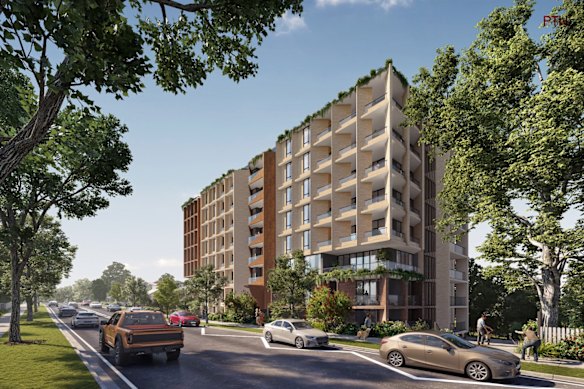
This apartment block in Gordon, shown as an artist’s impression, is the first project to win development approval after being fast-tracked through the Housing Delivery Authority.Credit: NSW Department of Planning, Housing and Infrastructure
Fishburn said the construction of more apartments would cater to family groups and downsizers; while the low-and mid-rise reforms would help remedy a long-standing dearth of medium density housing – often dubbed the “missing middle”. She said a change in the types of new homes being built was already transforming established areas such as Parramatta, Liverpool and Blacktown.
“You still have detached homes and you also have 30-storey apartment buildings. That’s really exciting to see those areas which used to be pretty monotypical in terms of housing start to create that diversity so different people and groups can find something in the areas they want to live.”
Would the shift kill the Great Australian Dream of a standalone house and a backyard? Unlikely, the experts said. However, the dream might look a bit different in some cases – and necessarily so.
“I don’t think the backyard is over,” Gurran said. She said Sydney’s ageing population, as well as a rise in solo living, would also increase demand for apartments and smaller dwellings across the city.
“Extended families who are more likely to live together in the future will look for larger properties, and the family homes of the 70s and 80s might be made over to support multigenerational living.
“And, optimistically, we might be able to see a much greener city in the future because people might be able to walk so we can give over all the space we’ve been giving to the motor car.”
Fishburn said the designs contained in the NSW Pattern Book, which aimed to fast-track construction of small apartment blocks, duplexes and terrace homes, meant many Sydney residents would be living in buildings that emphasised affordability, sustainability, and good design.
“That’s something I hope we see a lot more of. If we look to 10 years in the future, all residential buildings will be built with climate adaptability in mind, and they will be beautiful as well.”