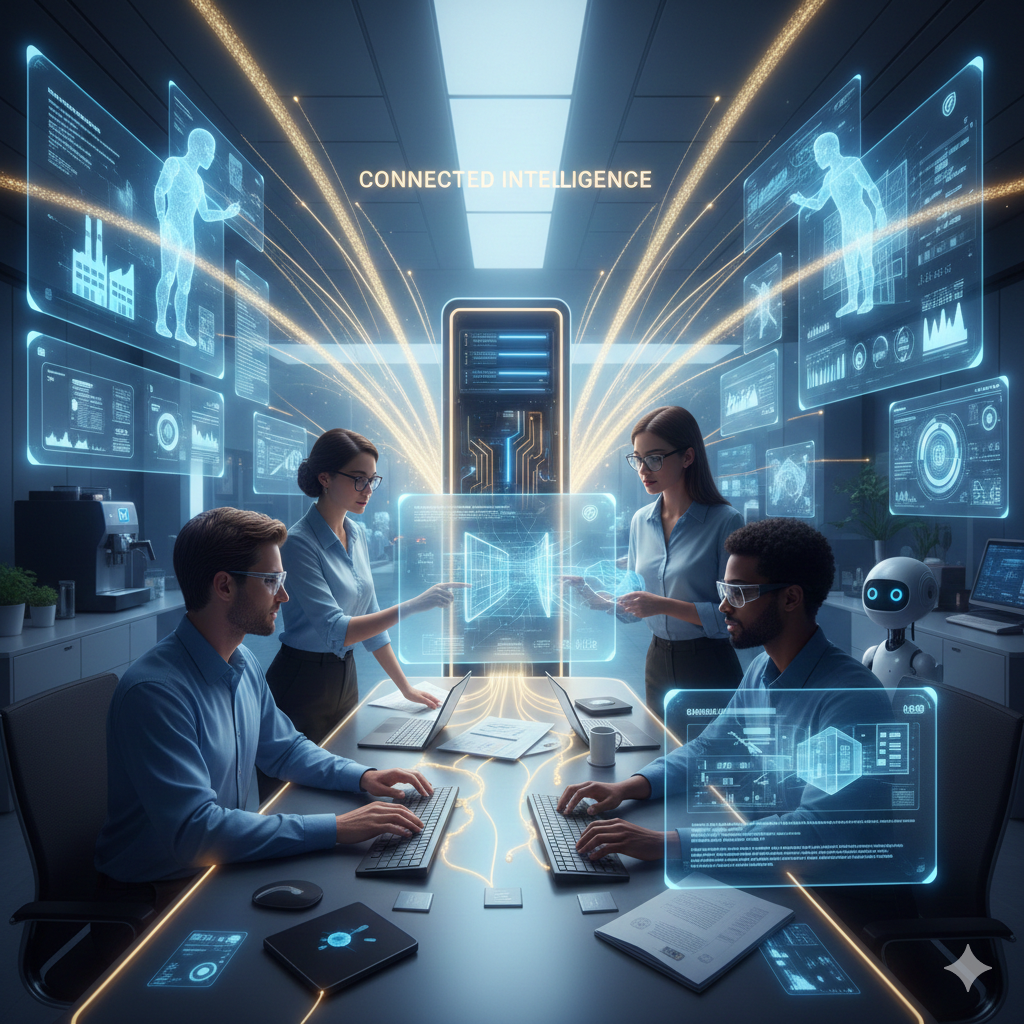
Work in 2026 will be defined by Connected Intelligence and successful companies will break down complex “AI stews” into manageable, domain-specific pieces tailored for specific industries like healthcare or finance.Aruna Ravichandran, SVP & CMO, AI, Networking & CollaborationBy 2026, the workplace won't evolve through more apps or digital assistants, but through Connected Intelligence-where people, data, and digital workers (AI agents) work together side by side. In this new era, collaboration happens without friction. Digital workers anticipate needs, coordinate tasks in the background, and resolve issues before they surface. Work flows naturally across teams, platforms, and time zones, allowing employees to focus on higher-value work instead of managing tools and handoffs.Connected Intelligence removes the limits of geography and individual capacity. Knowledge and expertise move instantly to where they're needed. Digital workers surface insights in context, automate workflows quietly, and keep work moving forward-without interrupting human creativity or decision-making.The organizations that lead in 2026 will embrace open, interoperable ecosystems built on trust. By unifying secure connectivity with intuitive, embedded AI, they will create workplaces where people and digital workers operate as one-unlocking new levels of agility, creativity, and performance.The result: collaboration becomes a strategic advantage, complexity fades into the background, and work finally moves at the speed of ideasBy 2026, the Enterprise Network Becomes Autonomous: Agents Run It, Platforms Win It, and Openness Fuels It.By 2026, workplace networking across campus, branch, and Industrial IoT will cross a structural tipping point: the network will stop being an object that IT operates and become a system that operates itself.First, AI agents will replace traditional AIOps as the dominant operating model.What began as AI-assisted troubleshooting will evolve into AgenticOps—digital workers that autonomously manage the full network lifecycle. These agents will detect anomalies, correlate root causes, enforce intent, remediate issues, and continuously optimize performance in closed-loop fashion. Humans will no longer “run” the network day to day; instead, they will supervise policy, risk boundaries, and business intent. In industrial and mission-critical environments, this shift is not optional—scale, uptime, and safety requirements demand autonomous execution with human guardrails.As AI agents operate across domains, closed systems become friction points. The network will increasingly expose open APIs, telemetry models, and extensibility frameworks that allow agents to reason and act across vendors, domains, and environments. Openness will not be ideological—it will be practical. Agents cannot be effective inside silos, and customers will demand ecosystems that allow interoperability across campus, WAN, security, cloud, and OT.In a world of autonomous operations, the value shifts away from individual devices toward the platform that orchestrates outcomes. Winning platforms will unify management, observability, security, automation, and AI agents into a single control plane spanning IT and OT. Enterprises will choose vendors that deliver business outcomes—resilience, experience, security, and efficiency—not those that simply offer faster hardware or better point tools.Factories, logistics hubs, utilities, and campuses are converging IT, OT, Wi-Fi, private 5G, and edge compute. This convergence dramatically increases operational complexity while reducing tolerance for downtime or human error. Industrial environments will be the proving ground where AgenticOps, open ecosystems, and platform-centric networking are no longer aspirational—but essential.Snorre Kjesbu, SVP/GM Collaboration, CiscoThe Workplace Will Be a True Partnership Between People and TechnologyBy 2026, the workplace is going to look and feel very different from what we’re used to. The workplace will be about people working side by side with technology. That means you’ll see more “agents” (think AI helpers and robots) assisting with tasks, not necessarily looking like something out of science fiction, but integrated into our day-to-day routines. The line between human and digital collaboration will blur, and the companies that do this well will be the ones that figure out how to bring people and technology together in smart, meaningful ways.We’re used to talking about closing the distance between people, but by 2026, we’ll also be closing the gap between people and AI, and even between different AIs. We’ll start to rely more on AI coworkers, or specialists that can handle everything from summarizing meetings to translating languages and even offering expert recommendations. On top of that, different AI agents will be working together behind the scenes, monitoring each other and collaborating to solve problems faster. The future of work is about “connected intelligence,” where humans and AIs all contribute as part of the same team.With all this new technology in the workplace, security challenges are only going to get more complex. The old model of just protecting the edges of your network isn’t enough. By 2026, companies will need to take a more “fused” approach to security, where protections are built-in at every layer, from the edge to the cloud to the core. As AI is woven into everything, we’ll need smarter, more adaptive security that can keep up with new threats, and we’ll have to think about how security and network management work together, not in silos.A lot of organizations still treat AI like one big, complicated stew where everything is mixed together, hard to manage, and even harder to get value from. By 2026, the best companies will take a different approach: they’ll “disaggregate” their AI, breaking it up into clear, manageable pieces that can be tailored for their specific needs (like collaboration, security, or customer experience). This isn’t a one-size-fits-all thing; every industry, whether it’s healthcare, finance, or manufacturing, will need its own recipe. That’s how companies will unlock real value and stay agile as AI evolves.Anand Mahurkar, CEO of Findability Sciences, notes that enterprises are moving into agentic systems capable of reasoning over company knowledge.In 2026, the biggest shift will be from ‘AI that talks’ to ‘AI that does.’ Enterprises will move beyond chatbots and pilots into agentic systems that can reason over company knowledge, orchestrate workflows, and execute decisions with human guardrails. The winners will be organizations that treat findability of data as a strategic asset unifying structured data, documents, emails, and domain expertise into a governed knowledge layer that AI can reliably retrieve, cite, and act on. We’ll also see a clear split between generic models and domain-specific intelligence. Smaller, specialized models fine-tuned on proprietary data and reinforced with knowledge graphs and hybrid search will outperform bigger models on accuracy, cost, and compliance. Multimodal AI will become mainstream, turning images, audio, and video into searchable, actionable knowledge, while real-time analytics will drive next-best actions in sales, service, and operations. In India especially, the next wave will be enterprise AI in vernacular and sector-specific contexts like sugar manufacturing, co-operative sector, agriculture, manufacturing, legal where ROI is tied to speed, precision, and governance, not novelty. The workforce impact will be ‘human + AI’ teams, with copilots embedded in everyday tools and measurable productivity gains. Finally, trust will be the currency of adoption. With stricter regulation, deeper scrutiny of data privacy, and rising expectations for transparency, leaders will invest in AI governance, observability, and explainability as seriously as they invest in model performance. The most valuable AI in 2026 won’t be the most impressive demo, it will be the most dependable system delivering measurable outcomes at scale. Ken Exner, Chief Product Officer at Elastic, The Search AI Company: The growth and reliability of agentic AI will hinge on accurate context engineering, which ensures AI systems access and utilize the right data at the right time. In 2026, context engineering will become critical as enterprises struggle with scattered data across unstructured sources like documents, emails, apps, and customer feedback. Effective agentic AI requires relevant data inputs to deliver accurate responses. Many failures in AI development trace back to the inability to provide relevant context for applications. Context engineering addresses this challenge by facilitating precise data retrieval, governance, and orchestration, enabling agents to seamlessly identify, retrieve, and process owned data. There are a limited number of platforms offering comprehensive context engineering capabilities at this time. Demand for such solutions will rise sharply in the next year. Businesses will increasingly seek AI platforms that integrate context engineering at their core, boosting the adoption of contextually aware and reliable AI systems.
As AI becomes the “operating layer” of the enterprise, trust has become the primary currency. Vijender Yadav, CEO & Co-founder, Accops and Dhiraj Gupta, CTO & Co-founder, mFilterIt argue that security must evolve from static perimeters to "continuous trust" and "forensic integrity."Vijender Yadav, CEO & Co-founder, Accops\In 2025, we anchored our innovation around two non-negotiables for regulated enterprises - data sovereignty and infrastructure independence. As cyber risks intensified alongside vendor volatility, it became clear that secure access could no longer be tied to a single cloud or platform. We responded by building a sovereign virtualisation stack that decouples digital workspaces from underlying infrastructure, allowing CIOs to repatriate workloads to agile, cost-effective environments without compromising security or regulatory compliance.Our security architecture evolved from static controls to continuous trust. By embedding adaptive risk assessment directly into the access gateway—validating user authenticity, device hygiene, and real-time context—we transformed access into an ongoing negotiation of trust while maintaining forensic integrity and operational efficiency. At the same time, we integrated quantum-resilient encryption and zero code exposure frameworks to future-proof critical environments against emerging threats, including post-quantum risks.The key lesson from 2025 was that fragmented security stacks and checklist-based compliance are no longer viable. Enterprises recognised the need for platform-agnostic, crypto-agile architectures that ensure absolute data residency while enabling hybrid work at scale. Looking ahead to 2026, our focus is on delivering governance-first digital workspaces that eliminate vendor lock-in, enforce strict data control, and give highly regulated industries the agility they need without ceding sovereignty.Dhiraj Gupta, CTO & Co-founder, mFilterIt :2025 marked a clear inflection point for digital advertising. Fraud and media quality risks no longer looked abnormal—they increasingly resembled genuine user behaviour, making traditional metrics like clicks, impressions, and even basic viewability insufficient. This is why our focus was on building deep, full-funnel visibility—tracking users from first exposure through conversion, validating intent, attention, and outcomes, and using AI-ML to proactively make optimizing decisions with transparency and confidence. By combining event-level intelligence, behavioural analysis, and self-learning algorithms, we enabled brands to block low-quality and fraudulent traffic early, protect brand safety across automated environments, and optimize campaigns based on what truly drove value. The broader industry takeaway is clear: brands that prioritised transparency, independent validation, and AI-led intelligence were better equipped to navigate uneven performance, identify gaps in traffic quality, and increasingly sophisticated threats. In 2026, our focus is on advancing this foundation—deepening AI to move from detection to prediction, expanding validation across the entire digital lifecycle from exposure to post-conversion outcomes, scaling these capabilities across global markets such as the USA and MENA, and addressing emerging risks like AI-generated fraud, synthetic engagement, and deepfake-driven brand misuse—so brands can operate with greater foresight, confidence, and control in an increasingly complex digital ecosystem.