Brendan Corey does not look or sound anything like national hero Steve Bradbury. He is quietly spoken, has a Canadian accent and has dark hair with red tinges in his neatly trimmed goatee.
He aims to skate for Australia at the 2026 Milano Cortina Winter Olympics, but that’s where the similarities with our first winter gold medal winner, Bradbury, end.
Brendan Corey skates in world short track speed skating championships in Beijing in March.Credit: International Skating Union/Getty Images
That’s why I introduce him to a concept he might be willing to embrace – “the Reverse Bradbury”.
We are sitting in the Melbourne high-rise office of Deloitte, facing south, looking out at the morning sun and down the Yarra River towards the MCG.
Loading
The Australian team has assembled for uniform fitting and a series of speed-dating-like interviews.
Corey is slightly nervous, and a touch apprehensive, so I launch straight into my idea.
Unlike the real Bradbury, I explain, you don’t wait for everyone to fall over. You do it the other way around. You ping straight to the front, stay at the front and cross the finish line in front, regardless of the chaos that unfolds behind you. I wait for a response.
“The Reverse Bradbury?” Corey eventually echoes with a bemused look. “That’s interesting.”
“Interesting” is code for the daftest thing he has ever heard, but at least he is smiling.
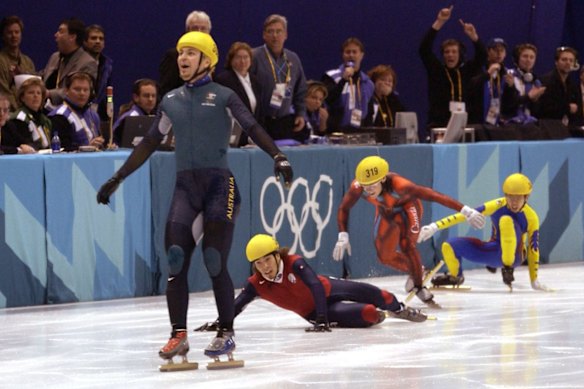
Steve Bradbury celebrates Australia’s first-ever Winter Olympics gold medal at Salt Lake in 2002.Credit: Getty Images
We park the Bradbury theory and move on to the next topic of conversation: how did he come to be an Australian?
The story starts, he says, with his mother, Melanie, who was born in Canada but went to school and university in Sydney from the age of nine.
Loading
She moved to Australia with her parents in the late 1970s. Her father, Ronald Hawkes, helped discover a gold mine in Western Australia.
Hawkes was a geologist and the general manager of Plutonic Gold. During the family’s time in Sydney, his company opened a pit in Western Australia, about 300 kilometres north-east of Meekatharra.
In 1988, Melanie returned to Canada to finish her economics degree and met and married Trevor Corey.
They spent time in Halifax and Toronto before settling back in their home town of Fredericton, New Brunswick. Corey was born in 1997.
But, as Melanie later explains down the phone from Canada, she never lost her connection to Australia.
“For me and my sister, it was our formative years,” she says. “So much of my schooling was done there. I did the HSC [Higher School Certificate], and, you know, the extracurricular activities that you do – it’s more part of you than you realise.
“My sister had a fantastic Aussie accent. I think mine was always just kind of mixed – my husband teases me because whenever I go back, it’s like a little light switch that comes back on.”
Corey was first introduced to ice hockey by his father, but by the age of eight had lost interest in the puck.
“I just want to skate fast,” he told his parents.
For the next 15 years, he pursued speed skating, rising through the ranks until he was in the top six in the country. He then hit a speed hump.
“It became apparent that there were certain skaters that were being given preferential treatment,” his mother explains. “And I had always sort of said, ‘You know if it doesn’t work out for you here, you can probably look to Australia’.”
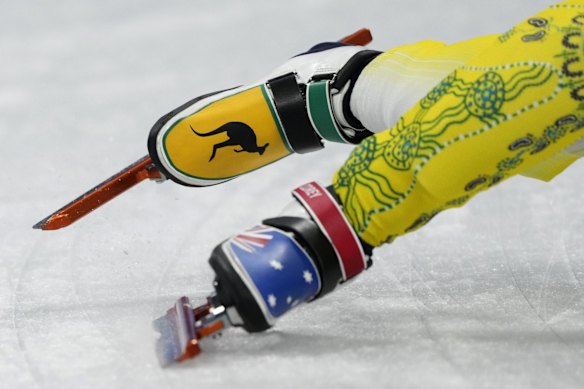
Brendan Corey’s skates during the quarter-finals at the 2022 Winter Olympics in Beijing.Credit: AP
The seed was further sown when Corey met former Australian speed skater Richard Nizielski at an international competition in Montreal in 2019. Corey explained that his mother had been a one-time resident Down Under.
Nizielski countered with an offer: “If you can ever come to Australia, we can always use a good skater.”
Then fate played a hand. Later that year, Corey missed selection for the Canadian team after being taken out by a teammate during a practice session and suffering concussion.
Suddenly finding his career in limbo, he decided to move to Australia.
“I’ve been living here on and off since 2019-2020,” Corey says. “I am usually here for two-to-three months of the year, and the other nine or 10, I’m overseas training.
“I’ve been training in Italy for the past two years with the Italian Olympic team in short track.”
While Corey has made Melbourne his new home, he says he is yet to find a favourite coffee shop or immerse himself fully in the city’s way of life.
“I’ll go to the occasional AFL game, but I’m just enjoying the sights while I’m here, exploring the city, going to the beaches sort of thing,” he says.
“I like to explore the country as a whole.”
As for his parents, Trevor and Melanie Corey immediately embraced their son’s choice.
“I know other people, when Brendan went to Australia, kind of were considering it as well, but to them, it was like, ‘Oh, Australia’s so far’,” Melanie says.
“Whereas for me, there was just no hesitation because I was familiar. It was not like a ‘here’ and ‘there’ kind of thing. It made sense, like it wasn’t foreign to me at all.”
Melanie says her two children, Brendan and his sister Brianna, grew up hearing her speak fondly of Australia.
“It was just kind of natural for them,” she says. “I think some of the words that I would use were Australian slang, and they got used to hearing that.
“For example, the word ‘reckon’ – a lot of Aussies use ‘reckon’, but people don’t so much here.
“And I would tell him he was ‘cheeky’, and that was another word that was not used here. So it was in their everyday life in some way.”
Once it became apparent Corey would represent his new country at international level, he was made an Australian citizen.
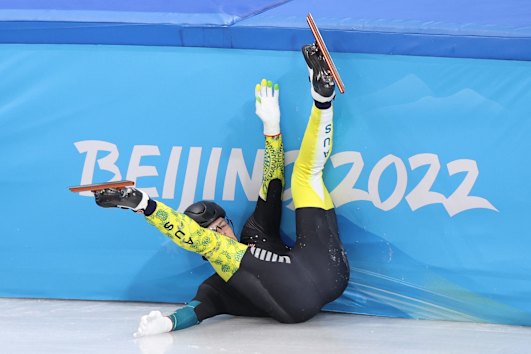
Brendan Corey crashes during the men’s 1000m quarter-finals in the Beijing 2022 Winter Olympic Games.Credit: Getty Images
He skated for Australia in the men’s 1000m short track skating at the 2022 Winter Olympics in Beijing, but crashed out in the quarter-finals.
“In this sport, the top two move on to the next round, and I was sitting in third on the last lap, so I thought, ‘I need to try something, I don’t want to just sit here and finish third’,” he explains. “I felt like I should try the pass, but I was a bit tight, and ended up being too tight.”
Which brings us back to Bradbury. Corey was only five when the peroxide-blond Australian won the unthinkable gold. But even in Canada he knew his story well. They have since met several times face to face.
“That was an incredible moment in sports,” Corey says. “I don’t think something like that will ever happen again.”
So the “Reverse Bradbury” concept, winning from the front, is a possibility?
“I like to be a part of the race, be in the action,” Corey concedes.
“I guess, the main thing is to use your energy at the ideal moment, not to use it all too early, and then risk getting passed at the end or waiting too late, and then you run out of time by the end of the race. You have to plan the attack, make split-second decisions.”
Thankfully, Corey’s mother is more attuned to the idea.
“He would love for that to happen,” she says. “There’s always a chance. In speed skating, anything can happen.
“He certainly has the right attitude and the right work ethic, and he has a lot of great quick-thinking sense on the ice.”
The Winter Olympic Games will be broadcast on the 9Network, 9Now and Stan Sport.