The Fallout: Power Play card game is mean, clunky, and slow
Slow gameplay, mediocre art, poorly balanced factions, and confusing rules make this tabletop adaptation a dud

Published 3 hours ago
There are better ways to visit the Wasteland
 Image: Modiphius Entertainment
Fallout fans are eating well right now. New episodes are airing weekly for the Prime Video show, which heads to New Vegas for season 2. Bethesda celebrated the 10th anniversary of Fallout 4 by launching an anniversary edition in November. The Fallout 76 Burning Springs update is one of the best in the game’s seven-year history. There’s also a card game coming soon from Doom: The Arena designers Resurrectionist Games and publisher Modiphius Entertainment.
Fallout: Power Play, which launches in late January, is a compact game consisting of four player decks and a small collection of shared cards and tokens that all fit neatly into a small, magnetically sealed box depicting Vault Boy. Unfortunately, the presentation is the best part of the poorly balanced and slow game, which fails to live up to its fun premise of letting players fight for control of the Wasteland.
Each of the 24-card decks represents a different Fallout faction with its own special abilities and play style. The Raiders often steal cards from other players and gain advantages from attacking opponents in the locations where they’re strongest. The Super Mutants are immune to the radiation tokens that can weaken other Factions and favor using overwhelming force. The Enclave is overpowered thanks to their ability to replay disruptive Power Play cards.
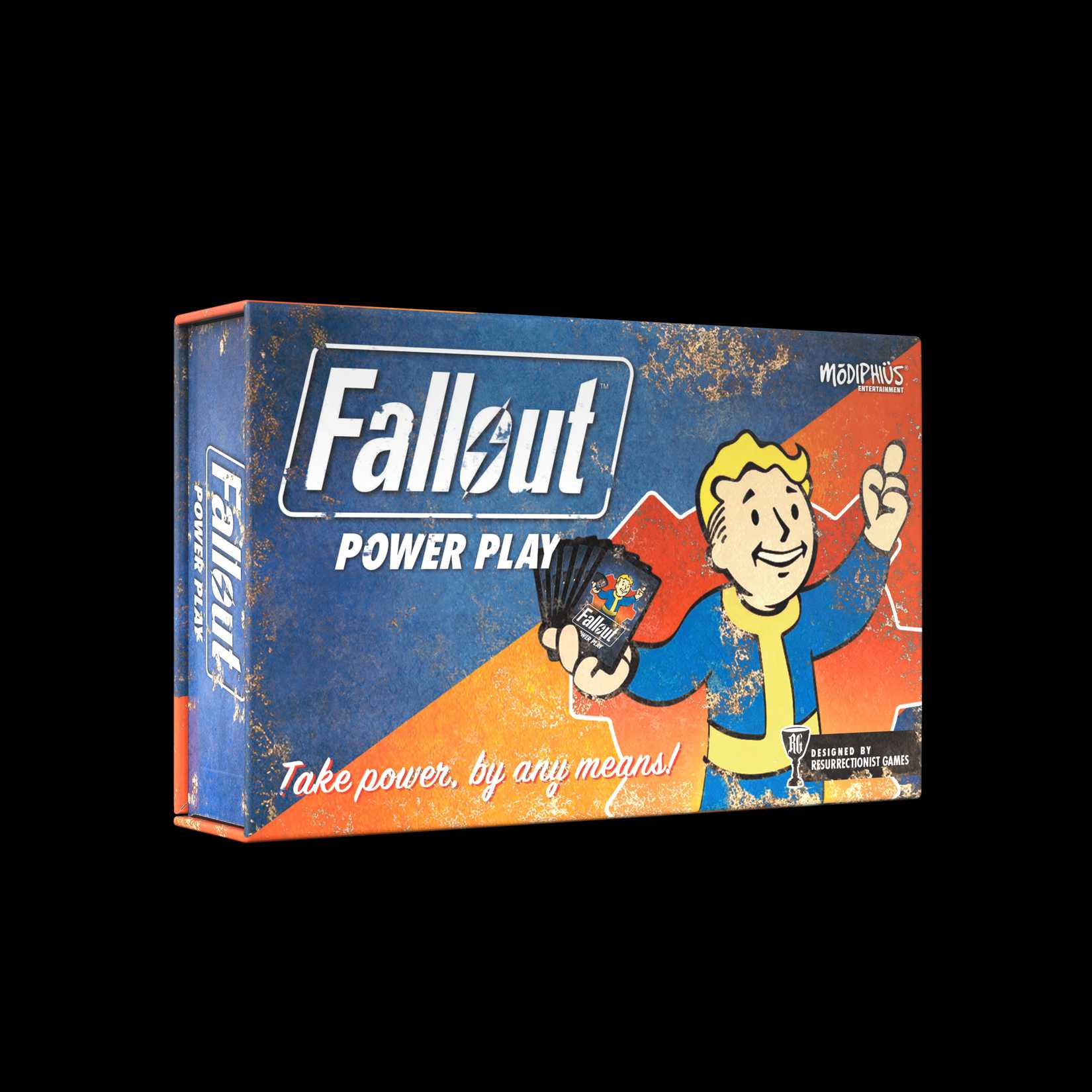Image: Modiphius Entertainment
Players draw four cards at the beginning of each round and take turns playing a card to one of the battlefronts in the Wasteland with the goal of building influence there. Agents have a set power rating, which can be used to attack other Agents or to establish dominance of a location. Quests have some sort of effect when they come into play, like drawing a card, and provide an objective you can complete to gain a reward, like ending the round with the most power in a location you don’t already dominate. At the end of the round, every location you dominate turns into a power point, and the winner is the first person to get 10.
The mechanics favor a highly reactive style of play. Putting a low-power Agent on the board is just asking for it to be squished by someone else. The player with the most power plays first every round, which is meant to provide something of a catchup mechanic since playing early is such a drawback. But the play structure also makes it very hard to build any type of strategy and means you can get unlucky if you have a hand that is best suited to messing with other people when there’s nothing on the board to react to.
If you pass, you can’t play cards during your turn for the rest of the round with the exception of Power Plays, which have special effects mostly meant to interfere with other players. That’s rarely a good decision. Every player gets to draw up to a hand size of four at the beginning of a turn, so passing doesn’t provide you with a meaningful edge for the next round. The balancing factor is ostensibly the small deck size, but the decks are all built to “scavenge” played cards, meaning running out of cards isn’t as much of a risk as it might appear. You also don’t want to try to set something up between rounds because Wasteland cards representing neutral threats like Deathclaws and automated turrets can further mess with things, though overall they don’t seem to do much to change the balance of power. While the gameplay is simple, Fallout: Power Play is surprisingly slow due to its focus on messing with your opponents and because you can only earn a few points each round.
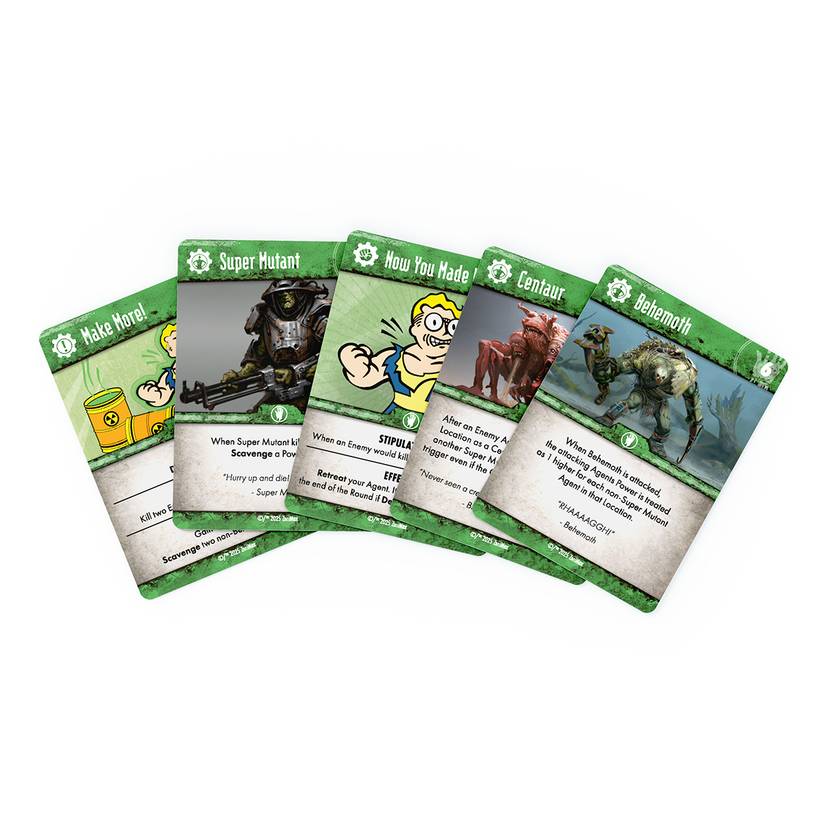Image: Modiphius Entertainment
While the quests are meant to evoke the feel of the video games, they don’t play well in cardboard form. For one thing, Fallout: Power Play doesn’t include enough of the tokens used to track progress on an objective. Sometimes it can become outright impossible to fulfill a quest: the Super Mutant quest Stupid Humans requires you to choose an enemy quest in play and end a round with one of your Agents sharing its location. But the rulebook provides no explanation for what happens if the quest you picked leaves the board before then, even though it’s a fairly likely outcome.
The game’s art is a mix of charmingly cartoony illustrations featuring Vault Boy in various scenarios and more realistic art that tends to look blurry. The rules are annoyingly vague on the targets of effects. The Enclave card Control the Assets allows you to draw, scavenge or redeploy “an Enclave Trooper.” The deck contains one card called “Hellfire Trooper” but nothing called “Enclave Trooper.” Is this supposed to be an Enclave Agent, or is it specifically referencing this single card? My table got into a big argument about whether text referring to “a Super Mutant Agent” referred to any Agent in the Super Mutant deck or only the card named “Super Mutant.”
Life in the Wasteland is meant to be brutal, but it should be a fun place for players to visit. Fallout: Power Play isn’t going to win over anyone new to the franchise. It’s got so many flaws even serious fans would be better off spending their time finding a different way to visit the weird post-apocalyptic world.