Lima: Shortly after the death of Hugo Chavez in 2013, Nicolás Maduro, who succeeded him as Venezuelan president, went on national television to claim that his late political mentor had reappeared to him as a tiny songbird.
Apparently speaking in earnest, the left-wing populist claimed that the chirping bird had circled his head several times as he prayed in a chapel, and that the pair then whistled back and forth to each other in conversation.
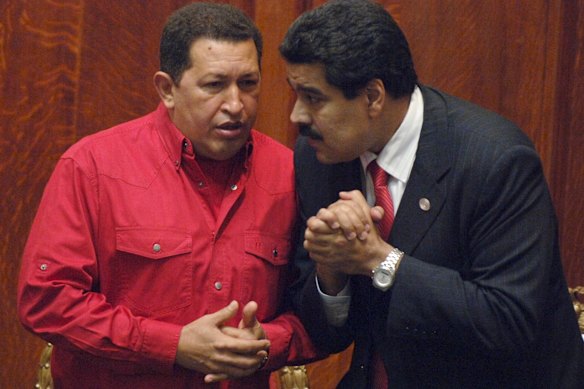
Hugo Chavez (left) with then foreign minister Nicolás Maduro in 2007. Credit: AP
“I felt his [Chavez’s] spirit,” Maduro told millions of Venezuelans during the live address. “I felt him blessing us and telling us: ‘Today, the battle starts. Head to victory, take our blessings.’ That’s how I felt him in my soul.”
The absurd scene neatly encapsulates the former bus driver and union leader’s 13-year presidency of Venezuela.
During that time, he constructed an elaborate official narrative based on bizarre mythologising and outright lies in a necessary refusal to acknowledge the calamitous, real-world consequences of his own policies.
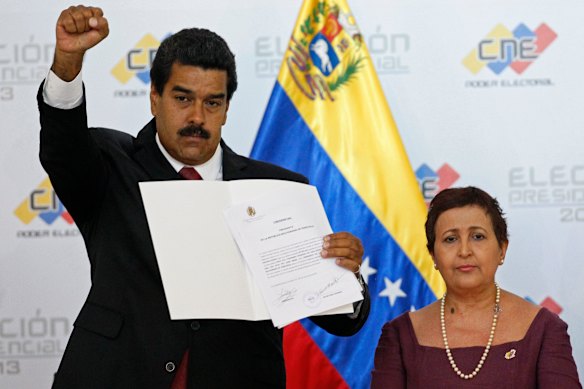
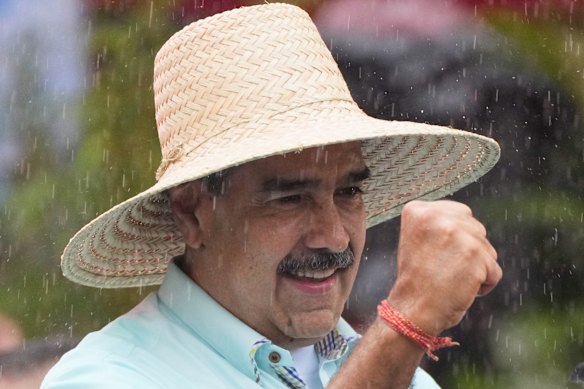
Maduro raises his fist as he holds up the official certificate declaring him winner of the presidential election in 2013.Credit: AP
It also reflects the fact that Maduro owed his entire political capital and branding – and possibly even survival as president – to his career as one of the late strongman leader’s closest loyalists.
While Maduro, 63, who has just been dramatically detained and whisked out of the South American country by US special forces, painted an increasingly surreal picture of Venezuela as a “Bolivarian socialist” paradise, ordinary citizens were forced to live in ever greater squalor and fear of their own government.
Venezuela is, according to the Organisation of the Petroleum Exporting Countries (OPEC), the only country in the world with larger oil reserves than Saudi Arabia. Yet under Maduro, the economy fell off a cliff, amid a blizzard of nationalisations, runaway corruption and gross mismanagement.
Loading
Chavista loyalists with no relevant qualifications were installed at PDVSA, the state-owned oil company that was the national cash cow, accounting for more than 90 per cent of exports. Predictably, its output nosedived.
Meanwhile, agricultural production plummeted as the regime supplied food free or at heavily subsidised prices to regime-supporting neighbourhoods, often in urban slums, while leaving the rest of the country to starve.
And medicines needed for cancer and a host of other life-threatening but treatable diseases vanished from the shop shelves. Many Venezuelans were forced into desperate strategies, including rummaging through rubbish, to survive.
Ultimately, as many as 8 million people – one quarter of the population – were forced to flee their homeland, in many cases just to be able to feed and clothe their families. It is, statistically, the western hemisphere’s greatest-ever refugee crisis.
Anyone who complained, from ordinary citizens to prominent opposition leaders, risked imprisonment and torture at the hands of the thuggish security forces. In the meantime, the economy shrank by at least 75 per cent under Maduro – the nail in the coffin for a country that the 1970s oil boom had transformed into Latin America’s richest.
Yet despite it all, Maduro may be judged – by his own dystopian standards – as a successful president. His ascent to high office, never mind clinging to power for so long, was not something that either critics or supporters of the regime ever expected.
Raised in El Valle, a blue-collar suburb in eastern Caracas, Maduro was steeped by his father in left-wing activism from an early age. He became a supporter of Chavez after “el Comandante” was jailed for a failed coup against a democratically elected government in 1992.
After the strongman was elected president in 1999, Maduro rose through the Chavista ranks, becoming a deputy, then foreign minister and eventually vice-president.
Even in those early days, there were clear hints of the corruption of which the ousted president is now accused. In 2006, when returning from the United Nations General Assembly in New York, which he had attended as Venezuela’s top diplomat, he was briefly arrested after paying for plane tickets for his entourage in cash.
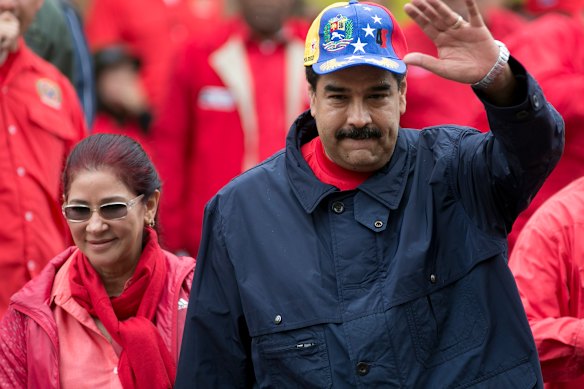
Maduro waves to supporters alongside first lady Cilia Flores in Caracas in 2016.Credit: AP
In 2012, in one of his final public acts, a cancer-riddled Chavez anointed his trusted sidekick as his political heir. It said everything that the dying autocrat felt his say-so – rather than the looming election – was all that was required to ensure the presidential succession.
Maduro won his first election later that year, beating his youthful opponent, Henrique Capriles, the unified opposition candidate, by just 1.5 per cent. Capriles demanded a recount, which the regime refused to provide, establishing the precedent for Maduro’s two subsequent presidential victories, in 2018 and 2024, both of which were marred by highly detailed allegations of widespread fraud.
At least initially, Maduro was widely regarded as a weak, fundamentally flawed leader, lacking both the crude charisma and wily political skills of Chavez. Many suspected that he was just a figurehead, with the regime’s hard man, Diosdado Cabello, a former army colleague of Chavez who led a tank unit during the 1992 coup attempt, the true power behind the throne.
Most commentators predicted that Maduro’s tenure in the Miraflores Palace, Venezuela’s palm-lined, colonial-era presidential residence, would be brief. Yet, somehow, he managed to stay in power for 13 years.
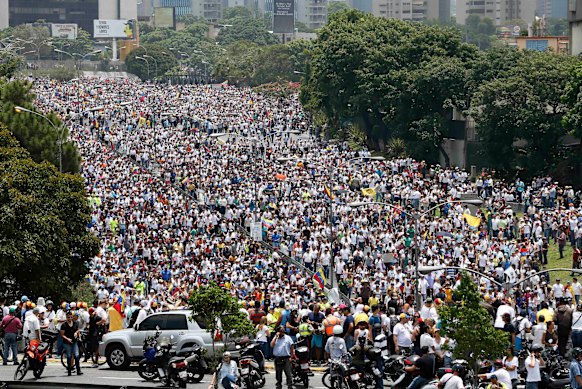
Anti-government protesters march along a highway in Caracas in 2017. Credit: AP
He did so even while economic mismanagement and collapsing oil prices ravaged the economy, turning a regime once popular for its largesse with the poor into one that relied on the military, police and heavily armed militias of motorcycle-riding Chavista supporters to terrorise opponents.
Maduro used foreign ‘plots’ to bolster support
Maduro also used the bogeyman of “gringo imperialism” to shore up his base, routinely giving speeches accusing the White House or Western oil companies of plotting against him, including on multiple occasions claiming – without ever providing evidence – to have thwarted foreign-backed assassination plots.
He also frequently appealed to the anti-imperialist legacy of Simon Bolivar, the revered “liberator”, who led most of South America’s struggle for independence from Spain in the early 19th century. Yet the truth is that Bolivar was a liberal in the classic sense, who must have been spinning in his grave at the way a corrupt, tyrannical regime sought to politically appropriate his legacy.
Maduro addresses supporters during a rally in Caracas last month.Credit: AP
Barack Obama and Joe Biden tended to publicly ignore Maduro during their presidencies, in an attempt to take the oxygen out of the adversarial relationship that the dictator used as a political prop.
During his first term, however, US President Donald Trump adopted the opposite tack, launching outspoken tirades against Maduro, hyping up the geopolitical tension between Washington and Caracas – and potentially giving both presidents a domestic political boost.
That war of words came to a crashing end on Saturday morning, Caracas time.
As he now contemplates spending the rest of his days behind bars in a high-security US prison, Maduro will be coming to terms with the fact that, this time, Trump was not bluffing.