The morning after England’s sucker-punch of an opening Ashes defeat in Perth, Brydon Carse was sitting at a riverside cafe with his teammates Zak Crawley and Harry Brook.
Carse put his hand in his pocket, and accidentally dislodged what eyewitnesses described as thousands of dollars in cash that flew into the air.
Jake Weatherald and Brydon Carse exchange words during the fifth and final Ashes Test of the summer.Credit: Getty Images
Patrons of the cafe, including English cricket journalists enjoying a quiet coffee, were left scrambling to grab the cash and return it to Carse. Crawley looked mortified.
The incident, whether innocent or otherwise, acts as an emblem for an Ashes tour that was loose, careless and at times downright baffling.
Bear in mind that Carse, just a year prior, had served a three-month ban for betting on cricket matches, which leads us into England’s curious choice of where to stay in Perth.
Loose behaviour and a casino stay
England opted to stay at Crown Towers, an opulent casino complex that is home to one of the best hotels in Australia. It was within a short walk of the new stadium, but living in a casino for weeks, with a total of two competitive days of cricket after the first Test ended so quickly, put temptation everywhere.
The players, often well-oiled, frequented the casino’s tables in full sight of England fans and other punters, some of whom were there because it was one of the only places in Perth open after hours and showed Premier League soccer.
Crown Towers in Perth.Credit: George Apostolidis
It was on the white-ball trip to New Zealand that preceded the Ashes that insiders believe unhealthy patterns of boozy behaviour – highlighted by captain Harry Brook’s run-in with a bouncer the night before a game – were set in motion.
Loading
Some of the most experienced members of the England backroom team started to feel uneasy about the planning, or lack of it, for the Ashes. Yes, the mid-season break to Noosa was booked, but why were England only securing a bowling coach, David Saker (who was far from first choice), five weeks before the first Test, and why did they not have a fielding coach at all?
The coaching ticket was a farce; Tim Southee did one Test and was mooted to come back for Sydney, but never did. Marcus Trescothick and Jeetan Patel are not known for challenging McCullum, made naive comments in the media, and by the end of the tour their arms were almost falling off having thrown so much in the nets. In Adelaide, Saker, Trescothick and Patel were put up for media across the first three days, a tell-tale sign that things are going badly. When it was announced that Patel would speak, the Australian press cheered ironically. They may not have had a fielding coach, but their mind guru Gilbert Enoka did appear intermittently.
David Saker and Brendon McCullum.Credit: Getty Images
In truth, England’s Ashes dream was unravelling before Ben Stokes even landed on Australian soil and joined the tour.
England’s captain arrived in Perth in early November. The England Lions were there and some of the fast bowlers. Many of England’s batsmen were enjoying their latest idyllic golf-and-beer holiday in New Zealand. But at least one senior player was sent to Perth earlier than planned because he turned up on tour overweight. He was not alone in being considered unfit.
England’s three key leaders: Director of cricket Rob Key, coach Brendon McCullum, and captain Ben Stokes.Credit: Getty Images
Saker, who has worked with teams all around the world and was part of England’s 2010-11 Ashes-winning backroom team, was said to be shocked at the approach of some of this new generation’s bowlers to fitness and conditioning compared to the old guard.
Booze-fuelled New Zealand tour ... and Stokes ignored
New Zealand, according to those there, was as booze-fuelled as any England tour under McCullum.
It started with a trademark bonding trip to Queenstown, and the cricket, played in damp and chilly spring, was extremely flat. England lost all three one-day internationals in almost identical fashion. While England were in Mount Maunganui, there was a big night at McCullum’s house in the horse-racing capital Matamata, followed by Brook’s Wellington bender.
Loading
The captain’s punishment – the maximum fine and a final warning – did not appear to bother players when they got to Australia, despite stern words from McCullum to the whole group in Wellington.
Compare and contrast with Mitchell Starc, who took 31 Ashes wickets and won the Compton-Miller Medal. He did not drink for six weeks before the Ashes, and was said by teammates to have had just one drink after the series-sealing win in Adelaide while Travis Head led some teammates on a bar crawl through his home town. Starc is the picture of professionalism, and recognised the effect alcohol could have on his body as he approached 36 years of age.
That night in Adelaide, Stokes told his England players not to head out into town. There were two reasons for this: the optics were poor, after an Ashes defeat in just 11 days, but also this was Australia’s night to celebrate. Stokes’s order was not obeyed by all players, with at least one spotted out later than the Australians.
Preparation failings
The New Zealand tour was damaging to players’ habits, but also their cricket. It had been inked into England’s schedule more than four years ago, before any member of the current hierarchy – from chief executive Richard Gould down to Stokes – was in position. The differences between Christchurch in October and Perth in November were clearly stark, and the tour was obviously an inconvenience, and a threat to England’s Ashes chances.
But England saw it differently. Richard Thompson, the chairman of the England and Wales Cricket board, speaking in August, described it as “good preparation”. With Brook bedding into the captaincy and England’s white-ball form so desperate that they are in danger of having to go through a qualifier for the 2027 World Cup, they felt duty-bound to pick a strong squad for New Zealand, but that suited their Ashes ideals, too. As it was, poor weather and spicy pitches in New Zealand meant bowlers in need of overs hardly trained, and batsmen struggled when their chance in the middle came.
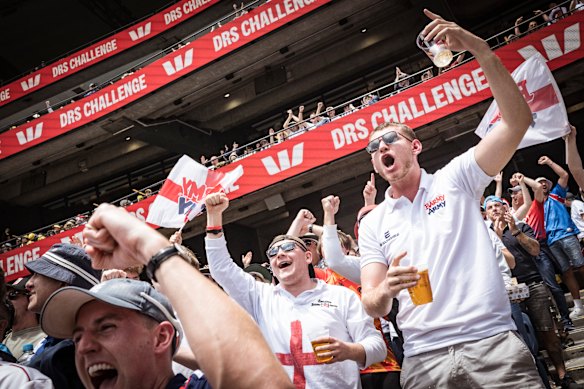
The Barmy Army in full flight during the Boxing Day Test.Credit: Chris Hopkins
They have never liked warm-up matches – possibly because McCullum and Stokes are the sort of freakish talents who did not really benefit from them – and felt this allowed a slow build-up in workload ahead of the first Test, culminating with the suburban park knockabout at Lilac Hill against the Lions.
After England went 2-0 down in Brisbane, a briefing war ensued with the tourists claiming they had not got what they wanted because they had been denied access to the WACA Ground, where conditions replicated Perth Stadium and where India had warmed up for a series they started superbly 12 months earlier.
One insider wryly noted to the London Telegraph that “even the Barmy Army got a game at the WACA”, with their “Bashes” series against Australian opposition played there the day before the Test. Cricket Australia was counter-briefing that England were offered a first-class game against Australia A at the Melbourne Cricket Ground in early November instead. The uncomfortable truth is that England largely got what they wanted, but what they wanted was the wrong thing.
New Zealand also failed to prepare England for the brutal scrutiny of Ashes cricket in Australia. While they were able to cover up Brook’s New Zealand night out for months, little goes unseen in Australia. They laughed off headlines in Perth, but got a taste of unwanted publicity when Stokes was asked if he would “apologise to the people of Queensland” for riding an e-scooter without a helmet, which was the Brisbane Courier Mail’s front-page splash. As they left Brisbane, their security detail naively clashed with a cameraman.
The Perth Test was bewildering. It finished in a flash on day two. Rob Key, the director of cricket, and Luke Wright, the selector, were at Lilac Hill watching the Lions on the second day of the Perth Test. They set off for a lap of the ground with England one wicket down and 100 in front in their second innings. By the time they completed the lap, England had lost five wickets, and the Test was gone. Stokes admitted to being “shell-shocked”, and morale – made worse by news of Mark Wood’s injury – was low.
England speedster Mark Wood just can’t stay injury-free.Credit: Getty Images
McCullum and Stokes divided
It was in the yawning chasm before the second Test that McCullum and Stokes, once perfectly aligned, began to diverge. With 12 days to kill, Stokes wanted some semblance of extra training. McCullum wanted to “run the players light” so they were fresh for the Test. Neither seemed to want them in Canberra, where day-night match practice was on offer with the Lions, albeit in very different conditions. Jamie Smith played his first pink-ball match ever at the Gabba, registering a total of four runs, dropping a simple catch and failing to go for another. Smith never quite seemed to recover.
As Stokes employed unusually timid tactics to Australia’s tail in Brisbane, helping them build a massive lead, McCullum could not hide his frustration in the changing room, to the surprise of some onlookers. When Stokes went a session without bowling later in the series, McCullum was said to be baffled. It was in Brisbane that Stokes first went into his bunker with the bat. He finished 10th on the batting averages and scored the seventh most runs for England, but faced the second most balls, which possibly confused his players.
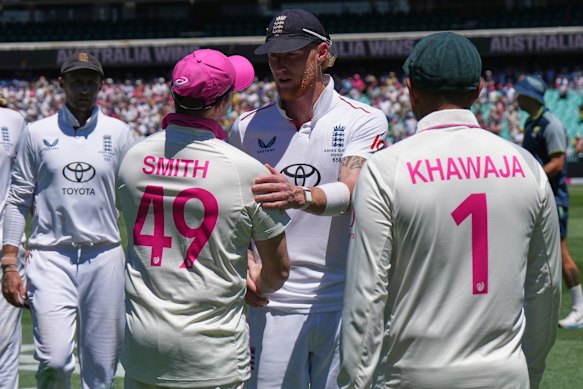
Stokes (centre) congratulates Steve Smith and Usman Khawaja after the final day of the 2025-26 Ashes series.Credit: AP
This happened at the same time the pair’s public pronouncements began to differ. Stokes spoke about Australia being no country for “weak men”, and called for his players to “show a bit of dog”. McCullum said they had overtrained and stuck with his usual mantras of “connectivity and camaraderie”. Stokes seemed to have remembered that Ashes cricket was mighty hard and that you could not chance your way through, but McCullum stayed true to “Bazball”.
One insider believed McCullum felt Stokes was blinking under pressure. It was no surprise, therefore, that they ended up with confused selections like Will Jacks at No.8 on flat pitches in Adelaide and Sydney. Key described him as a “hedge”, which is not very “Bazball” at all.
The Noosa ‘stag do’
“Keeping the army together” was what Noosa was all about. English cricketers have always liked a drink, and it is important to remember the unique strains placed on them by touring. By the time news broke of Brook’s Wellington indiscretion, he had been on the road for a full three months. Flying home on Friday, he will be in Yorkshire for around a week, before heading to Sri Lanka and India to lead England for possibly two months more. It is a dream life, but a demanding one, and England players have often let off steam in unhealthy ways this winter.
McCullum is right that not everyone in the squad gets stuck in, but Noosa was surely the most naive break they have ever taken. England hoped it would act as a “circuit-breaker”, but habits were too set-in. Noosa is a one-horse town, and was full of holidaying Australians, England fans, and media.
England made no effort to hide away, with some players drinking for six days straight. Their families, who would have provided a helpful distraction in Noosa, did not arrive until Adelaide, with the exception of Joe Root, who was experienced enough to recognise that it was time to fly his nearest and dearest out.
England players took a break from their Ashes tour in Noosa.Credit: Seven News
As the players underperformed on the field, and struggled to get the balance right off it, Stokes did not seem to know whether to read the riot act for fear it could make things worse. Terse words were exchanged on the fourth morning in Brisbane, with England siding towards defeat, and a big meeting was held before their first training session in Adelaide, where they sweated out the excesses of Noosa.
The off-field antics did not end in Noosa, either, with England’s new star Jacob Bethell filmed vaping on a night out with other England players prior to the Boxing Day Test.
By Melbourne, where England pulled off a shock win, Stokes was putting an arm round them. Ben Duckett was in the eye of the storm, but insiders credited Ollie Pope for putting aside his disappointment at being dropped to support his mate.
Stokes, who drinks only occasionally now, provided a fierce defence of his players, calling for empathy, in probably the strongest example of his leadership on tour. Despite his mixed performances on the field, tactical struggles, and England’s crushing defeat, he possibly ends the tour in a stronger position than he started it.
That victory took some of the heat off England as senior figures pledged to take their time over whether McCullum would stay or go, with a T20 World Cup imminent. The build-up to the Sydney Test was flat, with players celebrating the win heartily and some training just once, and normal service resumed. A 4-1 defeat was fair, and things got worse for England when their secret about Brook finally emerged.
The morning after the Sydney Test, as England’s players began the long journey home, McCullum headed to the Gold Coast for the Magic Millions horse race meet and sale. While England were in New Zealand, there was a worrying omen for the Ashes: Stokes died. Stokes was a six-year-old gelding, a “big chestnut with a pale face and dodgy legs”, as well as “a big heart”, according to its owner and breeder, McCullum, who named him after the captain with whom he had become so deeply entwined since being paired in 2022.
A couple of months on, the “Bazball” project owned and bred – but not named – by McCullum and Stokes was dead too, laid to rest by a brutal Ashes tour that promised so much and delivered so little.