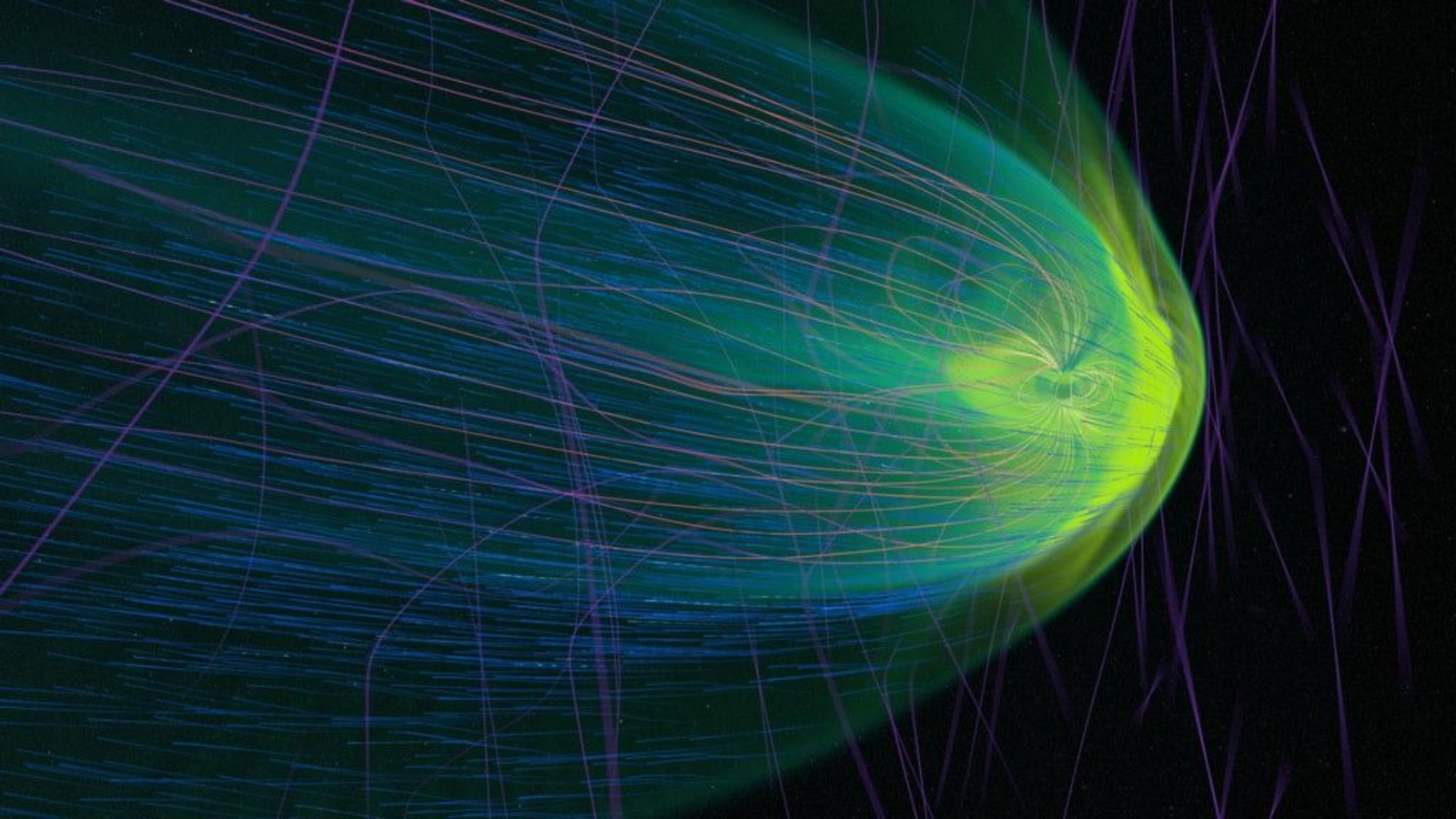
The moon has been secretly feasting on Earth's atmosphere for billions of years
A new study reveals that tiny fragments of Earth's atmosphere are transported to and absorbed by the moon via gusts of solar wind and our planet's magnetic field, upending a 20-year-old theory based on NASA's Apollo lunar samples.
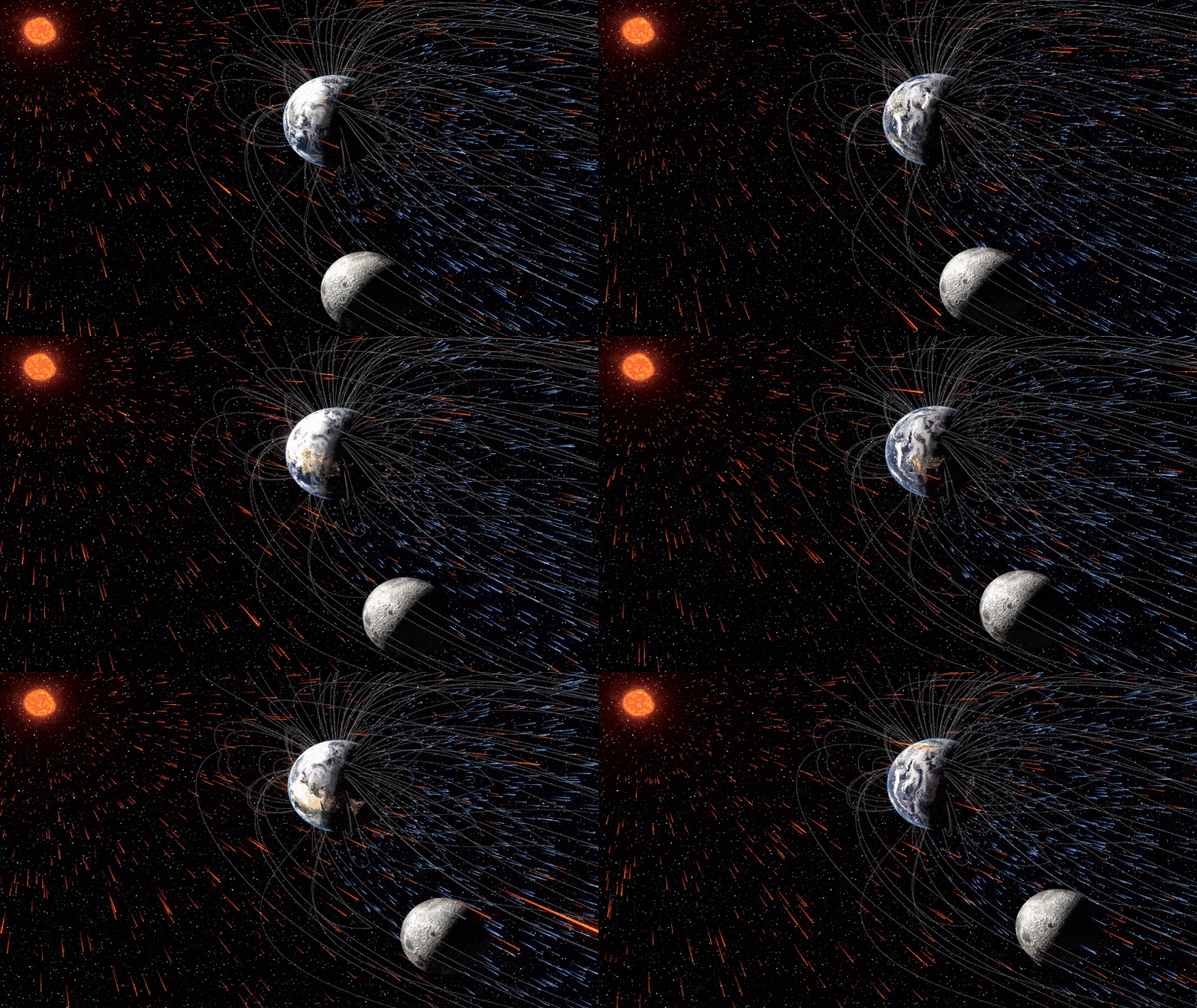
A new study reveals that ions from Earth's atmosphere (blue) get transported to the moon by the solar wind (red) via the invisible magnetic field lines (white) in Earth's magnetic tail. This occurs when our satellite passes through the tail around its "full moon" phase. (Image credit: University of Rochester illustration / Shubhonkar Paramanick)
The moon is quietly absorbing tiny fragments of Earth's atmosphere — and has been doing so for billions of years, a new study reveals. This surprising case of cosmic cannibalism is thanks to supercharged solar winds and, more importantly, our own planet's magnetic field.
The findings upend a 20-year-old theory about how certain charged particles, known as ions, ended up on the lunar surface, and could have big implications for upcoming moon missions, researchers say.
Since 2005, the leading theory suggests that this material transfer could have only happened before Earth developed its magnetic field, or magnetosphere, because this invisible forcefield would have likely trapped any atmospheric ions being blown away from our planet.
However, in the new study, published Dec. 11 in the journal Communications Earth & Environment, scientists combined data from the Apollo samples with computer models simulating the evolution of Earth's magnetosphere, and found that the transfer of atmospheric ions was greatest whenever the moon passes through our planet's magnetic tail — the largest section of the magnetosphere that always points away from the sun. (This alignment occurs when Earth gets between the moon and sun, near the full moon phase each month).
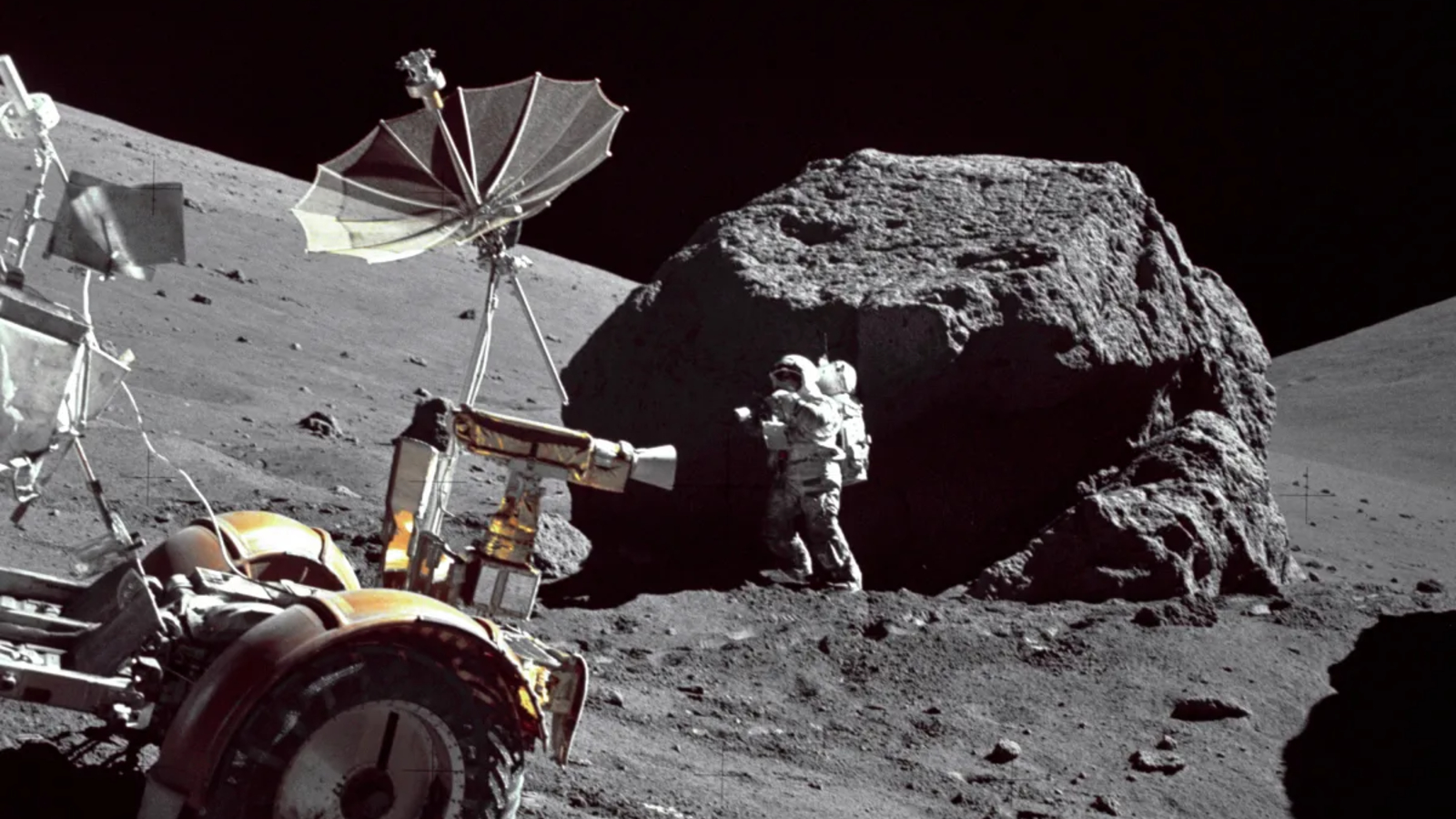
Samples of the lunar regolith have revealed a surprising amount of volatiles, such as nitrogen ions, that likely originate from Earth's atmosphere. This photo shows Apollo 17 astronaut Harrison Schmitt collecting some of these samples in 1972. (Image credit: NASA/MSFC History Office)
The models revealed that, rather than blocking atmospheric ions from being blown from our planet, the magnetic field lines within Earth's tail act as invisible highways for charged particles, guiding them toward the moon, where they are then settled into the lunar regolith.