The name of Brigitte Bardot will live on, for reasons right and wrong
SOURCE:Sydney Morning Herald|BY:Karl Quinn
She was one of the biggest stars of international cinema in the 1950s and ’60s, but her fame post-retirement in 1973 came largely for all the wrong reasons.
The name Brigitte Bardot immediately conjures a sort of fetishised notion of femininity, as the actress who burst onto the scene in the mid-1950s teetered on the cusp of girlhood and womanhood, modernity and pre-modernity, emancipated and coquettish.
Simone de Beauvoir wrote of the then-actress, and later animal rights campaigner, in her 1959 essay Brigitte Bardot and the Lolita Syndrome, that “she is temperamental, changeable and unpredictable, and though she retains the limpidity of childhood, she has also preserved its mystery. A strange little creature, all in all.”
De Beauvoir added that Bardot’s image – which was simultaneously stylised and natural – “does not depart from the traditional myth of femininity. She appears as a force of nature, dangerous so long as she remains untamed, but it is up to the male to domesticate her. She is kind, she is good-hearted. In all her films she loves animals. If she ever makes anyone suffer, it is never deliberately.”
But in the 52 years after she gave up acting, the name Brigitte Bardot increasingly came to represent many other things besides: racism, homophobia, anti-feminism, and a fetishisation of a notion of France that saw her support, at first tacitly and then explicitly, the far right.
Once a symbol of liberation, she came to represent a virulent form of conservatism, with only her commitment to animal liberation to grant her any liberal brownie points.
As Le Monde unflinchingly put it in an obituary published to mark her death on Sunday, “Brigitte Bardot, the actress, was known for [the film] Le Mépris (Contempt); Bardot, the political figure, embodied racial hatred.”
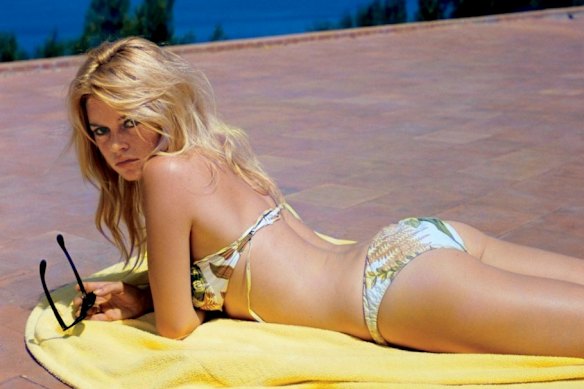
Bardot made her screen debut in 1952, aged 18. In her second, the same year, she played the title role in Manina, The Girl in the Bikini, and the die was cast: she would forever be associated with the rock-strewn beaches of southern France, her shaggy blonde hair, long legs and pouty lips suggesting all sorts of exotic and sensual adventures.
The on-screen and off-screen Bardot merges, as she embarked on a series of romantic affairs that tumbled one into another, often beginning on one film set and ending on another. She was married to three men between 1952 and 1969, and had affairs with many others. But from 1992 until her death she stayed married to her fourth husband, Bernard D’Ormale.
Born in Marseille to a French father and an Australian mother, d’Ormale was described by the French celebrity magazine Gala as “a businessman, [who] began his career in Africa where he invested in various companies across diverse sectors, including textiles, film, and aviation. Upon returning to France, he became involved in politics and served as an adviser to Jean-Marie Le Pen, founder of the National Front.”
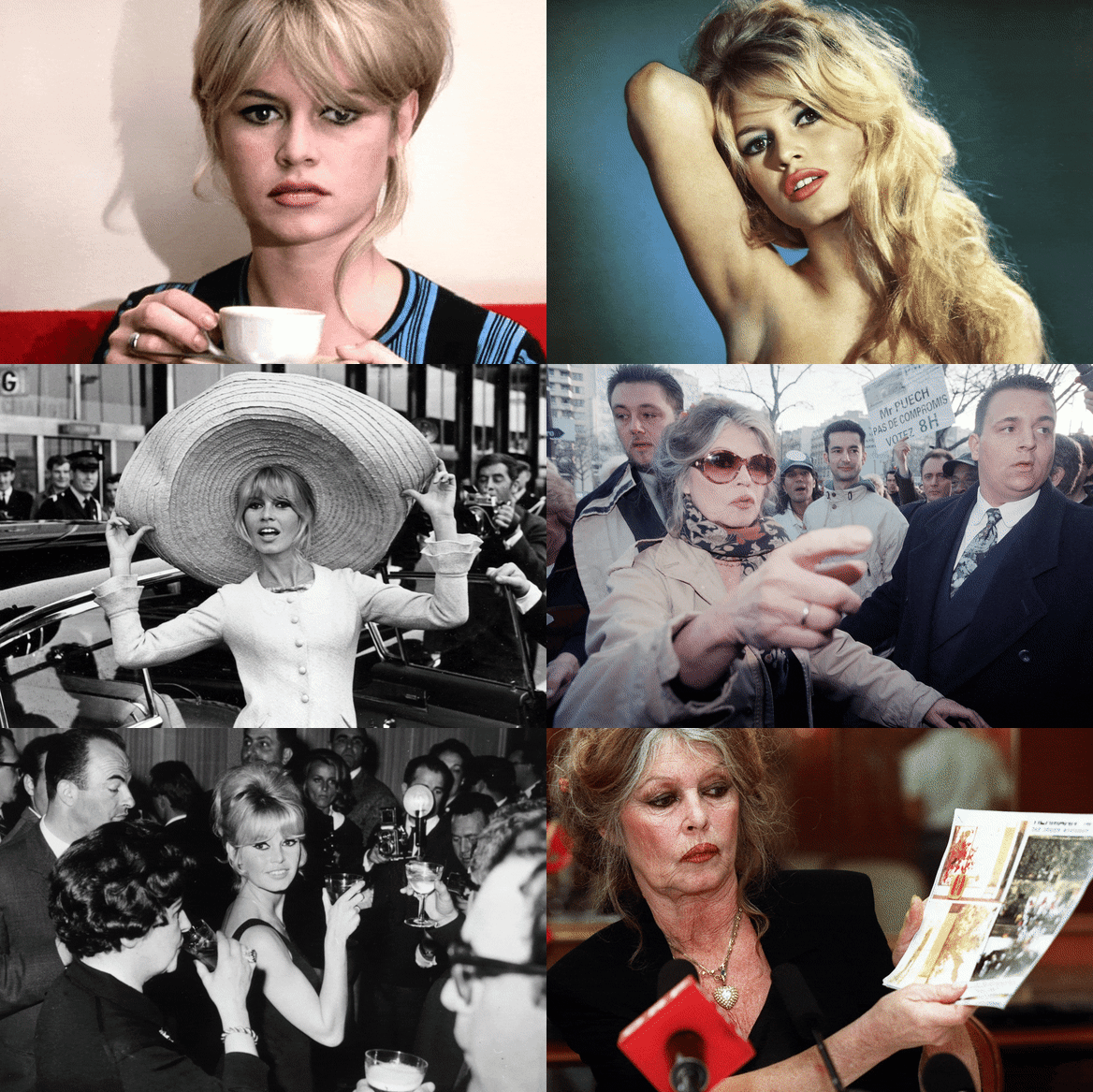
Brigitte Bardot was both a star and a conundrum.
The pair met at dinner thrown by Le Pen’s wife Jany, and were married just a few weeks later. According to Bardot, one of the key factors in their relationship was that he shared her concern for the welfare of animals. She told Paris Match just last year that d’Ormale allowed “three or four animals to sleep on [their] bed” each night.
Bardot was a committed animal rights activist, who aligned herself with Greenpeace in its campaigns against the slaughter of marine mammals. In 1977, she was famously photographed hugging a seal pup on the Canadian ice, as part of a protest against the annual harvest of the animals for their meat and fur. Traditionally practised by the Inuit as a means of sustenance, by the 1970s the hunt had become highly commercialised. By 2003, Canada had approved the killing of 975,000 seal pups over three years.
She was a vegetarian and campaigned against the wearing of fur. But her love of animals led her to make some inflammatory statements against Jews and especially Muslims in response to rituals around the killing of animals for meat.
“Her advocacy for animals went hand-in-hand with her Islamophobia,” wrote Le Monde. “In a letter published by the far-right magazine Présent, Bardot raised alarm over Eid al-Kebir, a major Muslim holiday marked by ritual animal slaughter.”
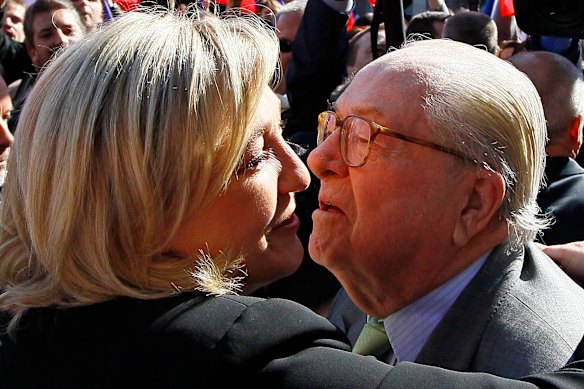
Bardot was a supporter of Front National founder Jean-Marie Le Pen, and once described his daughter and political heir Marine as a modern-day Joan of Arc.Credit: AP
In that letter, Bardot wrote: “They slaughter women and children, our monks, our civil servants, our tourists and our sheep, one day they’ll slaughter us.”
Six times, Bardot was convicted in French courts of inciting racial hatred, yet she insisted she was not “racist at heart”. In 2004, after being charged over comments in her animal rights book Un cri dans le silence (A Cry in the Silence), a teary Bardot said: “I never knowingly wanted to hurt anybody. It is not in my character. If I did hurt someone, I’m sorry.”
In a 2014 interview, Bardot claimed her concerns were not racially motivated, or right wing. “I am a woman that defends animals, right, left, and in the centre,” she said. “Animals aren’t political.”
Yet in 2019, she sparked outrage when she wrote, via her Brigitte Bardot Foundation, to the government of Reunion, a French protectorate off the eastern coast of Africa, to complain about its animal hunting practices.
Bardot was a symbol of women’s liberation, but also a critic of the #MeToo movement.
“The natives have retained their savage genes,” she wrote to the island’s prefect. She added that the island had “a degenerate population still steeped ... in the barbaric traditions that are their roots”.
She was not the only cultural icon to have married a deep concern for animals with right-wing views, of course. Similar charges have been laid against the singer Morrissey, former frontman of the Smiths, who in 2015 joined Bardot in decrying an Australian plan to cull 2 million feral cats because of the danger they posed to native wildlife. The sometime supporter of Nigel Farage noted on Instagram overnight that “an exceptional woman has passed away”.
“Lots of actresses try to play the tease with producers to get a role. And then, so we will talk about them, they say they were harassed,” she told Paris Match. Her comments came a week after Catherine Deneuve, another famous French beauty, who rose to fame in the 1960s, made similar comments.
Some of this might charitably be described as the behaviour of a woman adept at courting attention. But her tendency to cruel disregard extended to her most private interactions too.
In her 1996 memoir Initials: BB, Bardot referred to her pregnancy with her only child, Nicolas, describing him in utero as a “cancerous tumour”, and revealing how, in an attempt to abort the child, she had repeatedly punched herself in the stomach and asked her doctor for morphine.
Loading
She also claimed at a press conference following her son’s birth that she would have “preferred to give birth to a little dog”.
It may have been intended as a brave description of post-natal depression or an admission of a lack of maternal instinct, but Nicolas (and his father, Jacques Charrier) saw no redeeming qualities in her prose. They sued for defamation in 1997, and won.
The power of her image lived on long after she quit the screen. And the name Brigitte Bardot will no doubt resonate for a while yet, for reasons right and wrong.