Suitcases packed, hotel rooms vacated, sore heads and red eyes hidden under baseball caps and behind sunglasses, winners and losers alike face the same post-series exodus.
England will scarper with tails between legs, hoping to dodge an inquisition from the press when they land at Heathrow. Some will find an isolated tropical island where English is not the first language, some will shed the whites of Test cricket and begin preparations for the smash and bash of the upcoming T20 World Cup.
The dogs bark and the caravan moves on. Most of England’s batters will have little problem adapting to the game’s shortest form. But their Test team will be in flux from now until forever if they continue to pursue an inflexible philosophy. It has not worked against a team that met force with cleverness in conditions they understand.
The tourists have not faced meaningful consequences for their failures, and they will continue to underachieve until they do. The nice thing for us is that we don’t give a tinker’s sledge about what England do. There are, however, some issues to be sorted with the home team.
The magnificence of the 4-1 result is not to be trifled with. The absence of first-choice bowlers, including the captain, and the snakes and ladders feel to the batting order presented problems that were solved on the fly. Travis Head was superb, but it was never part of the plan that he would open the batting. Nathan Lyon’s soft tissue injury led to the most baffling selections since 1888, but Australia got away with it – just – because England made too many dopey batting decisions.
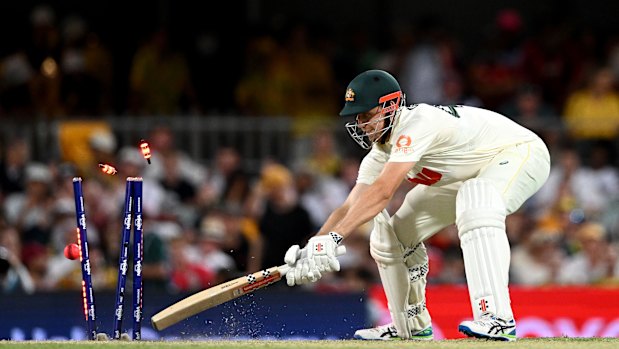
Usman Khawaja was listed as opener for the first Test in Perth and finished the series – and his career – at a concrete No.5. Cameron Green was feted before the first Test and failed almost all the way through to the fifth, falling to the worst shot of the series – quite a feat when you consider the contributions of Will Jacks and Jamie Smith. Green’s bowling lacked only two factors: speed and accuracy.
Brydon Carse bowls Australia’s all-rounder Cameron Green in a reckless period of batting in Brisbane.Credit: Getty Images
Once considered a genuine fourth seam bowling option, Green has lost his mojo and seems at a loss about how to regain it. The best way for him to get back into red ball form is by playing for his state, but the T20 World Cup is about to get in the way. If he has a poor World Cup, then maybe a spell back in club cricket might motivate him.
Beau Webster warmed the bench with admirable patience and, upon finally being given a chance in Sydney, again produced the goods with bat and ball. He will start the next Test come August batting at No.7.
Nathan McSweeney was given the rough end of the Kookaburra last summer when shanghaied to open against India and Jasprit Bumrah after having built an imposing resume in the middle order. Perhaps it is now time to let him establish himself in a more familiar setting as the renovations commence ahead of the 2027 Ashes in England – which is only 18 months away.
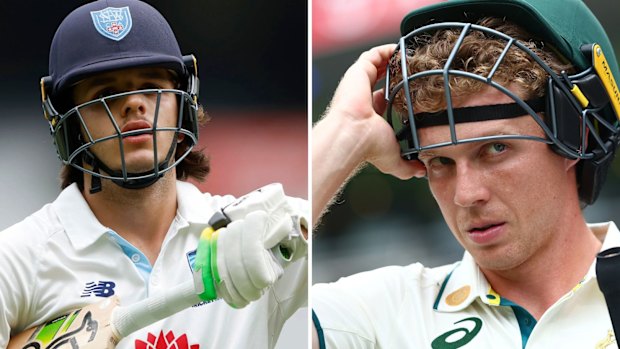
Sam Konstas is still just 20, a fact I keep reminding punters and critics of. After, “Why did we not play a spinner at the SCG?” I reckon the question I have been asked the most in the last week is, “What happened to Sam Konstas?”
Test contenders Sam Konstas and Nathan McSweeney both scored centuries in the first half of the Sheffield Shield season.Credit: Getty Images
Well, he’s alive and well and making runs in the Sheffield Shield – and the Shield is where the selectors had better be keeping a careful eye when it recommences in early February.
Left-handed batter Campbell Kellaway is one for the future and may well rejoin his Australian Under-19 partner Konstas at the top of the order, as long as the runs keep coming in the Shield. Both have time and talent on their hands.
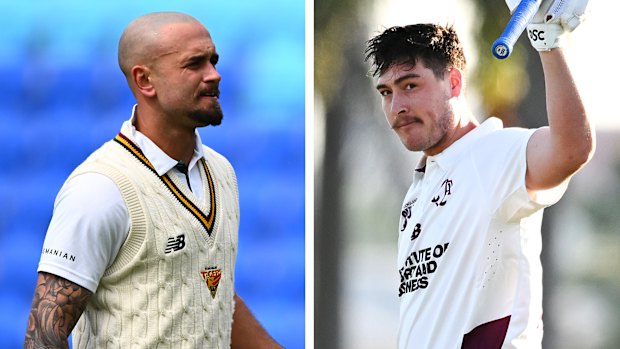
Matthew Renshaw has been in super four-day form and was just pipped by Jake Weatherald – on whom the jury is still out – for the opening spot at the start of the summer. It would be harsh to drop Jake after a winning Ashes campaign, but his numbers don’t stack up and many who have gone before him – Konstas and McSweeney, to name two – were jettisoned with better ones. He did feature in some useful partnerships with Head, and that will keep him in the conversation. But once again, there is no outstanding candidate to go in first.
The selectors can pat themselves on the back for a successful campaign, but their succession plans have been stained by lack of continuity. The trick with selecting is to identify the better talent and then let coaches, game time and teammates do the job of development.
Jake Weatherald earned the Test opener spot this summer while Matt Renshaw has scored three centuries for Queensland this season.Credit: Getty Images
There is plenty of talent running around in state cricket. Weatherald proved that at 31 you can reap the benefits of hard work, continuity in state selection and the evolution of your game. There is a national will for him to become a long-term Test player, but the selectors haven’t backed up their recent picks with patience, second-guessing themselves at the slightest provocation.
Lyon’s successor is lurking in the state ranks. Todd Murphy has taken 22 wickets in seven Tests already in Lyon’s absence. But when the Sydney Test came along the selectors retreated to their seam bowling security blanket, not only robbing Murphy of a Test match on home soil – and he would have taken wickets on that pitch – but also of vital experience and development. Just as they robbed Konstas of Test match experience in Sri Lanka and the World Test Championship final, then bought him back on difficult pitches in the West Indies.
Left-arm offie Matt Kuhnemann quite rightly gets the nod for the World Cup. He gets better every year and can do the job in Test cricket as well. WA’s Corey Rocchiccioli spins it hard and the leggies Mitch Swepson and Tanveer Sangha are destined for higher honours. There is spin talent out there, but the seam bowling candidates are less obvious.
Loading
Mitchell Starc will bowl for as long as he has the desire. Perhaps his most remarkable characteristic is his ability to maintain his velocity through the years. Jhye Richardson, who returned to the Test team in Melbourne, was disappointing because his penetration is mostly about speed and he never clocked 140 km/h. There are plenty of 130-135km/h seamers running around, but Test cricket demands more.
Can Spencer Johnson overcome his injuries and make a go of first-class cricket? A fast left-hander to back up or replace Starc would be nice. NSW leftie Ben Dwarshuis is bowling so well in T20, is a constant improver and is reaching the 140km/h mark consistently. Will Mahli Beardman or Tom Whitney or Ryan Hadley step up a notch?
Young guns Cooper Connolly and Jake Fraser-McGurk look to be putting their eggs in the T20 basket. It is performances at Shield level that should get you into the Test conversation. National selectors need not be confounded by white ball attitudes – look what that has done to England’s Test cricket.
For all of these candidates, the quality of pitches around the country needs to be addressed. The 22 yards of a first-class pitch is a space that delivers an exacting examination – it’s handy if the participants have a clue about the syllabus. Adam Lewis produced a classic Test pitch at the SCG: good bounce to start and spin at the death. Many Shield pitches are lush enough to produce cash crops, and that does not encourage resilient batsmen or bowlers.
The 2025-26 Ashes were compelling viewing. Battles with the oldest enemy generally are. Australia’s victory was a handsome one no doubt, but there is much work to be done if that result is to be repeated in 2027.