The Quantum era crept up while you were watching AI
Step aside, artificial intelligence. Another transformative technology with the potential to reshape industries and reorder geopolitical power is finally moving out of the lab.
By Catherine Thorbecke
January 2, 2026 — 11.00am
Step aside, artificial intelligence. Another transformative technology with the potential to reshape industries and reorder geopolitical power is finally moving out of the lab: quantum.
The United Nations dubbed 2025 the International Year of Quantum Science and Technology. It’s been marked by a flurry of announcements — and a mountain of hype — around a mind-boggling field of science long dismissed as perpetually a decade away from usefulness. But that’s how people talked about AI, too, before ChatGPT spurred the current global arms race and investor euphoria.
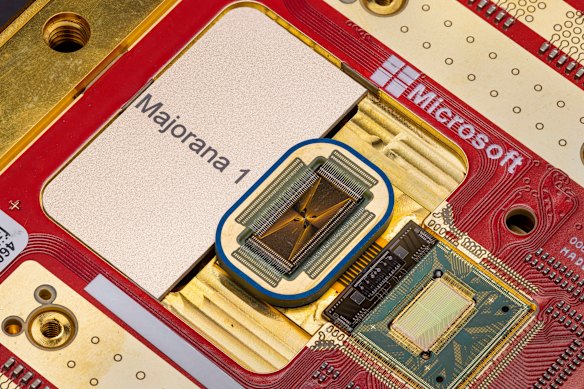
Microsoft Microsoft’s Majorana 1 Quantum Processing Unit.Credit: John Brecher
Quantum technology taps the odd mechanics of quantum physics — how particles behave at the atomic level — to create computers, sensors and communications gear that are exponentially more powerful than today’s. Classic computers process information in bits, which can be represented as “0” or “1.” Quantum computers use qubits, which — bear with me for a moment — can exist in a superposition of both states at the same time. That allows them to evaluate a vast number of possibilities at extraordinary speed.
As mystifying as it seems, quantum technology has the potential to transform sectors from medicine to finance. McKinsey estimates it could generate up to $US97 billion ($145 billion) in revenue worldwide by 2035. Fellow corporate consultant Bain, looking at the broader ecosystem, says it could unlock as much as $US250 billion in market value.
AI soaked up most of the attention this year. But if you weren’t watching closely, here’s what you may have missed in quantum, and what I’m watching out for next.
The hype is getting louder; the quiet story is how unprepared we are.
The year began with something rare in the field: a viral moment. In February, Microsoft unveiled its first quantum computing chip, touting a path to fitting a million qubits on a single processor. A sleek YouTube video broke down some of the jargon usually associated with the science and culminated with the declaration: “We’re at the cusp of a quantum age.” Some researchers later questioned if the PR hype machine was going too far, perhaps overselling the underlying science.