The six weeks that would destroy John Howard’s prime ministership
SOURCE:Sydney Morning Herald|BY:Shane Wright
In a six-week period, the Howard government made two decisions that would reverberate through Australian politics for the next 20 years.
John Howard ignored an explicit recommendation not to send special forces troops back into Afghanistan in 2005, a decision that would leave the Australian military mired in its longest-ever war.
Previously confidential cabinet papers released today show the defence department warned the risk to special forces outweighed any strategic interest in going back to Afghanistan, while both Treasury and the Finance Department expressed concern that there was no exit plan.
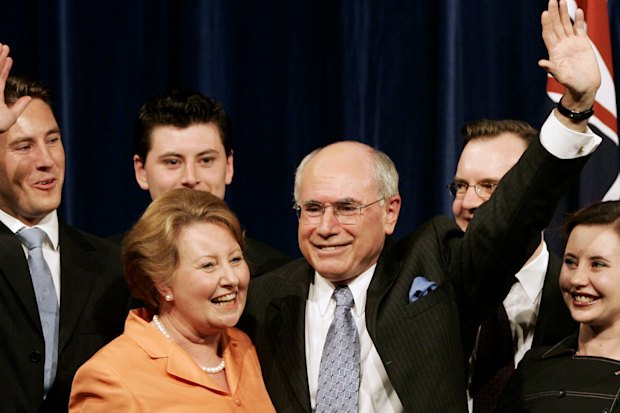
John Howard celebrates his 2004 election victory. The seeds for his loss three years later were sown in 2005.Credit: Mark Baker.
The documents, released today by the National Archives, also reveal a small government agency raised questions over Howard’s signature industrial relations reforms – WorkChoices – that would ultimately consume his government.
Howard’s absolute majority
Anthony Albanese’s 2025 electoral victory stands as one of the most astounding in political history. Labor won the most seats by a single party since Federation in its best two-party preferred performance since John Curtin’s 1943 win, while two leaders – Peter Dutton and Adam Bandt – lost their seats.
But Howard’s 2004 victory shone brighter. Not only did he win an election for a fourth successive time (something only achieved by Robert Menzies and Bob Hawke), but he also captured control of the Senate.
He had opened the election campaign by asking voters “who do you trust” – him or Labor’s Mark Latham. The answer was overwhelming.
Loading
As Howard would note in his autobiography, Lazarus Rising, the “Howard battler” trusted the economic security he was offering, was socially conservative, and backed the government’s position on asylum seekers.
The Senate majority achieved at the October 9 election, the most important element of the win, would not be realised until the middle of 2005.
And it was in those few weeks either side of the new Senate – the absolute zenith of Howard’s fourth (and final) term – that two decisions would be taken that continue to reverberate.
The forgotten war – Afghanistan
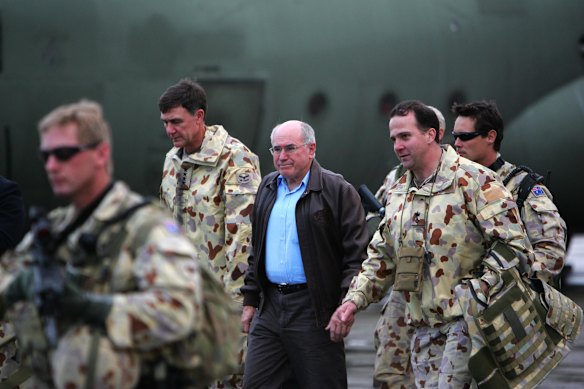
Prime Minister John Howard arriving in Kabul, Afghanistan, in 2005. Credit: Andrew Taylor
On July 13, 2005, John Howard and then-defence minister Robert Hill stood together to announce that Australia would send special forces troops back to Afghanistan.
Those troops had performed extraordinarily well in 2001 and 2002, when the world had responded to the September 11 attacks on New York and Washington by attacking the Taliban and the al-Qaeda terrorists it was protecting – including Osama bin Laden.
They would then be used in Iraq when Australia joined the “Coalition of the Willing”, led by the United States, in a war built upon claims, later found to be wrong, that Saddam Hussein and his dictatorial regime had weapons of mass destruction.
Loading
But by 2005, Afghanistan was faltering. US president George W. Bush and Afghan president Hamid Karzai had sought Australia’s support for troops on the ground. Washington made the request in mid-2004. Cabinet papers released this week covering the British government of Tony Blair over the same period show pressure from the UK on Howard for Australian military presence in Afghanistan.
“It’s fair to say that the progress that’s been made and the establishment of a legitimate government in Afghanistan has come under increasing attack and pressure from the Taliban in particular and some elements of al-Qaeda,” he said.
Australia’s commitment, for a 12-month period, would be 150 personnel made up of SAS and commandos.
Air Chief Marshal Angus Houston had taken over as chief of the Defence Force on July 4. The following week, he gave a verbal briefing to the National Security Committee.
On the day he announced the deployment, Howard told reporters that Houston had said “that the commitment is well within the capacity of the ADF”.
‘We recommend against sending special forces to Afghanistan’
But documents released by the National Archives on January 1 show Hill and then-foreign minister Alexander Downer had recommended against sending special forces back to Afghanistan.
The papers, from a July 12 National Security Committee meeting, use clear language against such a move.
“We recommend against sending special forces to Afghanistan in a dedicated combat role. A contribution to combat operations would expose ADF elements to significant risk,” they wrote.
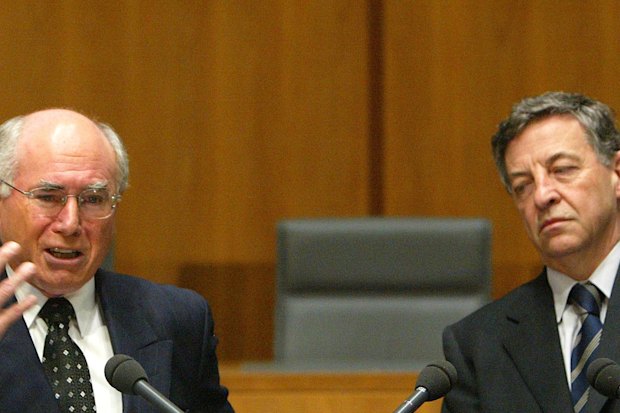
John Howard and Robert Hill on the day they announced Australia would send special forces back to Afghanistan.Credit: Penny Bradfield
In a single paragraph, the submission from Defence and Foreign Affairs warned that casualties should be expected, with soldiers put at risk against “determined and dangerous adversaries”.
“While a special forces deployment could meet some strategic interests, we do not consider that this warrants the risk involved.
“Working in a dedicated combat role does not meet reconstruction as well as security objectives.”
Loading
It also noted concerns that the US may not be able to provide adequate air support because of its ongoing commitments in Iraq.
Both Treasury and the Finance Department raised concerns about the open-ended nature of the commitment. Finance said there should be a “clear exit strategy” tied to any Defence commitment to Afghanistan.
Howard’s own department did not support the initial recommendation, arguing there had been “insufficient information” provided about the option of a special forces deployment. It was a clear sign the bureaucracy within Prime Minister and Cabinet believed their boss would lean towards well-armed and highly skilled troops on the ground.
The Office of National Assessments, rather than describing the situation in Afghanistan as “volatile”, as Defence had stated, believed it was “difficult and dangerous”. ONA’s assessment would prove much more accurate.
None of these issues would be raised by Howard at that July 13 press conference. The decision to send special forces back to Afghanistan did not rate a mention in Lazarus Rising.
Just the beginning
While the initial commitment was for just 12 months – the government wanted special forces back in Australia to beef up protection for the 2007 APEC meeting of world leaders – the mission would expand and endure.
The July 12 meeting set in train the deployment of a reconstruction unit to Uruzgan province that would start the following year.
Not until August 2021, when Australian forces were used to airlift people out of Kabul as the Taliban secured Afghanistan’s capital, would Australia finally leave the nation.
John Howard visiting Australian soldiers in Afghanistan in 2007. Australia’s military presence would remain until 2021.Credit: Andrew Taylor
At 20 years, it is Australia’s longest war.
The total financial cost has been estimated at almost $10 billion. Only World War II is thought to have been more expensive for Australia.
Loading
About 40,000 defence personnel served in Afghanistan over the two decades, with 47 dying as a result of their service and another 263 wounded.
That does not include those who have taken their own lives, which the Royal Commission into Defence and Veteran Suicide heard could be at least six times as many as those killed in service.
Special forces troops would serve into the mid-2010s.
The Brereton inquiry into alleged war crimes committed between 2005 and 2016 found “credible information” of 39 unlawful killings and cruel treatment involving 25 soldiers. The inquiry was specifically into the actions of the special operations task group that the Howard cabinet sent into Afghanistan.
How WorkChoices put Howard out of a job
Unlike the decision to head back into Afghanistan, another cabinet resolution that took place in mid-2005 had almost immediate political repercussions for Howard.
WorkChoices was the term coined to describe the overhaul of Australia’s industrial relations system that Howard and his government wanted to push through once they had control of the Senate.
At its heart, WorkChoices aimed to reduce the red tape around the IR system by shifting to individual work contracts negotiated between employers and their staff. Unfair dismissal laws were to be wound back and union power restricted, while employment laws would have national standing.
Loading
Then-industrial relations minister Kevin Andrews was given the job of pulling together the legislative package that would head to the Senate once the Coalition had its majority in place.
In three separate cabinet submissions, Andrews and his department worked through a maze of issues with the stated aim of lifting productivity and making it easier for Australians to get paid employment.
Just a few weeks before the Afghanistan decision was taken, one of those submissions contained the first inkling of the trouble that would be unleashed by WorkChoices.
The little agency that sounded a warning
Almost every department or agency largely backed the WorkChoices agenda. Treasury argued the government could go further by phasing out all workplace awards, freezing the pay rates of all people on awards until they were overtaken by a new national minimum wage.
With inflation starting to accelerate, such a policy would have delivered cuts in real incomes to millions of Australians. It was a political non-starter as the government sought to keep voters onside.
But one tiny agency, the Office of Regulation Review, raised a series of issues that would go to the heart of the political problems caused by WorkChoices.
Loading
It noted that a regulation impact statement – effectively an examination of the proposed legislation and what it may mean to different parts of the community – was simply not up to scratch.
Andrews’ department had failed to address “distributional effects or consider effects at the level of different industries, regions or socioeconomic groups”.
The same agency also clipped the department for research it had provided which purported to show a link between individual work contracts and productivity.
“The data … shows a correlation of factors, not causality, and the conclusions drawn from these data could be misleading,” it argued.
The jobless rate did fall. It dropped to 2.7 per cent in Western Australia, where the biggest mining boom in 150 years was driving unemployment down.
Overall wages growth remained strong across the entire economy. But evidence of the impact of WorkChoices on lower-paid people – often dismissed as union propaganda by Howard – quickly became apparent.
Unions identified real-world examples of people facing cuts in their wages under Howard’s new laws. In one case, part-time workers at the Spotlight fabric chain faced being up to $164 a week worse off.
Howard often dismissed these anecdotes. The problem for him was that the case studies were real.
Net satisfaction in Howard as prime minister, as measured by Newspoll, had been positive since 2001. That streak, the longest in Newspoll’s history, ended in October 2005 as WorkChoices started to bite as an issue.
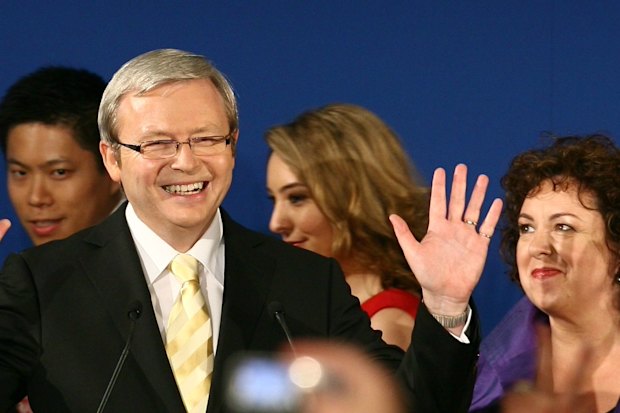
Kevin Rudd led Labor to emphatic victory in 2007, in part due to the Howard government’s WorkChoices policy.Credit: Glen McCurtayne
The union movement and Labor would use WorkChoices to hammer Howard and the government all the way to the 2007 election.
In his campaign launch speech, Howard only referenced industrial relations on a single occasion. But Kevin Rudd would note that Howard had not even used the term WorkChoices in his address to voters.
“WorkChoices has become the industrial relations law that now dare not speak its name,” he said.
Almost two decades on, any move by the Coalition to make substantial changes to industrial relations is invariably described as the “ghost of WorkChoices” by Labor and union opponents.
The Senate majority that delivered Howard his finest moment continues to hang over the nation’s workforce settings.