The six words from Trump that had Zelensky – and the world – wincing
SOURCE:Sydney Morning Herald|BY:Michael Koziol
The question is whether this Trumpian blind spot for Putin’s intent will ultimately doom the peace process by railroading Ukraine into accepting terms its people or its parliament cannot abide.
New York: It was the moment Ukrainian President Volodymyr Zelensky nearly broke his studied composure.
“Russia wants to see Ukraine succeed,” Donald Trump said.
“It sounds a little strange. But I was explaining to [Zelensky]: President Putin was very generous in his feeling toward Ukraine succeeding, including supplying energy – electricity and other things – at very low prices.”
It’s difficult to know where to start with Trump’s assertion that Vladimir Putin has Ukraine’s interests at heart, as his full-scale invasion approaches its fifth year.
On one hand, it was quintessentially Trumpian to portray it as a great outcome that Putin, having invaded and turned half of Ukraine into some kind of vassal state, would turn around and offer Kyiv discounted electricity.
It shows, of course, that Trump was not listening or understanding when Putin embarked on a long and by all accounts painfully detailed history of why Ukraine is really part of Russia when the two men met in August in Alaska.
Loading
But we knew that already. The question is whether this Trumpian blind spot for Putin’s intent – this apparent willingness to take the Russian leader at face value – will ultimately doom the peace process by railroading Ukraine into accepting terms its people or its parliament cannot abide.
That was one of the items left undetermined as Zelensky left Mar-a-Lago, but he wants any credible peace plan to be put to a referendum in Ukraine, following a 60-day ceasefire. Putin opposes a ceasefire and has seemingly cajoled Trump into seeing it as a waste of time.
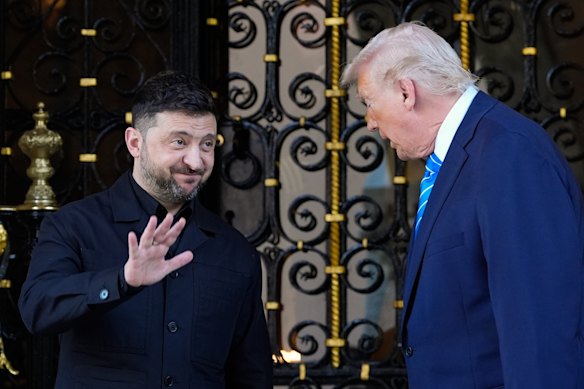
As Trump told the cameras that Russia wanted Ukraine to succeed, Zelensky cocked his head – a bit like the woman whose head-tilting facial expression while tasting kombucha became a beloved internet meme – and allowed himself to smile when Trump admitted it “sounds a little strange”.
That moment was something of a test for Zelensky, whose US visits this year have been a rollercoaster. In his disastrous White House appearance in February, when Trump and Vice President JD Vance seemed set on an ambush, Zelensky took the bait and fired back. Since then, he has kept his cool, kissed the ring and avoided anything that could be construed as ingratitude.
President Donald Trump greets Ukraine’s President Volodymyr Zelenskyy at his Mar-a-Lago club, on SundayCredit: AP
When Zelensky appears in public with Trump now, this carefulness can come across as meek deference. But in a Fox News interview in the US on Monday night (Tuesday AEDT), Zelensky made it clear that he is telling Trump privately what he needs to hear.
Zelensky pointed out that Trump had referred to opinion polling suggesting an overwhelming majority of Ukrainians wanted an end to the war.
“I said, ‘Yeah, this is our life, 87 per cent support peace’,” Zelensky said. “At the same time, 85 per cent [are] against to withdraw from east, from the Donbas. Everybody wants peace, but [a] just peace.” (The poll, from the Kyiv International Institute of Sociology and reported by the Kyiv Independent, actually found 75 per cent of respondents were against a peace plan that required withdrawing from the Donbas.)
Clearly, Ukraine relinquishing the small part of the Donbas it still controls is a red line that Zelensky does not want to and cannot cross. It is evident he is still having trouble convincing Trump on that front.
“All the parties have to understand that the worst way is to go out from the Donbas. It will be big risks for Ukraine, not acceptable by Ukrainians, and [the] referendum will not be positive,” Zelensky told Fox News.
Zelensky is trying to tell Trump and his team – special envoy Steve Witkoff and son-in-law Jared Kushner – that the dynamics at play, and the civic sensitivities, are slightly more complicated than they might appreciate.
Nor can Zelensky get a bad peace agreement through his parliament. He may have stopped himself criticising Trump’s indulgence of Putin’s lies, but back home, MPs were aggrieved by Trump’s comments.
“President Trump said he believes that Putin wants peace,” said Kira Rudik, leader of the Holos party. “That’s why we need him to come to Ukraine, to witness everything with his own eyes. To talk to people whose loved ones were killed the same time Putin was saying he wants peace.”
Rudik told US television network MS-NOW that peace could not come at any cost, such as selling out Ukrainians who happen to live closer to Russia. “I haven’t heard people saying, ‘Let’s give up some of our fellow citizens just so we can live’,” she said.
Trump floated the idea of speaking to the Ukrainian parliament – just as he addressed the Israeli Knesset in October – if it would help move the peace deal along.
But with remarks like “Russia wants to see Ukraine succeed”, that’s unlikely.
The takeaway from the Mar-a-Lago talkfest is that little has changed, despite lip service about progress from both sides. Territorial sacrifice demanded of Ukraine remains an insurmountable hurdle, and Putin is content to keep bombing as the process drags on.
Although Moscow provided no evidence of the alleged attack, Trump was ready to believe it. “You’re saying maybe the attack didn’t take place, that’s possible too, I guess,” he told reporters at Mar-a-Lago. “But President Putin told me this morning it did.”
Some analysts viewed Moscow’s accusation as another attempt to frustrate the peace process, and a tacit admission that US-Ukraine talks had gone well.
Former US diplomat and presidential adviser Daniel Fried, now at the Atlantic Council, said on X: “The US and Ukraine seem to be closing in on a peace framework. So the Kremlin tries to derail it. Disrupt, deflect, delay.”
Doug Klain, the deputy director for policy at the US-based Razom For Ukraine and a non-resident fellow at the Atlantic Council, said the Mar-a-Lago meeting appeared to go well for Ukraine, insofar as Trump was mollified and confirmed US security guarantees.
“But in reality, these are still supposed partners forcing negotiations with themselves, not the one party that is continuing the war,” Klain told this masthead.
“While the meeting seems to move Ukraine and its partners toward a common framework for what peace could look like, I don’t think it did anything to push Russia toward cutting a deal.”
Klain said Trump’s pro-Putin rhetoric – including another lengthy diatribe about what the two of them “went through together” when Russia was accused of interfering in the 2016 US election – would only embolden Moscow.
“If it’s going to make a deal to end the war, Russia has to feel some pressure,” he said. “Trump has taken almost all pressure off Putin and let the Kremlin set the tempo for much of these negotiations.”