There’s more to healing racism than a royal commission
Any inquiry into racism in Australia would need to start with the arrival of the First Fleet and the subsequent treatment of our Indigenous people.
Any inquiry into racism in Australia would need to start with the arrival of the First Fleet (“Business leaders join call for royal commission, turning heat on PM”, January 2) and the killing, incarceration, stolen children, deaths in custody and the continued control and poor treatment of our Indigenous people and subsequent introduction of the White Australian policy. White Australians have always been racist, ever since we arrived in this occupied country, and generally unwelcoming to new arrivals ever since. Recognition/improving the lives of our Indigenous people, acknowledging Australian wars and sites of massacres, and entering into a treaty would be a good start in healing racism. Brian McDonald, Willoughby
I am not a lawyer but it seems obvious why the government doesn’t want a royal commission for the Bondi shootings. Most of the evidence provided by security agencies would be classified and not for public release. It would not be a very satisfactory outcome if the royal commission redacted or couldn’t refer to a lot of this evidence in its report. In my view, the referral to a distinguished former public servant is much more effective. In the end, any terrorist incident is the responsibility of security agencies, and they are not going to tell us the details of their operations, let alone tell us what they are going to do in future. We would only get the mumbo-jumbo that greater co-operation and resources are needed. John Rome, Mt Lawley (WA)
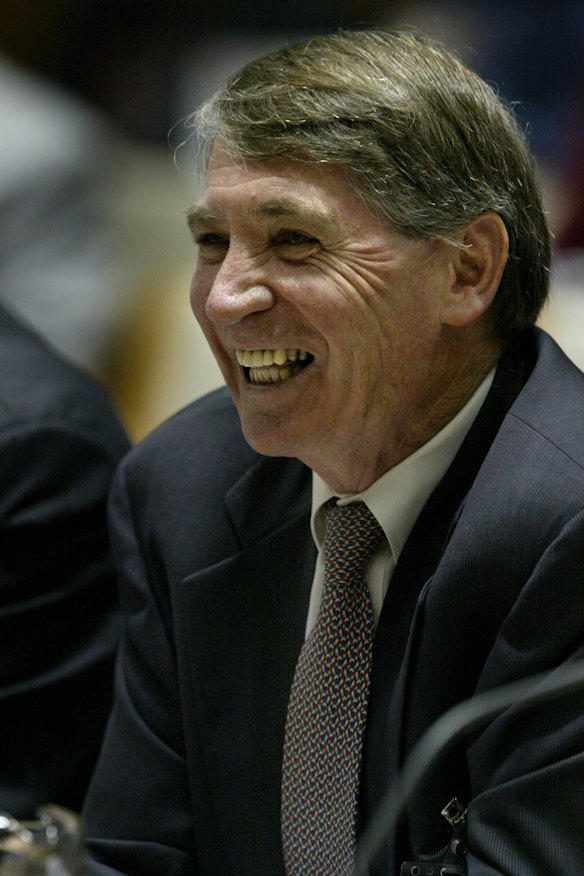
Dennis Richardson, just let the man get on with itCredit: Fairfax Photographic
If the crucial issue for the royal commission requested by business leaders is an inquiry into antisemitism, the terms of inquiry (Letters Patent) given to the commission may limit an examination of other important factors that may have contributed to the Bondi shootings. Catherine Turner, Cremorne
What do people expect a Bondi royal commission to find? Presumably it would find many things but likely few things not already identified. Some responses have been forcefully urgent. The issues on the table are hardly uniquely Australian. As for national responses, an international consensus is presumably emerging on how to balance respect for ″freedom to speak″ with restraint on how it may be said. One local initiative could bring together, in an open framework, key leaders from our multicultural community to negotiate a consensus – the time would seem to be right. Managing the risks of terrorism is related but different. Peter Mair, Dee Why
I cried on the night of the Bondi horror, so let no one say I was unaffected. But I am a bit perplexed by headlines that say Australia is forever changed by it. My daily experience of racism is unchanged: Jewishness is ignored but hatred for Muslims is commonly verbalised, and disdain for our Indigenous people and sheer ignorance of the brilliant complexities of their care for Country continues unabated. Any royal commission should examine all racism, not just one particular type. Dick Clarke, Elanora Heights
We may well, as another correspondent suggests, have a royal commission into all forms of racism (wouldn’t that be interesting?), but for now while the emotions are raw, can we just lower the temperature, drop the political opportunism and let the well-credentialed Dennis Richardson conduct his inquiry into ASIO, federal and local police? Phil Bradshaw, Naremburn
In the aftermath of such a violent incident in our nation, leaders and those demanding a royal commission must be brave and honest enough to ask themselves some complex questions. For those clamouring for the lengthy and expensive investigations of a royal commission, are they honestly asking themselves if how and to what extent the antisemitism they declare must be eliminated is unarguably conflated with Israel as a political and military apartheid system committing grave human rights crimes? Will a royal commission address how this tragically places Jewish communities in the line of fire and binds their fate to these state crimes? While antisemitism is a dangerous reality, will a royal commission address how it might be weaponised to silence important and genuine criticism of Israel, instead of confronting hatred? Or will these processes become misdirected witch hunts and avenues to suppress or restrict public debate, protests and academics under a misclassification of antisemitism? Our whole population, and all of humanity, deserves all the protections of human rights legislation, and we are not facing a selective religious issue but rather a much wider political and ethical problem that extends far beyond our shores. Robyn Dalziell, Kellyville
Between 2023 and 2024, dozens of women were killed in Australia by domestic and family violence. In the call for a royal commission into the Bondi shootings, rather than the government’s call for a public inquiry into the tragic circumstances surrounding it, Human Rights Commissioner Lorraine Finlay has entered the fray, publicly supporting a royal commission. Would she also support a royal commission into the tens of women murdered in domestic and family situations throughout our country? Her department has, as one of its priorities, public inquiries into significant human rights issues such as violence against Indigenous people. Minister Tanya Plibersek has committed full-blown and financial support for fighting such violence, so perhaps Finlay could help in supporting issues closer to her day-to-day responsibilities. William Tuck, Mosman
Care in the community
I live in a well-connected neighbourhood. People speak to each other, keep their eye out for each other and are simply pleasant and neighbourly. The past few days have changed all that. This neighbourhood is upset and distressed because some stocky 40-year-old with a set of nasty tattoos on his arm has, just on darkness, letter-bombed the streets with white-nationalism pamphlets and a call to arms against migrants. We were concerned for our Italian neighbour, our Sri Lankan family across the street and the Muslim family around the corner – all very much part of our community – when they digested what this inflammatory flyer says about this country. These fascists are now emboldened, they are literally out on our streets, and there are elected representatives of this country who have emboldened them by their rhetoric. Wendy Atkins, Cooks Hill
Uzzie, Uzzie, Uzzie
I was a Filipino cricketer growing up in Sydney (‴Look at me now:′ Usman Khawaja takes parting shot at ‘racial stereotyping’ as he announces retirement”, smh.com.au, January 2) and Usman Khawaja was an endless source of inspiration to myself and the legions of non-Anglo-Saxon cricketers who were coming through the grades. His success was a beacon of hope in that anyone, regardless of their cultural background, might one day don the baggy green. Usman will be remembered for his unflappable manner at the crease, his elegant straight drives and his inner determination to keep believing in himself when it seemed that no one else did. His most significant contribution, however, will be the manner in which he displayed confidence, compassion and conviction, time and time again, by speaking his mind on political issues that affected marginalised groups on our shores and abroad. Jonathan Hill, Old Erowal Bay
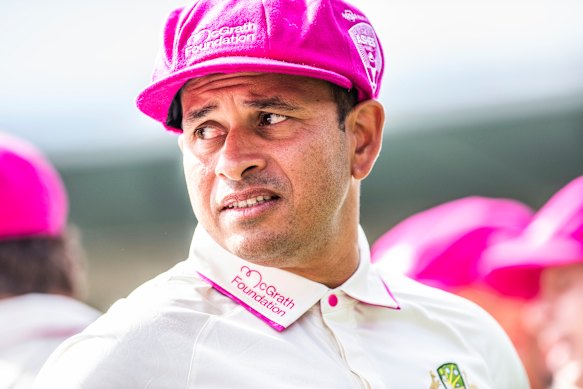
Usman Khawaja after announcing his retirement on the eve of the Sydney Ashes Test Match at the SCG.Credit: Steven Siewert
Thank you, Usman Khawaja, for your outstanding contribution to Australian cricket. It was a very tough gig as an opening batsman, especially when you were the first Muslim to represent Australia. Your character and humble traits are a model to the sporting society. Peng Ee, Castle Cove
Security secrets and lone wolves
Waleed Aly raises interesting perspectives on the lone-wolf aspect of the newly developed model of terrorism (“No easy answers in split terrorism”, January 2). The shocking events perpetrated by two gunmen at Bondi will haunt Australian history forever and, as each small part of an intricate story unfolds, we will all learn more of the backstory of those gunmen and, I hope, their reasons for this attack on the Jewish community. I would like to know how many potential terrorist events the Federal Police have been able to stop, but I realise that for security reasons these operations need to be held secret. Obviously, this one got through the monitoring. My migrant parents came to Australia from war-torn Europe. They were seeking peace and stability. It is apparent that a minority of our new Australians wish to bring their former beliefs and value systems with them – for what purpose? A misdirected belief in martyrdom? Let’s hope that 2026 brings us the peace and calmness the majority of Australians crave. Robert Mulas, Corlette
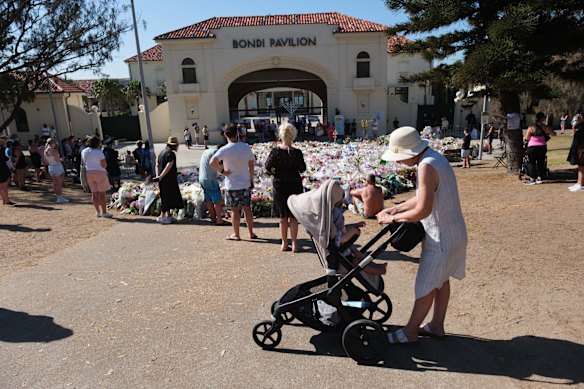
Mourners and tributes at the Bondi PavilionCredit: Oscar Colman
Thank goodness for Waleed Aly bringing some sense to the Bondi tragedy. As he notes, no government has shown the ability to tackle myriad rabbit holes and chaotic availability of every extremist discourse. Jillian Segal’s existing plan to combat antisemitism may well help, but as Deborah Lipstadt said in her book Antisemitism: Here and Now (2018), antisemitism is an irrational form of hatred and trying to defeat it with a rational explanation is virtually impossible. Peter Nash, Fairlight
Another balanced opinion piece from Waleed Aly suggests that precursors to the Bondi attack are multifactorial. Given that young and impressionable minds are easily influenced by online conspiracy theories, as well as hate preachers spewing calls for violence against “evil” and “cursed” Jews, this is all the more reason a royal commission is urgently needed. Guns, radicalisation, unfettered calls for jihad and management of police resources are just a few of the issues requiring examination to keep all Australians safe. Come on, Prime Minister Albanese, here is your opportunity to show that true leaders change their minds when circumstances change. Do you want to be remembered as the prime minister on whose watch Australia suffered its worst terrorist attack or the prime minister who put aside personal politics and opened the door to a fully independent royal commission to uncover myriad precursors to the attack, in the hope of preventing the escalation to future attacks? Just do it. Irene Nemes, Rose Bay
Waleed Aly makes it clear that terrorist atrocities cannot be completely stopped. The very concept of failures by the security services implies that all acts can be stopped. Hate is a mindset. Terrorism is hate put into action. What we can do is restrict the number and availability of guns. Samantha Lee (“Shooters will still be allowed four to 10 guns. Bondi terrorist Sajid Akram had six”, smh.com.au, December 20) exposes the disproportionate influence of the gun lobby, and the willingness of our governments to act in the commercial interests of the gun industry and against the public interest. No political party has ever had a mandate to wind back gun laws, and no party of government has ever campaigned for such a mandate. The proposals offered so far in the wake of the Bondi massacre do not go far enough. We must have much stricter controls. There is no good reason for anyone living and working in the city to have a gun in their home. If target shooting is considered a legitimate reason for gun ownership, guns could be stored at the gun club. Hunters could have their weapons stored in a secure public facility. Each gun licence application must critically examine the reason for the ownership. How can multiple units of the same weapon be justified? We all have to register our cars annually. Why would we not examine the rationale for gun ownership and the bona fides of the owner more regularly? Alan Kesby, Casula
Waleed Aly reminds me of the power of symbols, especially cultural and religious symbols. Such symbols not only convey deeply held beliefs and identities, they make such beliefs physically present and effective. Organisations of themselves cannot do that. Mark Porter, New Lambton
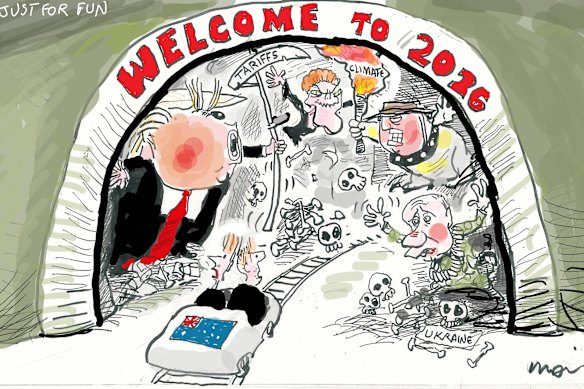
Credit: Alan Moir
In the smooth lane
I love the impact that double demerits have on driving behaviour. We are all forced to slow down, though this can be annoying when someone wants to pass you but not exceed the speed limit so they quickly pull in front of you and then slow down, often forcing you to brake to avoid a rear-end collision. My remedy is to travel five to 10km/h below the speed limit, allowing smooth traffic flow by faster cars, and also making my journey much more relaxing. Better fuel economy is another bonus. I used this technique this week on a one-day 950km return journey from Sydney to Jindabyne, pulling a heavy trailer, with a total journey time of 14 hours, including many stops for driver change and meals. The whole journey took an extra hour, but it was infinitely less tiring and I arrived home fresher than when I started, so early that my previous night’s sleep was disturbed. Perhaps double demerit points should occur more often. Peter Kamenyitzky, Copacabana
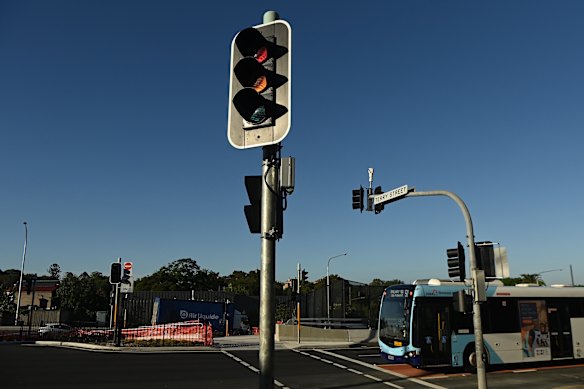
Pay attention when drivingCredit: Faifax Media
A considerable amount of money is spent every holiday session advising drivers to drive responsibly and not drink and drive, not drive under the influence of drugs or, most importantly, not speed. I feel that if police had a higher profile on our roads this would be the best deterrent. Every driver has observed how driver behaviour changes for the better if a marked police car or motorbike police officer joins traffic, or a police car is parked on the side of the road. I appreciate this is costly, but so are resources for rescue workers, ambulance and police when an accident occurs. Surely, it is cheaper to prevent rather than pay the costs involved as a consequence of speeding or irresponsible driving. Jill King, Lane Cove
Bathurst misses out
I am so glad that Sydney residents were able to enjoy the entertainment and fireworks provided by the City of Sydney to celebrate New Year’s Eve (Letters, January 2). NSW Police provided more than 2500 officers to conduct patrols. There were officers from the riot squad, PolAir, the dog squad and specialist traffic and water police officers. Extra paramedics were on duty and there was increased staffing of emergency departments. (All costs to the NSW taxpayers.) Authorities say the measures were in place to help people feel safe after the Bondi attacks. Obviously, this was successful, with only 38 arrests across Sydney, including only nine in the CBD. Meanwhile, in many regions, including Bathurst, we had no provision for public gathering and celebration. The increasing financial burden placed on councils through cost shifting by the NSW state government (eg, the emergency services contributions) has led to our New Year’s Eve Party in the Park being cancelled since 2023. This was a safe, family-based picnic event with modest fireworks at 9pm. More inequity for the people of regional NSW as we subsidise Sydney. Jane Lawrence, Bathurst
Rags to stitches
I take exception to Damien Woolnough’s assertion (“If you have a problem with thong bikinis, the problem is you”, smh.com.au, January 2) that if one is offended by thong bikinis then the problem is mine to own. As a father of daughters and my youngest, at 25, a devotee of the thong bikini, I don’t particularly like the idea of young men (and no doubt older ones too) luxuriating at the view of my daughter’s buttocks. However, I respect her choice and her self-confidence to do so. I often think that the old saying “less is more” is suitable in this instance. Less skin and more fabric can often accentuate the body’s curves more attractively than the body itself can. A well-made, well-designed and well fitting one-piece can often be a masterpiece in swimming attire. In closing, I have to say that if the guys started adopting such a fashion statement, apart from competing lifesavers, then personal outrage would reach stratospheric levels. Tony Bennett, Broke
Post haste

Anya Taylor-Joy as Emma Woodhouse, contemplating writing a letterCredit: Invision
Your correspondent’s snail mail lament (Letters, January 2) contrasts well with Jane Austen’s references to the Royal Mail of 1814 in Emma. “The post-office is a wonderful establishment!” “The regularity and despatch of it!” ... “So seldom that any negligence or blunder appears! So seldom that a letter, among the thousands that are constantly passing about the kingdom, is even carried wrong – and not one in a million, I suppose, actually lost!” ... “The public pays and must be served well.” Adams v Lindsell (1818) also suggests that our postal services were once so reliable, affordable and fast that the Postal Rule in contract law emerged. What have the British ever done for us? Ronald Elliott, Sandringham (Vic)
Mass destruction
Let’s also acknowledge the Howard government overreach for committing forces to the 2003 war in Iraq (Letters, January 2). The weapons of mass destruction intelligence was widely disputed and Labor argued that Australia should not join the war. ISIS emerged from the chaos of that war and the tragic effects of this terrorism continue. Another Howard legacy. Brian Hastings, Drummoyne
- To submit a letter to the Sydney Morning Herald, email letters@smh.com.au. Click here for tips on how to submit letters.
- The Opinion newsletter is a weekly wrap of views that will challenge, champion and inform. Sign up here.