London: Iranian security forces fired shotguns and tear gas at protesters attacking a government building on Wednesday amid escalating unrest.
Videos from Fasa, in the southern Fars province, showed armed forces shooting pellets at people outside the governorate building. The protesters could be heard chanting “death to Khamenei” – referring to Iran’s Supreme Leader, Ali Khamenei – as they climbed over walls, attempted to destroy the office’s gate and threw stones at the building.
More cities joined the protests as night fell on Wednesday (early Thursday AEDT), with shots heard in western Kuhdasht.
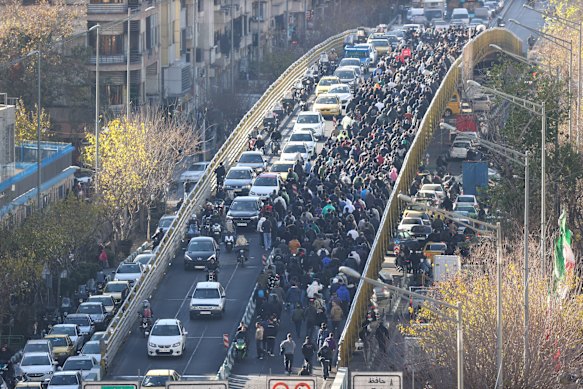
Protesters march in downtown Tehran on Monday.Credit: AP
On Tuesday, the Islamic Revolutionary Guard Corps in plain clothes trapped students who were chanting “freedom” and “death to the dictator” inside Tehran University and attacked them. It is not known how many were injured.
Roads were blockaded, shops in Tehran’s Grand Bazaar were shut, and riot police clashed with protesters outside the British embassy in scenes of mass disobedience.
Loading
The violent confrontation in Fasa is the latest in the anti-government demonstrations that have spread across multiple cities since Sunday. Officials confirmed that four people were arrested during the clashes in Fasa, and said three security personnel were injured.
The semi-official Mehr news agency reported that about 20 people, chanting anti-government slogans, stormed the building after breaking down its entrance gate. Security camera footage was being used to identify additional suspects, according to officials.
Strikes and protests over the country’s deepening economic crisis, which later spread into anti-regime demonstrations, entered their fourth day on Wednesday.
The protests erupted on Sunday in Tehran’s largest mobile phone market after Iran’s currency, the rial, plunged to a record low of 1.42 million against the US dollar – a 40 per cent decline since June.
The unrest comes at a delicate time for Iran after multiple setbacks to its regional proxy network, a brief war with Israel and the US in June, and renewed international sanctions.
The currency crisis prompted the resignation of Mohammad Reza Farzin, the central bank governor, and led shopkeepers in multiple cities to close their businesses.
By Wednesday afternoon, demonstrations had spread to at least 10 cities, including Tehran, Isfahan, Kermanshah, Shiraz and Karaj.
Merchants in Tehran’s Grand Bazaar, whose closures have historically signalled serious political trouble for Iranian governments, kept their shops shuttered.
Protests erupted in the historic Naqsh-e-Jahan Square in central Isfahan, alongside the deployment of security forces across western Kermanshah.
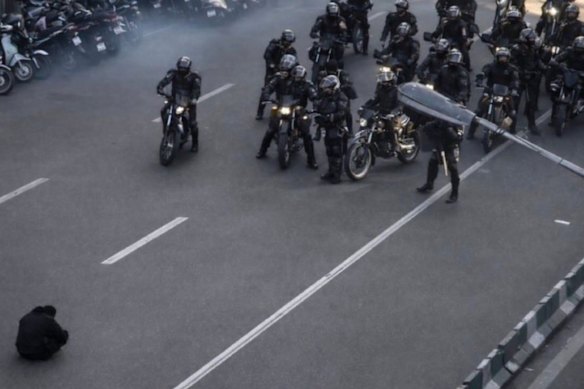
A still from video reportedly showing a protester sitting in the middle of a Tehran street, refusing to move, as security forces on motorcycles advance before beating him. The image has been likened to China’s Tiananmen Square “Tank Man”.
Residents in central Tehran reported a heavy presence of armed and masked security forces, along with water cannons, on Wednesday afternoon.
Six students detained at demonstrations at Tehran University on Tuesday have also been released, the student council said.
Iranian universities have historically served as launching points for political upheaval.
One of the first major challenges to the clerical establishment erupted at the University of Tehran in July 1999, when students protested against the closure of the reformist Salam newspaper.
Loading
In what appeared to be a response to the student demonstrations on Tuesday, Iran’s Ministry of Science, Research and Technology announced the replacement of security chiefs at three major universities in Tehran.
The ministry cited “normal management” changes as the reason. However, some media outlets reported that the dismissals of the security managers were due to their “inappropriate behaviour” towards students.
Khamenei also appointed Ahmad Vahidi as deputy commander of the Islamic Revolutionary Guard Corps (IRGC). Vahidi played a central role in suppressing the 2022 protests that followed the death of Mahsa Amini, a young woman who had been arrested for allegedly violating dress codes. Those protests resulted in several hundred deaths, including dozens of security personnel.
Vahidi is also wanted by Interpol in connection with the 1994 bombing of a Jewish community centre in Buenos Aires which killed 85 people. Under the new appointment, he is tasked with working alongside the general staff of the armed forces to enhance the IRGC’s operational readiness and advance its missions.
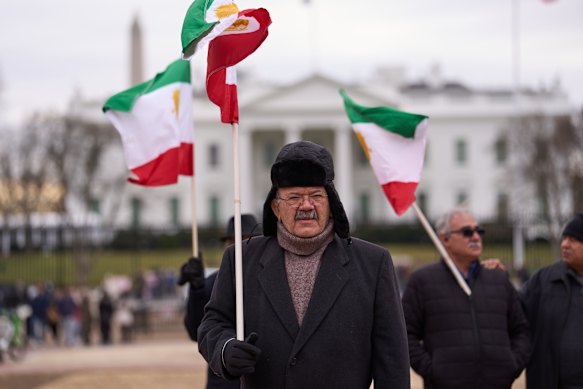
Former Iranian Olympic wrestler Moslem Eskandar-Filabi rallies with supporters of the National Council of Resistance of Iran outside the White House for regime change in Iran on Wednesday.Credit: AP
The administration of Iranian President Masoud Pezeshkian announced that all government offices, markets, schools, universities and banks would be closed for the day, citing cold weather and energy conservation needs.
The timing of the announcement, issued with one day’s notice, led to speculation that it was connected to the protests.
The capital’s Shahid Beheshti and Allameh Tabataba’i universities said classes would be held online next week for the same reason.
Fatemeh Mohajerani, a government spokesman, acknowledged the demonstrations on Tuesday, saying the government “recognises peaceful assembly rights enshrined in the Constitution” and that officials were listening to citizens’ economic concerns.
Loading
Her comments drew sharp criticism from pro-regime outlets. Hossein Shariatmadari, the editor of the conservative Kayhan newspaper, accused Mohajerani of legitimising what he characterised as foreign-backed agitation, calling the protesters “Israeli pawns”.
Iran’s prosecutor general, Mohammad Movahedi Azad, attempted to strike a middle ground on Wednesday, telling state media that “peaceful livelihood protests are part of social and understandable realities” but warning that any attempt to create insecurity would be met with a “legal, proportionate and decisive response”.
Pezeshkian appointed Abdolnasser Hemmati, a former economics minister, as the new central bank governor following Farzin’s resignation.
Loading
In March, parliament dismissed Hemmati over alleged mismanagement and claims that his policies weakened Iran’s rial against major currencies.
In his first comments after being appointed to lead the central bank, Hemmati promised to restore economic stability and vowed to fight corruption coming from multi-tier currency rates.
“We will dismantle the network of corruption and rent-seeking that results from multiple exchange rates,” he told reporters after the cabinet meeting on Wednesday.
He promised to control inflation, strengthen the currency and address bank mismanagement.
Widespread demonstrations erupted in 2019 over a sharp petrol price increase. Authorities raised fuel prices again earlier this month.