This could be Trump’s Iraq, and Americans must ask: Is it what we voted for?
SOURCE:Sydney Morning Herald|BY:Michael Koziol
Donald Trump made it clear that oil is what his Venezuelan venture is about. But it is entirely unclear how he envisages the next few days – or few years – playing out.
When it was pointed out to Donald Trump on Sunday (AEDT) that the US has a “mixed track record” when it comes to ousting dictators – which is putting it mildly – he responded in typical Trumpian fashion.
“That’s when we had different presidents, but with me that’s not true,” he said. “With me, we’ve had a perfect track record of winning. We win a lot.”
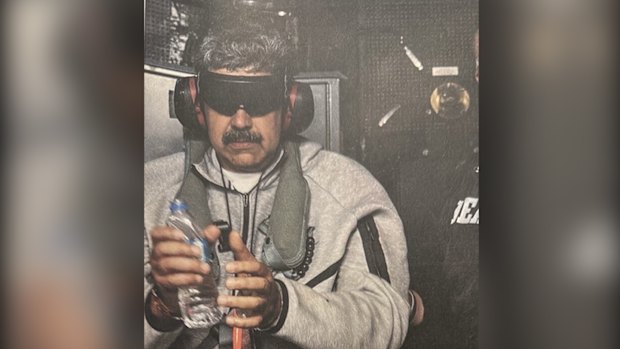
A photo posted by US President Donald Trump to Truth Social showing Venezuelan President Nicolás Maduro aboard the USS Iwo Jima.Credit: @realDonaldTrump/ Truth Social
He has a point. Trump listed examples: the death of Islamic State leader Abu Bakr al-Baghdadi; the killing of Iran’s top general, Qassem Soleimani; and, in this term, the disabling of Iran’s nuclear facilities in a daring US military operation last year. You can see why he would be confident.
But regime change is a different beast. It is something the US has done, or tried to do, only to end up locked into “forever wars” in Iraq and Afghanistan – against which public opinion soured so completely that it created the conditions for the rise of Trump himself.
Now Trump is doing regime change in Venezuela. Or, he might be. After an hour-long press conference, it was entirely unclear how Trump and his team envisage the next few days – or few years – playing out.
Let’s start with what we know. The brazen military and intelligence operation was clearly a stunning success. We heard lots of detail about how it unfolded: more than 150 aircraft launched from 20 bases; low-flying choppers guided under cover of darkness into Nicolás Maduro’s compound in the middle of Caracas, where he and his wife were captured as they tried to enter their safe room.
It was a scarcely believable display of American military might, made all the more striking by the fact Trump wasn’t even watching from the White House Situation Room; he was at his Mar-a-Lago resort in Florida. It told the world: I can do this anywhere, any time – even from my holiday home, after a day of golf.
The operation had been months in the making, before Trump even began launching lethal strikes on Venezuelan fishing boats suspected of ferrying drugs. A CIA team started compiling intel on Maduro’s habits, movements and even pets in August, and the plan was “set” in early December, said the chairman of the US’s joint military chiefs, Dan “Raizin” Caine.
Loading
And now Maduro – thug, criminal, dictator and illegitimate officeholder – is gone. That fact was applauded by world leaders as varied as Trump’s right-wing ally in Argentina, Javier Milei, and France’s Emmanuel Macron, who said the Venezuelan people could only rejoice.
But what comes next? This was where the triumphalism of Trump’s victory lap press conference gave way to almost deliberate indifference and vagueness.
“We’re going to run the country,” Trump declared, adding in his utopian style that the Venezuelan people would all be taken care of, and a great, oil-funded golden age would begin.
Asked for details about who exactly would run Venezuela, Trump shrugged, before suggesting it would probably be the people standing behind him, including Secretary of State Marco Rubio and Defence Secretary Pete Hegseth. It was no more than an afterthought.
But then we were told Rubio had actually been on the phone with Venezuela’s vice president, Rodríguez – Maduro’s deputy – and that she was sort of co-operating.
“She’s essentially willing to do what we think is necessary,” Trump said, adding (fairly) that she didn’t have much choice.
Not only that, but Trump dismissed the possibility of Venezuelan opposition leader Maria Corina Machado taking power, claiming she lacked public support or respect. That is despite her party and its candidate Edmundo González comfortably winning last year’s presidential election (which Maduro ignored).
So, consider the extraordinary circumstances here. Upon removing a despised dictator and escorting him to New York to face trial, Rubio rings up the ousted tyrant’s deputy to enrol her as a puppet leader, potentially presiding over American boots on the ground.
Rodríguez didn’t sing from that song sheet in her remarks on state television. Instead, she condemned the US’s “illegal and illegitimate kidnapping” of Maduro, demanded his immediate return and said Venezuela would not become a colony of any nation. But then again, what else could she say?
Loading
Trump never pretended his goal was to make Venezuela a democracy, and any student of US-led regime change knows that is only ever a fig leaf. When George W. Bush invaded Iraq on the pretence of removing weapons of mass destruction and spreading democracy, cynics said it was really about seizing the country’s oil reserves.
Well, Trump made it explicitly clear that oil is what his Venezuelan venture is about. While Maduro and his wife will face trial for “narco-terrorism”, American companies will be busy commandeering Venezuela’s crumbling oil infrastructure and taking over the country’s most important industry. And Trump said he was nonplussed about running Venezuela indefinitely because the oil money would ultimately pay for everything.
Trump and Hegseth say that’s what makes this operation “America First”. They’ll subdue a dangerous neighbour and reap the oily spoils, with not a drop of American blood spilled.
Delcy Rodríguez is the country’s oil and finance minister, putting her at the centre of the Venezuelan state and economy. It is possible that behind the scenes, she has done some kind of deal with the Americans to facilitate this bloodless victory.
But what would such a promise be worth? And what of all the other unknowns? What percentage of Venezuelans would stay loyal to such a puppet regime? And what of the vast networks of criminal gangs in one of the most violent countries in the world?
The prospect of the US being drawn into a war in Venezuela, or “running” it interminably, did not seem to faze the president. But it might bother many of his supporters, who, while cheering an impressive US military feat, will wonder why they are again being asked to fund and support a risky, open-ended intervention overseas.
Justin Logan, the director of defence and foreign policy studies at the libertarian Cato Institute think tank, said Americans did not sign up for a nation-building campaign in Venezuela.
“They haven’t even been asked,” he said. “[Hegseth’s] claim that the attack was about ‘the safety, security, freedom, and prosperity of the American people’ strains credulity past the breaking point.
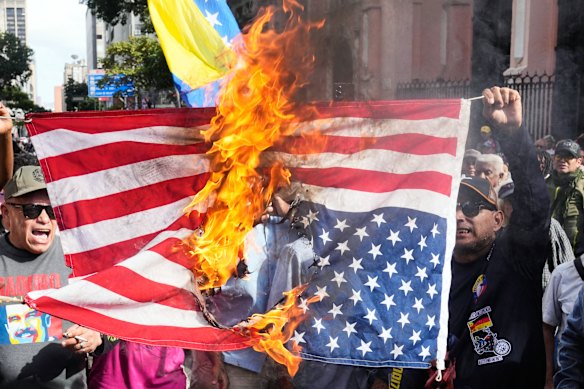
Maduro supporters burn a US flag in the Venezuelan capital, Caracas, after the US attack. Credit: AP
“We still have no answers to what ‘run Venezuela’ means, nor any clarity about who will be doing it, what it will cost, when it will end, or how it will be paid for.”
Logan said it was time for the US Congress to rein in an administration that had gone well beyond its authority.
That is something which, to date, Congress has shown little capacity to do. And Trump has stitched together a run of good fortune and chutzpah that has earned him a great deal of leeway, even from some of his doubters.
Can that last forever? History would say not. But Trump doesn’t just believe in “peace through strength” – he believes strength trumps history.