This employee quit within a week of joining: Here's how to explain a short stint in a job interview
A recent Reddit post highlighted an employee's swift departure from a new job due to misrepresented pay and inadequate training. Interviewers often probe such exits to gauge a candidate's judgment and clarity. Experts advise framing brief tenures as a mismatch discovered early, focusing on alignment rather than blame, and pivoting to future aspirations.

A new job is often supposed to buy time. Time to settle in, time to learn, time to decide whether the role fits. But for one employee who shared their experience on Reddit, that time collapsed quickly.“I quit my first job after not even a week of getting it,” the employee wrote, explaining how what was presented as a sales role with a weekly base pay of 800 turned out to be something else entirely. “The actual base pay per week was 300, not 800,” they added, saying the higher number was later framed as a commission estimate despite having asked clearly about base pay.Training, too, fell apart. The senior employee assigned to guide them was “on FaceTime all 8 hours,” they wrote, leaving them to navigate account setup and technical issues during live work hours.
“She proceeded to be completely useless for another 4 hours,” the post said. Within days, the employee walked away.
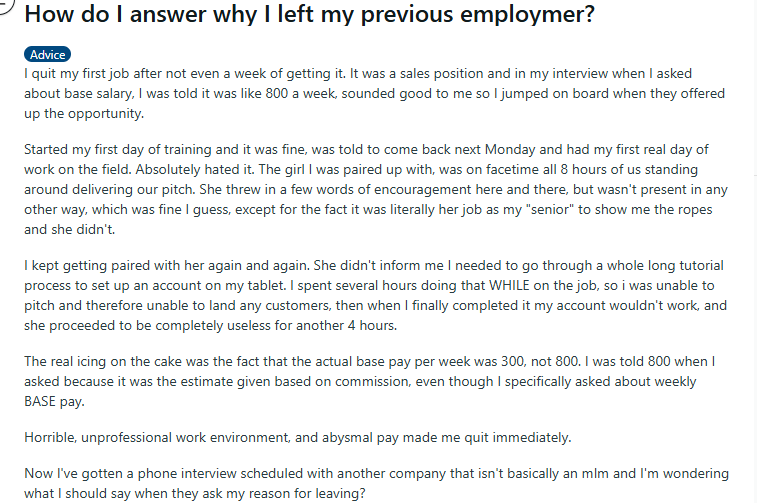
Now facing a new interview, the question looms. How do you explain leaving a job you barely started.
What interviewers are really trying to understand
The anxiety behind that question is common. Interviewers often ask why a candidate left their last role to check for patterns. Are they impulsive. Difficult to manage. Unwilling to stick things out. But hiring managers are usually listening for something simpler.
Whether the exit makes sense, and whether the candidate can explain it with clarity.The mistake many candidates make is assuming the answer needs to justify the past. In reality, it needs to show judgment in the present.
Start with honesty, but limit the frame
In cases like this, the facts matter. Misaligned pay terms. Poor onboarding. Lack of role clarity. These are legitimate reasons to leave. But honesty does not require detail. Saying “the compensation structure was different from what was communicated” is enough.
The Reddit user’s line that the environment felt “unprofessional” captures the point without turning it into a complaint.What interviewers tend to resist is not the reason itself, but the tone. Long explanations can sound defensive. Listing every failure of the previous employer shifts attention away from the candidate.Short exits call for short explanations.
Name the mismatch, not the mess
The safest way to explain a brief stint is to describe it as a mismatch discovered early.
That signals awareness, not instability. When the Reddit user says they “had no time to experience growth,” they are pointing to a lack of structure, not impatience.Framing it as “the role did not match what was discussed in the interview” keeps the focus on alignment. It avoids blame while still being truthful.