This space technology change how we manage Earth’s orbit
Space junk poses a growing threat to vital satellite services. Scientists at CU Boulder are developing an electrostatic tractor beam, a non-contact technology that gently nudges debris to de-orbit. This innovative approach, inspired by science fiction but grounded in physics, offers a safer and more efficient alternative to traditional cleanup methods, potentially revolutionizing orbital debris management.
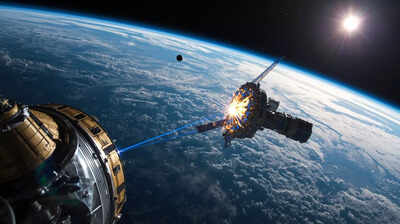
AI-generated
Some problems grow quietly, almost politely, until they stop being ignorable. Space junk is one of those. It does not announce itself from the ground, yet it circles above us every day, passing satellites, brushing past spacecraft, waiting for a mistake.
Over time, the clutter has built up. Old rocket shells, broken parts, forgotten machines. Now and then, scientists step back and ask whether the usual tools are enough. At the University of Colorado Boulder, one group began thinking less about grabbing debris and more about nudging it. Their idea sounds familiar, even playful, but the work behind it is careful and serious. A tractor beam, not from fiction, but shaped by physics, lab testing, and a concern for what comes next.
Space junk is really causing problems and risks in orbit
Earth’s orbit is not empty. Thousands of objects move through it at speeds that make even a paint chip dangerous. When debris hits something, it rarely ends there. Collisions create more fragments, which raises the risk again. This cycle worries satellite operators and space agencies alike. Navigation, weather forecasting, and communications all rely on clear paths overhead.Many cleanup ideas involve contact. Nets, harpoons, robotic arms.
They look practical on paper. In space, things behave differently. A slight miscalculation can turn a controlled grab into a violent impact. Fuel use also rises fast when spacecraft need to match the motion of debris. The margin for error is thin.
Electrostatic tractor beam: CU Boulder’s idea actually works
The University of Colorado team is testing something less direct. Their system uses electrostatic forces, created by charging objects and shaping electric fields. Instead of grabbing debris, the beam attracts it gently.
Engineers describe it as a virtual tether. Nothing touches. The force does the work slowly, steadily.A service satellite would fly close to a piece of debris. By adjusting electrical charges, it could pull the object just enough to alter its orbit. Over time, that change might send the debris toward Earth’s atmosphere, where it would burn up. The process is gradual. That is part of the appeal.
Science fiction in space research
The comparison to Star Trek is hard to avoid. Hanspeter Schaub from CU Boulder admits the link while being clear about limits.
This beam will not move planets or ships. It is narrow in purpose. That honesty matters. Fiction inspires curiosity, but physics sets boundaries.The work comes from CU Boulder’s aerospace engineering department, with support from NASA and the US Department of Defence. Researchers like Julian Hammerl focus on simulations and lab tests. They charge lightweight materials and observe how forces behave over distance.