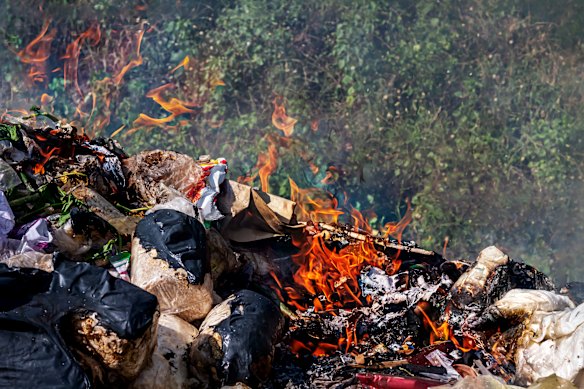
Last year, we revealed a growing crisis: poor people in city slums across the Global South are burning plastic waste to cook their food and heat their homes.
Now, for the first time, we have real-world data showing just how prevalent this dangerous practice has become.
Plastic is being burnt for fuel and food cooking across the developing world.Credit: Adobe Stock
In a comprehensive survey spanning 26 countries and involving over 1000 community informants, we’ve documented the shocking scale of this hidden health emergency.
Our findings show that burning plastic as household fuel is far more commonplace than previously thought.
Among our survey respondents – teachers, local government officials, community leaders, and researchers familiar with conditions in low-income urban communities – one in three reported awareness of plastic waste being burned as household fuel in their cities.
Perhaps most concerning: 16 per cent admitted to burning plastic themselves for various purposes, from cooking to heating to starting fires.
When we asked specifically about the prevalence of plastic burning, the responses were stark. A combined 69 per cent of informants described the practice as moderately to extremely prevalent in their cities. Just 8 per cent said it wasn’t prevalent at all.
This isn’t just about lighting fires. Among those aware of the practice, nearly half had witnessed others burning plastic as a cooking fuel, while 14 per cent had done so themselves. For heating purposes, 37 per cent had seen it and 12 per cent had engaged in it personally.
The data confirms what we suspected: this practice emerges from the collision of two crises – energy poverty and failed waste management systems.
The survey revealed significant correlations between plastic burning and both supply factors, such as massive amounts of waste generated and expensive clean fuels, and demand factors, including the need for households to self-manage waste.
Loading
Respondents in low-income countries reported higher rates of plastic burning, with particularly acute problems in Sub-Saharan Africa.
Regional differences are striking: in some areas, fuel substitution with plastic appears more widespread than in others.
The survey uncovered troubling specifics about what materials households are combusting.
Polyethylene terephthalate (PET) – the plastic in water and juice bottles – is the most frequently burned, followed by low-density polyethylene (LDPE) used in plastic bags. Both are ubiquitous in household waste.
Nearly two-thirds of respondents reported burning food wrappers, while half said chemical packaging materials like fertilizer containers and cleaning product bottles were also common fuel sources.
Even more concerning, polyvinyl chloride (PVC) – notorious for producing toxic dioxin emissions when burned – ranks among the top five plastic types being used as fuel.
The burning typically happens in traditional cooking stoves: three-stone stoves, mud stoves, and charcoal stoves are the primary devices being used.
Burning plastic releases a cocktail of toxins including dioxins, furans, and heavy metals.
These chemicals are known to cause cancer, heart disease, and lung diseases. Women and children, who typically spend more time indoors, face the highest exposure risks.
Our survey found overwhelming awareness of these dangers, yet the practice continues – because people have no other choice.
When we asked respondents why households burn plastic, the answers paint a picture of desperation and systemic failure.
The strongest agreement centred on three factors: lack of awareness about health impacts, the need to manage waste in areas without collection services, and expensive clean fuel.
Respondents were clear about which communities face the highest risks. Households in areas excluded from waste management services were identified as most likely to burn plastic, followed by those experiencing poverty and those living in informal settlements.
Households with members working as waste pickers were also perceived to be more likely to burn plastic as fuel.
Loading
For the first time, our data provides a foundation for evidence-based solutions.
Survey respondents ranked improved solid waste management services for informal settlements as the most important intervention, followed by increased access to clean energy technologies and raising awareness about the harms of plastic burning.
Importantly, regional variations suggest that one-size-fits-all solutions won’t work.
Respondents in South Asia and Southern Africa prioritised bans on plastic use, while those in Latin America emphasised waste management. In East and Central Africa, access to clean energy was seen as the most critical need.
The correlation analysis from our survey confirms that affordability is crucial.
Perceptions that waste management services and clean fuels are expensive were strongly associated with plastic burning practices.
You cannot solve plastic burning by addressing only waste management or only energy poverty. Both problems must be tackled simultaneously.
Restrictions on open burning alone could simply push the practice indoors, making the health impacts even worse.
This survey represents the first systematic documentation of plastic burning as household fuel across the Global South at this scale.
While our respondents were purposively selected for their knowledge of local conditions rather than being population-representative, their insights reveal that this practice is both widespread and deeply embedded in the daily survival strategies of millions.
More research is urgently needed to understand the full health and environmental impacts.
We need to measure emissions from different plastics burned in various stove types. We need to quantify food contamination risks. And we need to design and test integrated interventions that address both waste management and energy access.
But we also need immediate action. The data shows that expanding basic waste collection services to excluded communities and providing support to make clean cooking fuels affordable could significantly reduce this health-damaging practice.
Nobody wants to burn plastic waste to cook food.
This practice exists because people have been abandoned by systems that should serve them.
Our survey data shows the problem is real, it’s widespread, and it demands urgent attention from policymakers, development agencies, and the international community.
The question is no longer whether plastic burning in households is happening. Now it is: what are we going to do about it?
Dr Bishal Bharadwaj, from the Curtin Institute for Energy Transition, is the lead author of Prevalence of plastic waste as a household fuel in low-income communities of the Global South, along with co-authors Professor Hari Vuthaluru, from Curtin’s WA School of Mines, Dr Pramesh Dhungana, from Curtin’s School of Molecular and Life Sciences, and CIET director Professor Peta Ashworth.