Tiny bump on 7 million-year-old fossil suggests ancient ape walked upright — and might even be a human ancestor
The way Sahelanthropus tchadensis moved has long been debated. The discovery of a small bump on the front of the thigh bone is "beyond convincing" evidence this ape was bipedal.
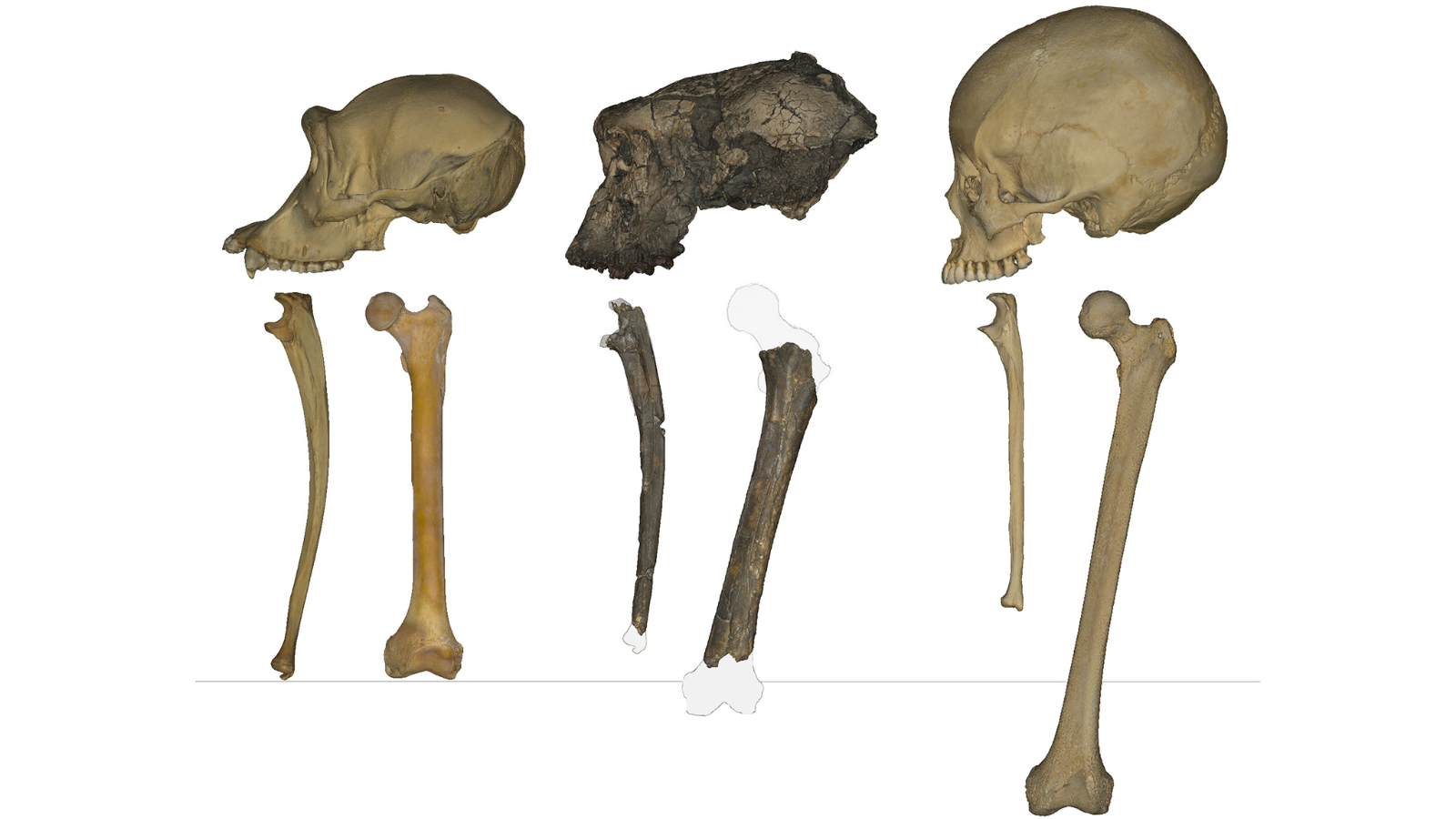
Sahelanthropus tchadensis' (center) knees and hips functioned more like humans' (right) than chimpanzees' (left). (Image credit: Williams et al, Science Advances (2026) CC-BY-4.0)
The discovery of a never-before-seen bump on the leg bone of a 7 million-year-old fossil ape shows it walked upright on two legs while it was on the ground, a new study finds.
Only members of the human lineage have this lump, called the femoral tubercle. That makes the species, Sahelanthropus tchadensis, the earliest known hominin, according to the study, published Jan. 2 in the journal Science Advances. (Hominins are the group of species, including humans, that existed after the split from chimpanzees and bonobos. Walking upright on two legs is a defining characteristic of hominins.)
The reanalysis of S. tchadensis' femur also confirmed two more human-like anatomical features. First, the bone twisted inward, placing the knees closer together than the hips, as in modern humans. Second, there was a distinct lump on the side of the fossil where the largest glute muscle attaches, which isn't found in living nonhuman apes.
S. tchadesis' curved arm bones suggest that, like modern-day chimps and bonobos, the species was adapted to climbing trees. But its hips and knees functioned like those of hominins which suggests the ape frequently walked bipedally while on the ground.
"I think it must have been on the ground a significant amount of the time in order to evolve bipedalism," Williams said.
A hotly debated fossil
Discovered in modern-day Chad, S. tchadensis was first described in 2002 and remains highly controversial. The authors of that study claimed the fossil ape was the earliest known hominin based on the position of the opening in the skull where the spinal cord attaches, called the foramen magnum. The opening was in the middle of the skull, which suggests the ape stood upright like humans do, but others argued that positioning didn't prove walked on two feet.