Tiny implant 'speaks' to the brain with LED light
By directly communicating with the brain, a new wireless device could someday help restore lost senses or manage pain without medications, its developers say.
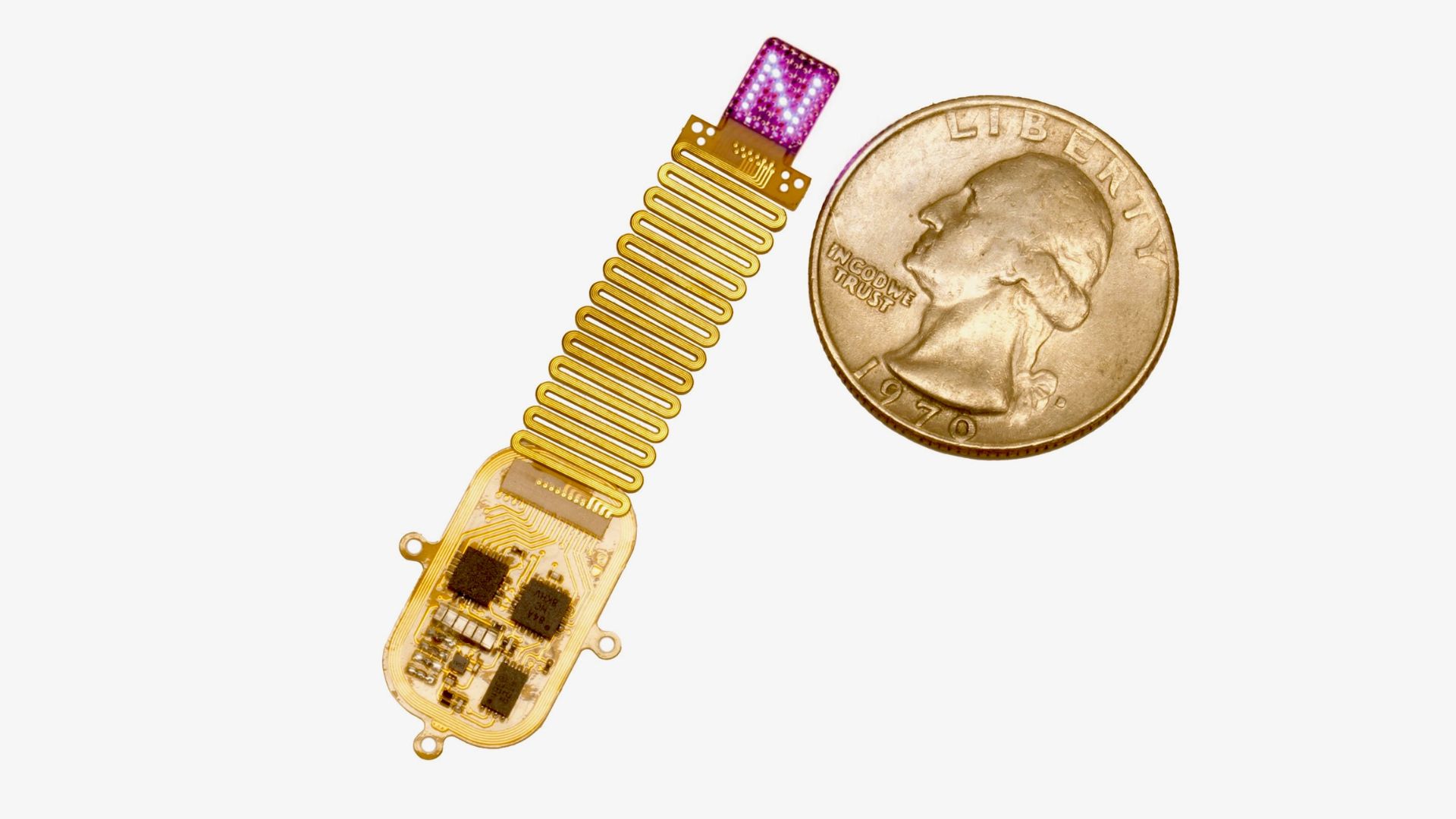
A small device (left) is designed to be implanted under the skin of the scalp and deliver LED light into the brain tissue beneath. (Image credit: Mingzheng Wu/Rogers Research Group)
A new brain-machine interface (BMI) uses light to "speak" to the brain, mouse experiments show.
The minimally invasive wireless device, which is placed under the scalp, receives inputs in the form of light patterns, which are then conveyed to genetically modified neurons in brain tissue.
In the new study, these neurons activated as if they were responding to sensory information from the mice's eyes. The mice learned to match these different patterns of brain activity to perform specific tasks — namely, to uncover the locations of tasty snacks in a series of lab experiments.
The device marks a step toward a new generation of BMIs that will be capable of receiving artificial inputs — in this case, LED light — independent of typical sensory channels the brain relies on, such as the eyes. This would help scientists build devices that interface with the brain, without requiring trailing wires or bulky external parts.
"The technology is a very powerful tool for doing fundamental research," and it could address human health challenges in the longer term, said John Rogers, a bioelectronics researcher at Northwestern University and senior author of the study, which was published Dec. 8 in the journal Nature Neuroscience.
Bypassing the sensory system
The device, which is smaller than a human index finger, is soft and flexible, so it conforms to the curvature of the skull. It includes 64 tiny LEDs, an electronic circuit that powers the lights, and a receiver antenna. Additionally, an external antenna controls the LEDs using near-field-communications (NFC) — electromagnetic fields for short-range communications as is done for contactless card payments.
The compact device is designed to be placed under the skin, rather than being implanted directly into the brain. "It projects light directly onto the brain [through the skull], and the response of the brain to that light is generated by a genetic modification in the neurons," Rogers told Live Science.
Get the world’s most fascinating discoveries delivered straight to your inbox.
Brain cells don't normally respond to light that is shone on them, so gene editing is required to make that happen.
"The genetic modification creates light-sensitive ion channels," Rogers explained. When activated by light, these channels allow charged particles to flow into brain cells, tripping a signal that then gets sent to other cells. "Through that mechanism, we create light sensitivity directly in the brain tissue itself," he said. The genetic modification of the brain cells was done using a viral vector, a harmless virus made to deliver the desired genetic tweak into specific cells in different regions of the brain.