To make sense of the Venezuela attack, look to the hotter heads around Trump
Perhaps the key to the Venezuela puzzle is to remember that Trump’s administration is made up of divergent factions. When it acts it is because one has prevailed, or the factions have agreed.
Opinion
January 9, 2026 — 5.00am
January 9, 2026 — 5.00am
What exactly is this? It’s not regime change because, having unleashed a military raid to snatch Venezuela’s president from his bed, US President Donald Trump has left the rest of the regime in place. Nicolás Maduro’s deputy, Delcy Rodriguez, has inherited the presidency, just as Maduro did from Hugo Chavez, and the Venezuelan government remains Chavistas all the way down. And whatever Trump means when he asserts the US is now “running” the country, he apparently envisages no transition to democracy.
Not only has he barely mentioned democracy during this episode, he has dismissed the opposition leader, (and Nobel Peace Prize winner) Maria Corina Machado as someone who “doesn’t have the support within or the respect within the country”. This despite the fact her approved candidate handsomely won the 2024 election which Maduro immediately stole.
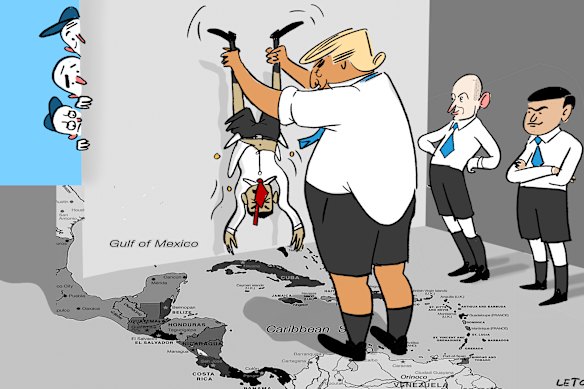
Illustration by Simon Letch
This doesn’t make much sense as a war on drugs, either. America’s current crisis is with fentanyl, and Venezuela does cocaine. Even in this, it is something of a minnow, well behind Colombia. And even then the Venezuelan boats carrying drugs through the Caribbean, some of which the US has been bombing since September, are mostly bound for Europe, not America. Meanwhile, Trump has gone out of his way to pardon the former Honduran president, Juan Orlando Hernandez, whom a US court convicted and sentenced to 45 years in prison on similar drug-trafficking charges to the ones Maduro now faces.
Oil? Trump has bluntly threatened Venezuela with further military strikes if it fails to give American companies “total access” to its oil industry, from which Chavez’s nationalisation program effectively excluded them. Now he has announced that Venezuela will “turn over” 30 to 50 million barrels of oil to the US. It’s true that Venezuelan oil is useful to America, because its heavy crude is the perfect type for American refineries, which currently import it from the Gulf states via a pipeline from Canada. Adding Venezuelan oil could be very useful for Trump’s reindustrialisation agenda.
But the shoe doesn’t quite fit as comfortably as all this implies. Partly that’s because oil is now cheap. It’s far from clear American companies are keen to pour the huge investment into Venezuela required to resuscitate its slumped industry, in an unpredictable environment, for potentially very little profit. But mostly it’s because Maduro had already in which American companies would be given access to all oil and gold projects and get preferential treatment for contracts. Maduro even offered to switch oil exports from China to the US, and reduce Venezuela’s energy and mining contracts with China, Iran and Russia. The Trump administration rejected this, cut off diplomatic ties, and ultimately bombed Venezuela. It wanted to do this.