Trump has just sacked 30 ambassadors. The consequences for Australia are profound
In the past year, we have seen a wholesale change in how American power works, and these ambassadorial changes are an emblem of the president’s foreign policy.
Opinion
December 31, 2025 — 5.00am
December 31, 2025 — 5.00am
Earlier this month, amid a slew of other news and on the same day as a botched release of comically almost-redacted files from the Epstein case, Donald Trump fired about 30 ambassadors who had been appointed under Joe Biden.
These are career diplomats, people whose work spanned multiple presidencies, including Trump’s first term. Their mission is to represent the interests and people of the United States in difficult and contentious environments around the world, often unstable nations in Africa and Asia. They serve for a couple of years before being reassigned in short terms designed to ensure that diplomats continue to see themselves as servants of the American people rather than long-term residents of their host nations.
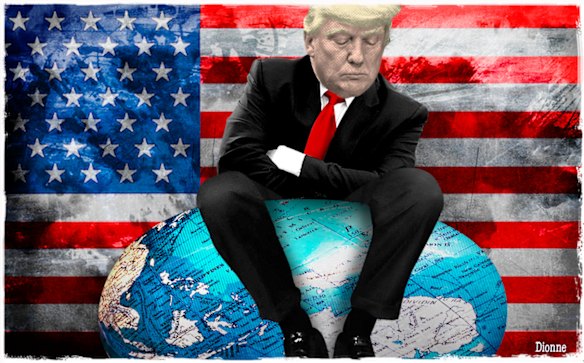
Illustration by Dionne Gain
They are distinct from politically appointed ambassadors, who the president chooses. Each president nominates about 40 countries to which they send politically appointed ambassadors, who are usually friends of or donors to the president. They are usually sent to nations that are key US allies, such as major European nations and countries such as Australia, where former president Biden appointed Caroline Kennedy, daughter of president John F. Kennedy, to serve as ambassador in Canberra. There are also the caricatured examples of holiday destinations, such as sending former NFL star Herschel Walker to be the ambassador to the Bahamas.
Trump may replace the 30 career ambassadors he sacked with politically appointed ambassadors, who generally don’t have the experience to navigate the delicate path of diplomacy in complex environments. Or he won’t replace them at all.
This is because, in Trump’s view, the geopolitical network of the 21st century is fundamentally and irreparably broken. The bloody conflicts and decades-long entanglements of the modern American empire are, in his version, the result of an overcomplicated system. Trump’s actions suggest he sees the possibility only of individual relationships in the ruins of postwar institutions that have collapsed under their own weight in a world where leaders can speak to each other directly. We’ve seen this in his flashy summits with Volodymyr Zelensky, Vladimir Putin and Xi Jinping, and the hosting of plenty of other leaders at Mar-a-Lago.