Little now remains of the moral and legal order that we used to call the West.
Loading
It would take a decade and tens of billions of dollars to restore output to 3 million barrels a day, the rate of the early 2000s, and at least $US100 billion ($150 billion) to extract serious volumes from the Orinoco – where Sir Walter Raleigh came to grief chasing the fool’s mirage of El Dorado in 1618.
The share prices of Chevron, Exxon and ConocoPhillips have soared on the prospects of windfall profit.
Investors might wish to think about the 6 million Glock 17, Beretta 92 and other handguns at large in the country, and the protection fee that the paramilitary “colectivos” armed with Russian AK-103 assault rifles will exact to let a single barrel move.
One is reminded of Che Guevara, a young Argentine doctor working in Guatemala in 1954 when the CIA toppled a left-wing government as a favour for the United Fruit Company and its well-connected US stockholders. Five years later, Che helped lead the Cuban revolution.
Ten years later, there were rural guerilla or urban warfare movements in seven Latin American countries – all with an anti-US flavour – soon to be followed by the Acao Libertadora Nacional in Brazil and the Montoneros in Argentina. Big provocations have a long tail of consequences.
But that is not the message Trump wishes to send. A darker picture is emerging of a joint venture in which Trump retains – props up? – the leftist Chavista kleptocracy, decapitating Nicolás Maduro but otherwise keeping its machinery of block captains, food control and police state repression.
“This is a far cry from the ‘Iraq 2003’ agenda of full-scale invasion and occupation for the sake of democratising regime change,” said Christopher Granville, from macroeconomic research firm TS Lombard.
The commodity grab in Venezuela is not disguised. It is openly and triumphantly proclaimed.
He thinks the Trump model is more like the historical tributary system of imperial China.
The interior minister and Chavista “No. 2″, Diosdado Cabello, is still in place and still running the , even though he has a $US15 million US bounty on his head and is listed on the same New York indictment as Maduro.
Cabello is rounding up dissidents and journalists as I write. His security forces dressed in balaclavas have set up checkpoints across Caracas, randomly examining mobile phones to catch anybody who dared to celebrate the US attack.
The litmus test is what now happens to this unloveable gentleman, who was out on the streets this week breathing defiance. “These rats attacked, and they are going to regret it for the rest of their lives,” he said.
Loading
Marco Rubio, the US secretary of state, brushed aside the awkward matter of the Chavista interior and defence ministers with an admission that Trump lacks a congressional mandate and the sustained public backing to finish the job.
“They’re already complaining about this one operation. Imagine the howls we would have from everybody else if we actually had to go and stay there four days to capture four other people. We got the top priority,” he said.
Trump aims to work with Delcy Rodríguez, the regime’s vice president and pliable stand-in leader, while also threatening to destroy her if she refuses to do his bidding.
“If she doesn’t do what’s right, she’s going to pay a very big price, probably bigger than Maduro,” he said.
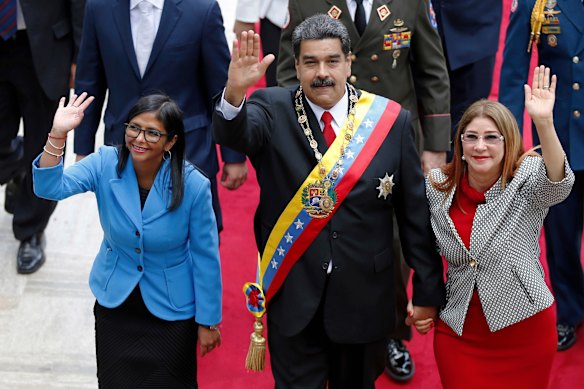
Nicolás Maduro with Vice President Delcy Rodríguez (left) and first lady Cilia Flores, in 2018. Rodriguez is now in his chair, and Trump expects her to do his bidding.Credit: AP
Not that Trump stuck to his side of that shameful and misnamed “deal” – pocketing the concession and then pushing his pro-Kremlin demands even further.
Trump has long had a covetous eye for other people’s stuff. He excoriated George W. Bush for failing to “take the oil” in Iraq after the second Gulf War, as if the only point of war is to steal things.
The commodity grab in Venezuela is not disguised. It is openly and triumphantly proclaimed. Trump wants us to know that he recognises no legal constraint and will do as he pleases.
That is the iron-fist message he is sending, uncontaminated by romantic infantilism about Venezuelan democracy.
Perhaps one can search too hard for a Trumpian masterplan. “There are no grand designs, just vanity and vindictiveness,” says Bill Kristol, a “Lincoln” Republican and founder of political website The Bulwark.
He invokes Rudyard Kipling’s poem Recessional on British imperial hubris in the late 1890s, a warning to a nation drunk with power and prone to “frantic boast and foolish word”.
Loading
The Venezuela escapade is not entirely about oil. It is also about asserting the Monroe Doctrine, in caricature form and as an end in itself, although I doubt that the authors of Trump’s National Security Strategy (NSS) have read the original speech by president James Monroe in 1823, or understand its purpose, or know that it was enforced for most of 19th century by Britain’s Royal Navy acting in concert with America.
Monroe wanted a compact between the US and Europe to manage transatlantic rivalries: Europe would stop further colonisation and meddling in the Western hemisphere; the US would respect existing European colonies in the New World and agree not to foment revolution on European soil.
Trump is violating both of Monroe’s pledges: his NSS paper declares ideological war against Europe’s liberal democracies, with the stated goal of “cultivating resistance to Europe’s current trajectory within European nations”.
He is turning the screws yet further on the Danish crown territory of Greenland, alleging that it is surrounded by Russian and Chinese warships.
“We do need Greenland, absolutely: we need it for defence,” he told The Atlantic over the weekend. The Donroe Doctrine indeed.
Nevertheless, the Venezuela attack is chiefly about the control of 300 billion barrels of putative oil reserves – more than Saudi Arabia – and three-quarters of South America’s gas reserves.
For this, Trump says he is willing to launch a second, larger attack and to put “boots on the ground”, for this one objective and for no other. “We’re going to have a presence in Venezuela as it pertains to oil,” he said.
If, by some miracle, Trump does succeed in setting off a US-run boom in the Orinoco belt, it might eventually threaten the Canadian oil sands industry, since it produces similar heavy oil.
Venezuela would have an edge from closer access to the sea and a warmer climate, making it easier to extract the viscous tar-like crude.
Loading
But it would not give the US a dominant hold over global energy supply and the world economy, as some old men seem to think, for the simple reason that much of East Asia is moving beyond oil and because the “oil-intensity” of global GDP is in any case collapsing.
The share of electric cars and plug-in hybrids reached 53 per cent in November. This pattern is fast being replicated even in long-haul trucks.
China is set on a course to eliminate all dependency on seaborne oil and gas supplies at a breakneck pace and for strategic reasons.
In the process, it has driven down the cost of EVs to levels that wipe out fossil-fuelled rivals in any open market – almost anywhere in the world.
Theodore Roosevelt’s policy in Latin America was to “speak softly but carry a big stick”. Trump’s policy is to shout incessantly.
Sales reached 51 per cent in Singapore in November and well over 40 per cent in Vietnam. Thailand is fast becoming an EV production hub for South East Asia, with output up 20-fold in a year.
Europe is tapping the brakes behind a wall of tariff protection, but sales of pure petrol cars have continued to slide nevertheless, falling from 46 per cent to 36 per cent in the 11 months to November compared with a year earlier.
This is what Trump and his MAGA pirates are up against in Venezuela, and more broadly in their anachronistic, pre-modern view of how the world works.
Loading
To the extent that the Orinoco ever produces serious oil, it will add barrels to a structurally saturated market and will in the end cannibalise US shale on home ground.
Trump has attacked a country for a mess of pottage. He wants to plunder economically marginal wetlands best left to crocodiles, anacondas and capybara water rats, but can’t even pluck up the nerve to secure the intended booty.
Theodore Roosevelt’s policy in Latin America was to “speak softly but carry a big stick”.
Trump’s policy is to shout incessantly, while seeking to coerce from the distance of an offshore naval armada badly needed for genuine strategic tasks elsewhere – and just wait to see what happens in Venezuela once another crisis appears.
We have all woken to a different world. It is not one in which American power and prestige are in any way enhanced.