Trump’s $1.5 trillion military budget would add $5.8 trillion to the national debt, with interest, CRFB says
Meanwhile, the Peterson Foundation updated its projection: the U.S. would be spending more on defense than the next 35 countries combined.
A sudden proposal on social media from President Donald Trump to increase U.S. military spending to $1.5 trillion for Fiscal Year 2027 is facing severe scrutiny from fiscal watchdogs, who warn the move would pile on massive liabilities to the federal ledger. According to an analysis released Wednesday by the Committee for a Responsible Federal Budget (CRFB), the president’s plan would add $5.8 trillion to the national debt over the next decade, once interest costs are factored in.
The seeming policy change stems from a post on Truth Social, where President Trump called for increasing the defense budget to $1.5 trillion, a significant jump from the $1 trillion level he had previously signaled he would propose. While the administration argues that aggressive trade policies will offset these costs, budget analysts suggest the math does not add up—or piles even more onto the large and growing $38 trillion national debt.
Tariffs falling short of spending targets
President Trump has justified the proposed expenditure by pointing to the “tremendous numbers being produced by Tariffs.” He has asserted that these funds would be sufficient to finance the expansion toward a “Dream Military,” still reduce the federal deficit, and even “pay a substantial dividend to moderate income Patriots within our Country!” Here, he seemed to refer to his $2,000-per-person tariff dividend idea, which has failed to gain traction in Congress. In a November 2025 analysis, the CRFB found that it alone would cost twice as much as the tariff revenue coming in at that point.
The CRFB’s preliminary estimates of the increased military budget paint a starkly different fiscal picture than what Trump promises. The nonpartisan budget watchdog projects that the proposed hike would increase defense spending by $5 trillion through 2035. Even when accounting for tariff income, the spending increase is projected to be “far larger” and “about twice as large as expected tariff revenue.”
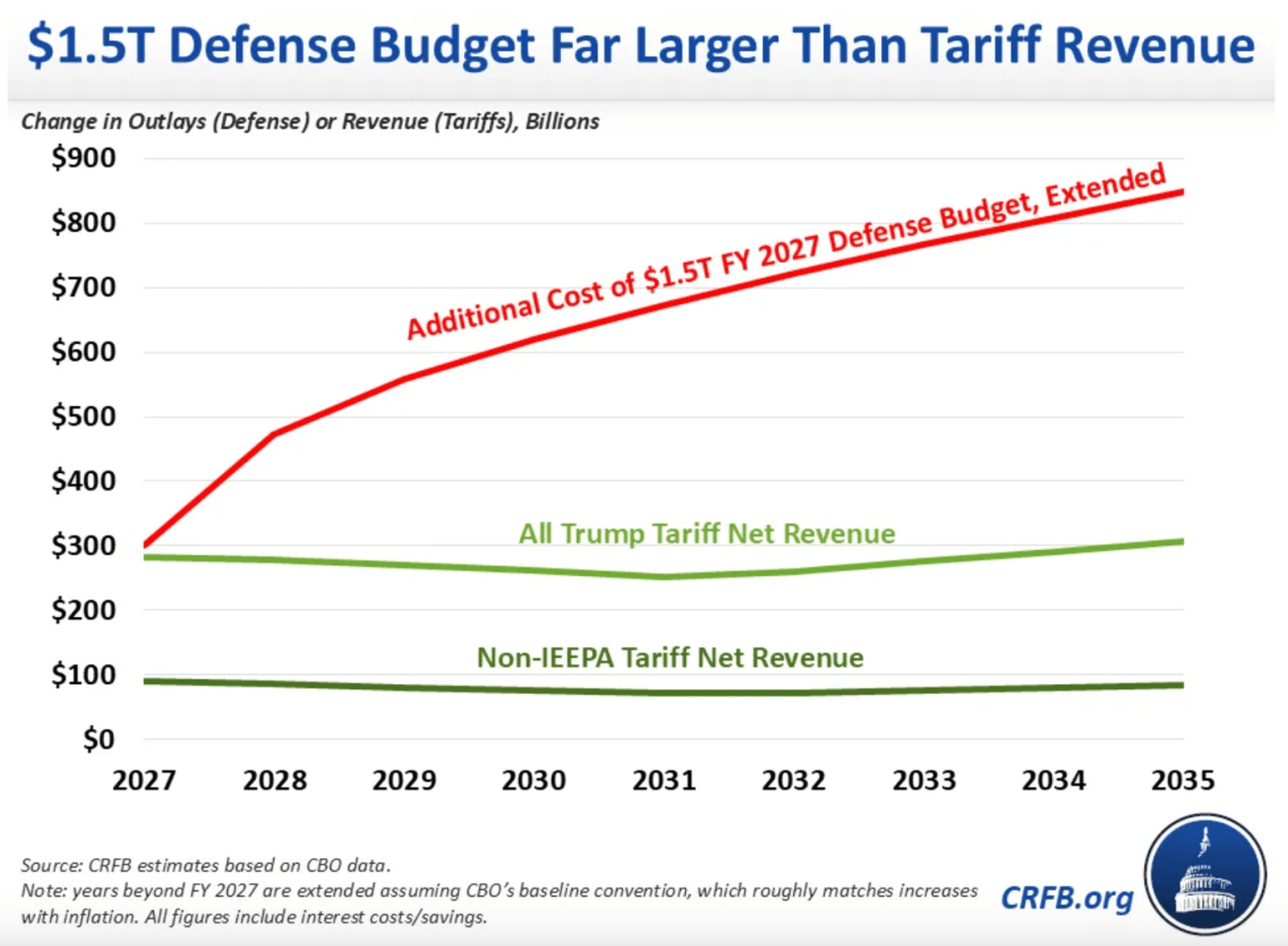
The CRFB cites recent projections from the Congressional Budget Office (CBO) that current tariffs will raise approximately $2.5 trillion through 2035, or roughly $3 trillion when interest savings are included. This leaves a multitrillion-dollar gap between the revenue the President is banking on and the price tag of his military ambitions.
Another budget watchdog, the Peter G. Peterson Foundation, had previously calculated that the U.S. government spends more on defense than the next nine countries combined. Based on the most current available data, the foundation said in a statement to that this new suggestion would dramatically increase that gap. Viewed from the top down, the foundation said, a $1.5 trillion U.S. military budget would exceed the combined military expenditures of the next 35 highest-spending countries. And starting from the bottom up, a $1.5 trillion U.S. military budget would exceed the military expenditures of every other nation combined except for China.