Trump’s Golden Fleet’s battleship unlikely to set sail
The US president has named a proposed new vessel after himself.
Editorial
December 28, 2025 — 3.34pm
The US Great White Fleet sailed into Sydney Harbour in August 1908 and virtually the entire city turned out to greet the ships. There were parades, balls and parties as we fell for the first time under America’s beguiling sense of power.
The fleet had circumnavigated the globe to trumpet the US’s arrival as a world naval power and now president Donald Trump plans to set to sea in Theodore Roosevelt’s wake.
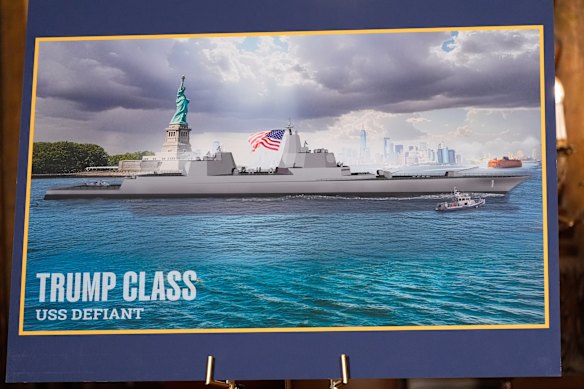
What the planned new Trump-class warship should look like - if all goes to planCredit: AP
Trump has announced that the US will commission a new series of heavily armed “battleships” named after himself, as part of a revamped “Golden Fleet” aimed at expanding the US Navy to catch up with China. “They’ll help maintain American military supremacy, revive the American shipbuilding industry and inspire fear in America’s enemies all over the world,” Trump said.
He boasted the new class of warships would be 100 times more powerful than previous battleships and larger than any other surface combatant on the oceans. He criticised current warships as ugly, apparently unaware that their designs reflect radar and he has mooted aesthetics as a criterion for US Navy design teams.
Long fascinated with battleships, Trump was unable to resist his passion for branding himself on favourite projects. However, dubbing the new ships “Trump class” breaks naming conventions, including not naming ships after living persons.
Loading
But he had to float something big to create the impression that both American industry and military were poised to regain hegemony on the high seas.
The US has faded considerably as a maritime power since the 1940s and although there were fits at rebuilding, the fleet has languished and now numbers some 300 vessels. For the first time in living memory, the US faces a serious competitor for naval dominance in the form of the People’s Republic of China. Beijing moved to fill the void and, with some 400 ships, the Chinese navy is now the biggest in the world. Not only that, about 60 per cent of worldwide orders now go to China’s shipyards.
But the Trump class battleship has a major credibility problem.
The ship will take years to design; it will cost an estimated $US13.4 billion each to build; and it flouts the US Navy’s new concept of operations: high-speed missiles, drones – above, on and under the water – alongside advanced sensors and communication. Nearly all modern naval doctrine and thinking is heading in the direction of dispersal over concentration.
Battleships grew out of the days of sail, when concentration was good and bigger ships were powerful enough to stand in the line of battle during a major fleet action. With their massive armour and big guns, they remained on duty for three centuries, until the end of the Cold War turned speed and dexterity into more potent weapons.
Trump’s vainglorious need to dwell in the past of his childhood days has impressed few outside his circle of friends. The economic and logistical challenges and the diversion of money from the development of more effective ships has convinced most naval experts that his ship will never sail.