Turner and Constable Face Off in London
Is there any real rivalry in Tate Britain’s Turner & Constable: Rivals & Originals, or is it a PR exercise to lure us through the door?
Is there any real rivalry in Tate Britain’s Turner & Constable: Rivals & Originals, or is it a PR exercise to lure us through the door?

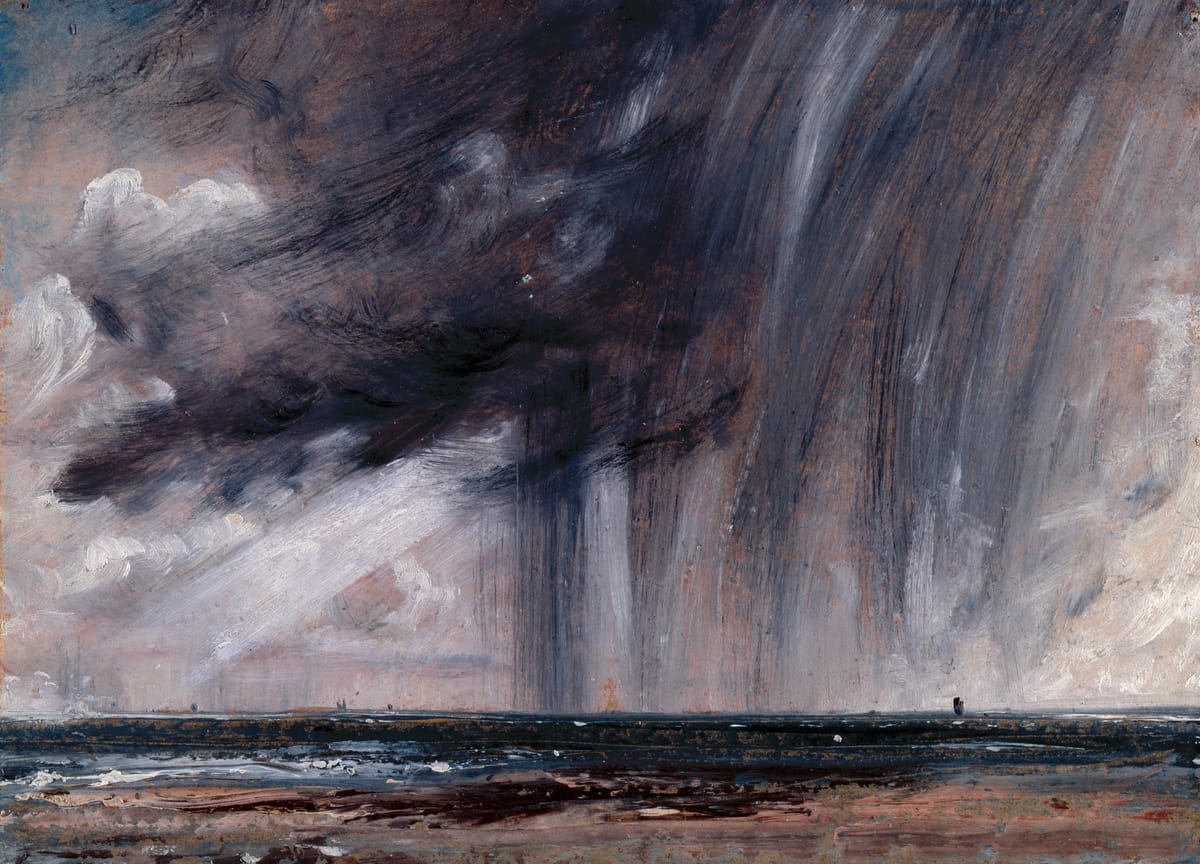
John Constable, "Rainstorm over the Sea" (c. 1824–28) (© Photo Royal Academy of Art, photo by John Hammond)
LONDON — Is the suggestion of competition in the title of Turner & Constable: Rivals & Originals at Tate Britain intended to get the juices flowing? Is there any truth in it? Or is it a crude PR exercise to lure us through the door?
The show is enormous — 12 galleries in all. Turner and Constable seem to define between them much about the nature of art in England at the turn of the 19th century. The soaring sublimity of J.M.W. Turner (the triple rat-a-tat of those abbreviated initials seems to give the name added gravitas) is set against the paintings of the humbler-sounding John Constable, a gentler seeker of some authentic representation of Dedham Vale and the Stour Valley in rural England. Though Constable strayed from this landscape into which he was born, he also circled and circled it lifelong. It was his heart’s home, inexhaustible as source material.
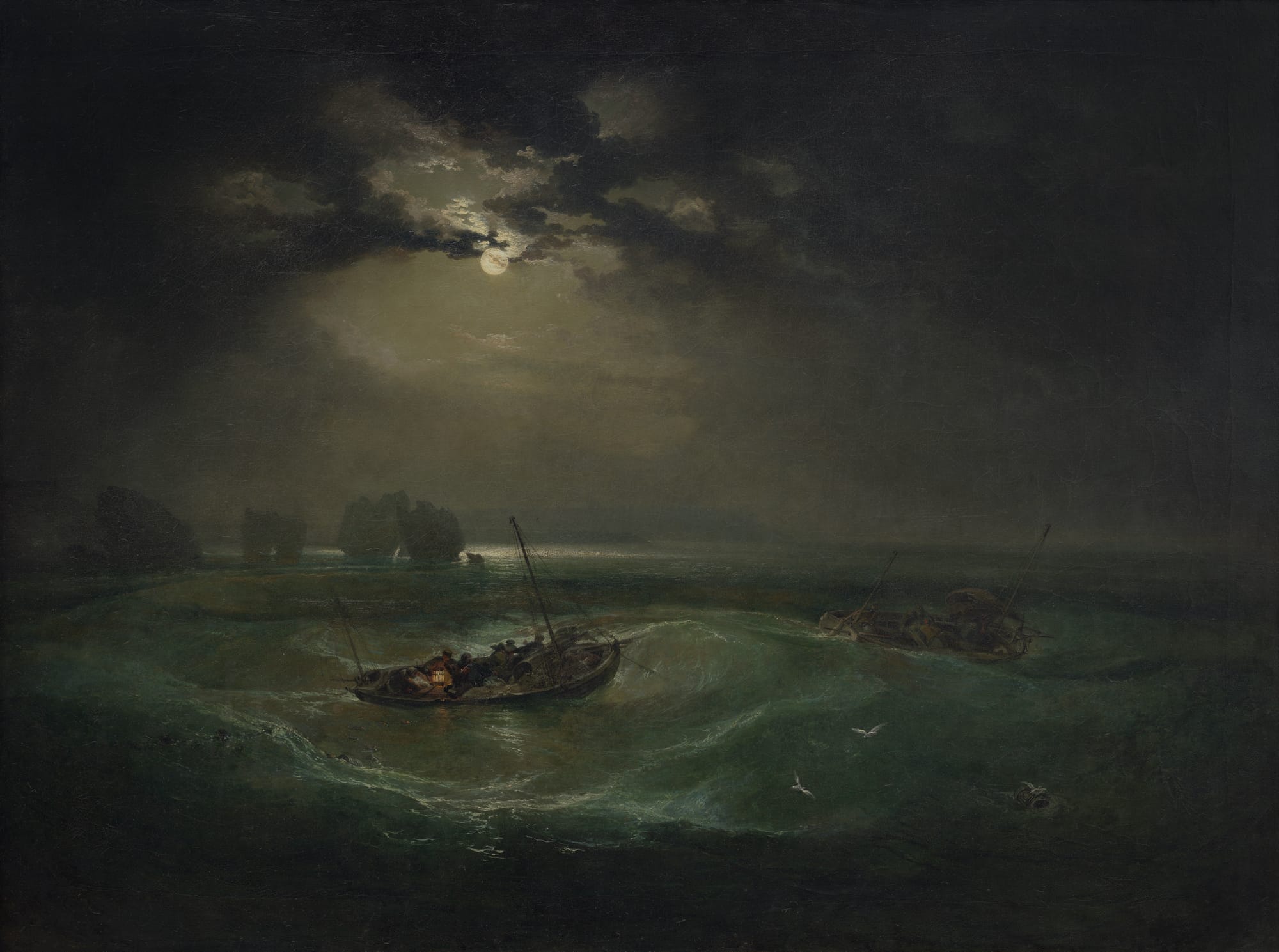
J.M.W. Turner, "Fishermen at Sea" (exhibited 1796) (image courtesy Tate)
Turner had no such place. He was a gadabout, forever thirsting after the shockingly new, but with a passion for recreating scenes of antiquity too. As a young man he was eager to bolt on his wings and fly like a giddy Leonardo: into Europe, for example, to record Alpine scenes of awe-inspiring drama — chasms, soarings! Unfortunately, his efforts to actually get there were often bedeviled by the bloody antics of Napoleon, whose nasty wars dragged on for decades.
What else defines their similarities and differences? They were both born within a year of each other (Turner in 1775 and Constable in 1776). Turner was a Londoner, the son of a barber from the East End, Constable the scion of a mill owner in rural Essex who also had a shipping business. Turner became successful at a much younger age. One of the markers of that success was his acceptance by the Royal Academy; he was elected a full academician in 1802 at just 27 years old. Constable became one in 1829, at the age of 52. Turner disseminated his works more widely, too, through prints. About 900 prints are known by him, 57 by Constable. And what of their characters?
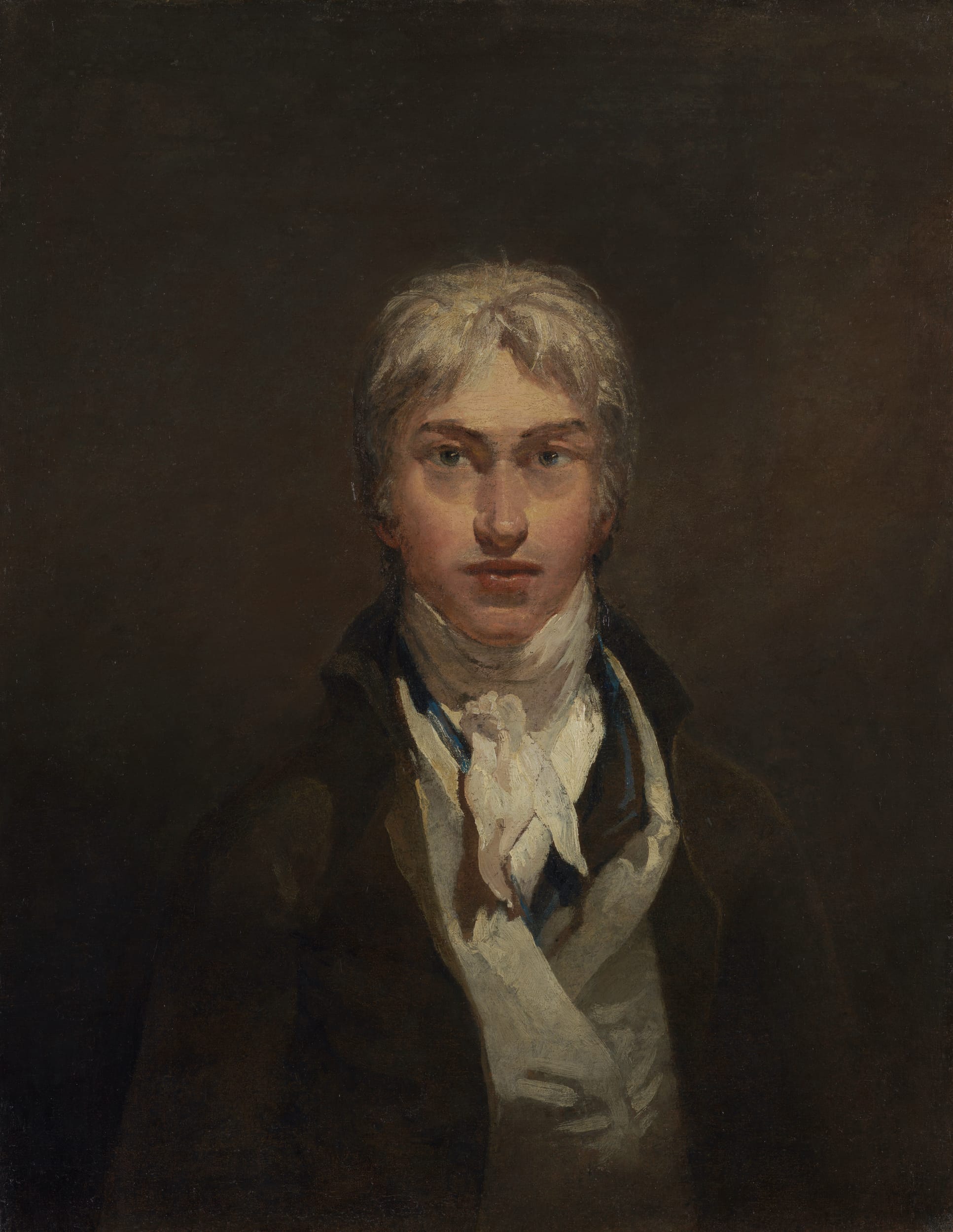
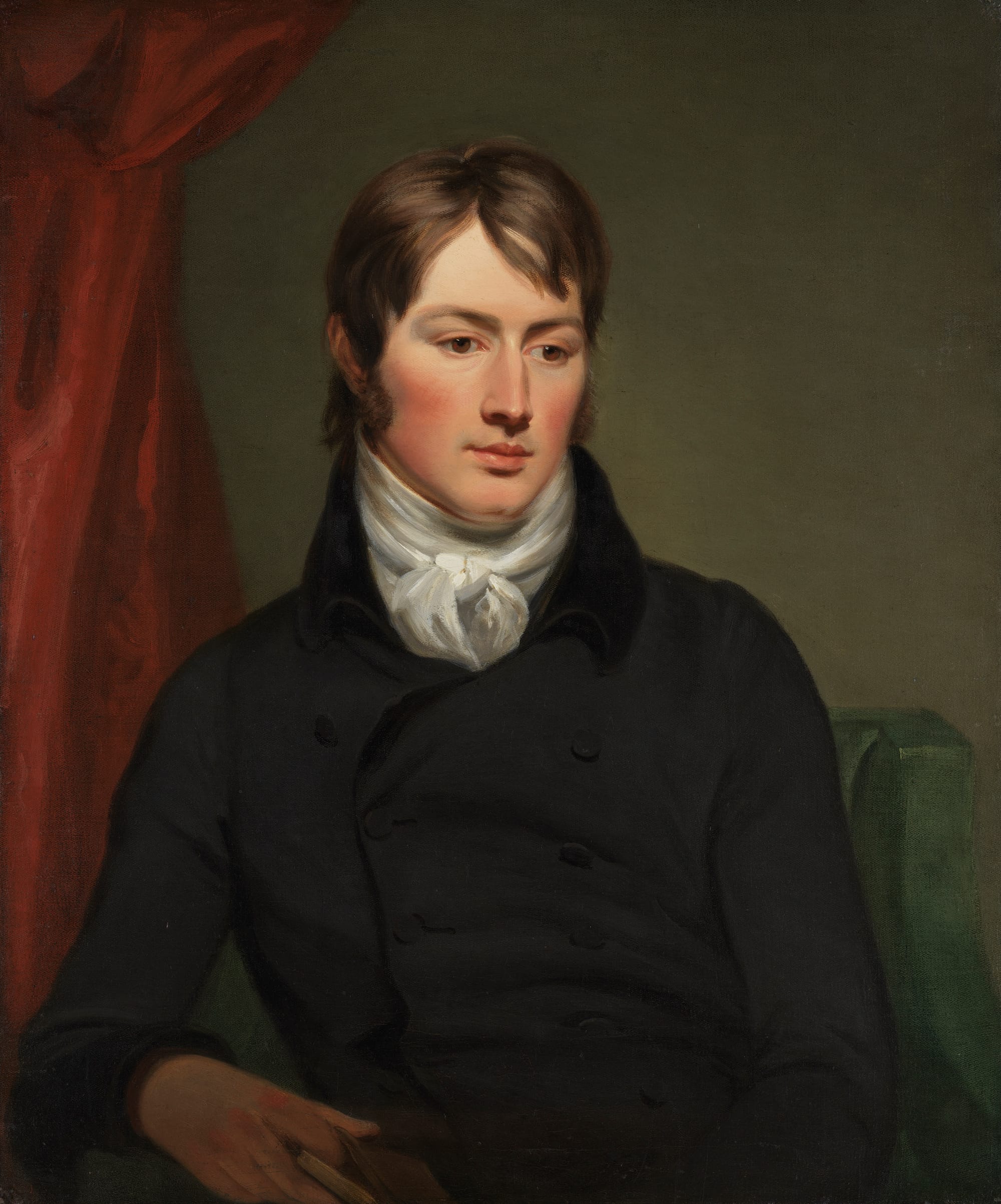
Left: J.M.W. Turner, "Self Portrait" (c. 1799) (image courtesy Tate); right: Ramsay Richard Reinagle, "John Constable" (c. 1799) (© National Portrait Gallery, London)
One of the best ways to appraise their differences of character is to look at the two youthful portraits that are on display in Gallery One. How would you wish to show yourself off? Turner painted himself as more raffish, more devil-may-care, more greedily ambitious. The look is fiercely concentrated. He has an animal’s instincts, ever at the ready.
Constable’s face appears so smooth by comparison. Prosperity is in this look, more than a hint of entitlement, but also a degree of shy self-awareness, and even of self-absorption. A bit of an earnest contemplative at heart, but a fairly steely one. His father wanted him to take over the family business. He pushed back. In contrast, Turner’s father hung his lad’s paintings up in the barber’s shop for all the world of his customers to see.
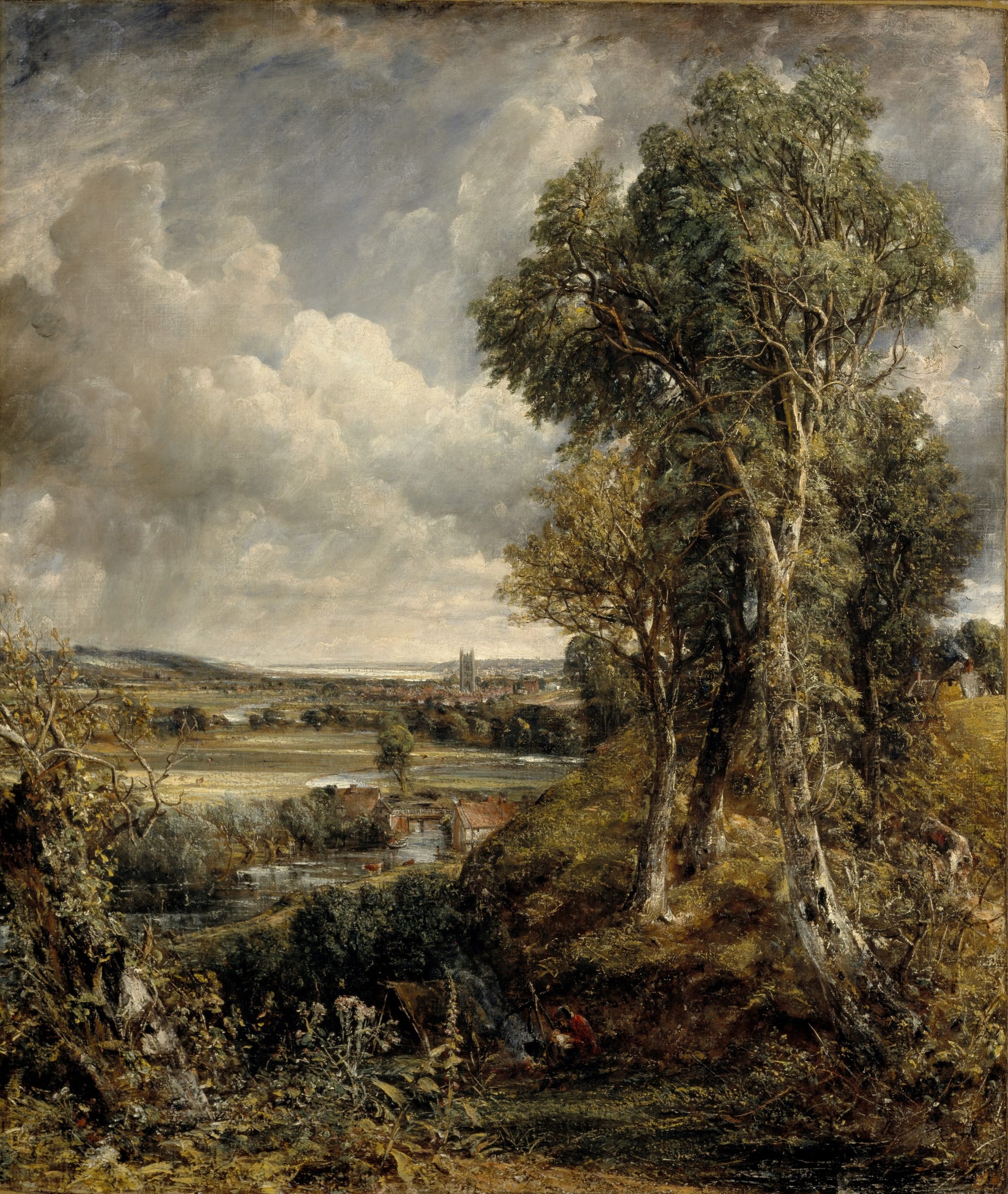
John Constable, "Dedham Vale__"__ (1828) (© National Galleries of Scotland, purchased with the aid of The Cowan Smith Bequest and Art Fund, 1944. Photo by Antonia Reeve)
In time, Constable recognized that one of the impediments to success and greater public recognition was that his paintings were not big enough. Turner never had such problems: The larger, the more emotionally overwhelming — he wanted the onlooker to weep with joy. So Constable scaled up, dramatically. He had to find a new studio space in London to accommodate his six-footers. That’s how he thought of them, matter of factly. It was a commercial decision. And, yes, he had Turner in his sights.
These six-footers were of two sorts: canvases that he regarded as the finished thing, and preparatory oil-sketches. (What a size to be sketching at though!) Hindsight views these sketches, these hectically brush-worked, provisional notions, with enthusiasm. They seem to possess tremendous energy, to be capturing a talent working at a fever pitch, a country scene where horses leap thunderously, showering mud as they go. Constable's decision to size up meant that he was entering territory once dominated by the likes of Turner, who was always more than a bit of a showman — on Varnishing Day at the Royal Academy, he had a habit of striding up to one of his paintings and, with tremendous flourish, adding a bit more.
So when Constable showed off his great painting — in size and impact — of Salisbury Cathedral from the meadows, the two men were fighting in the same ring at last. Unfortunately for Constable, the man who had commissioned the painting, the imperiously godly Bishop of Salisbury, took exception to the sky. Why were the clouds louring so? Couldn’t it be sunny? The battle between the man with the money and the artist with the singular vision had begun, in earnest.
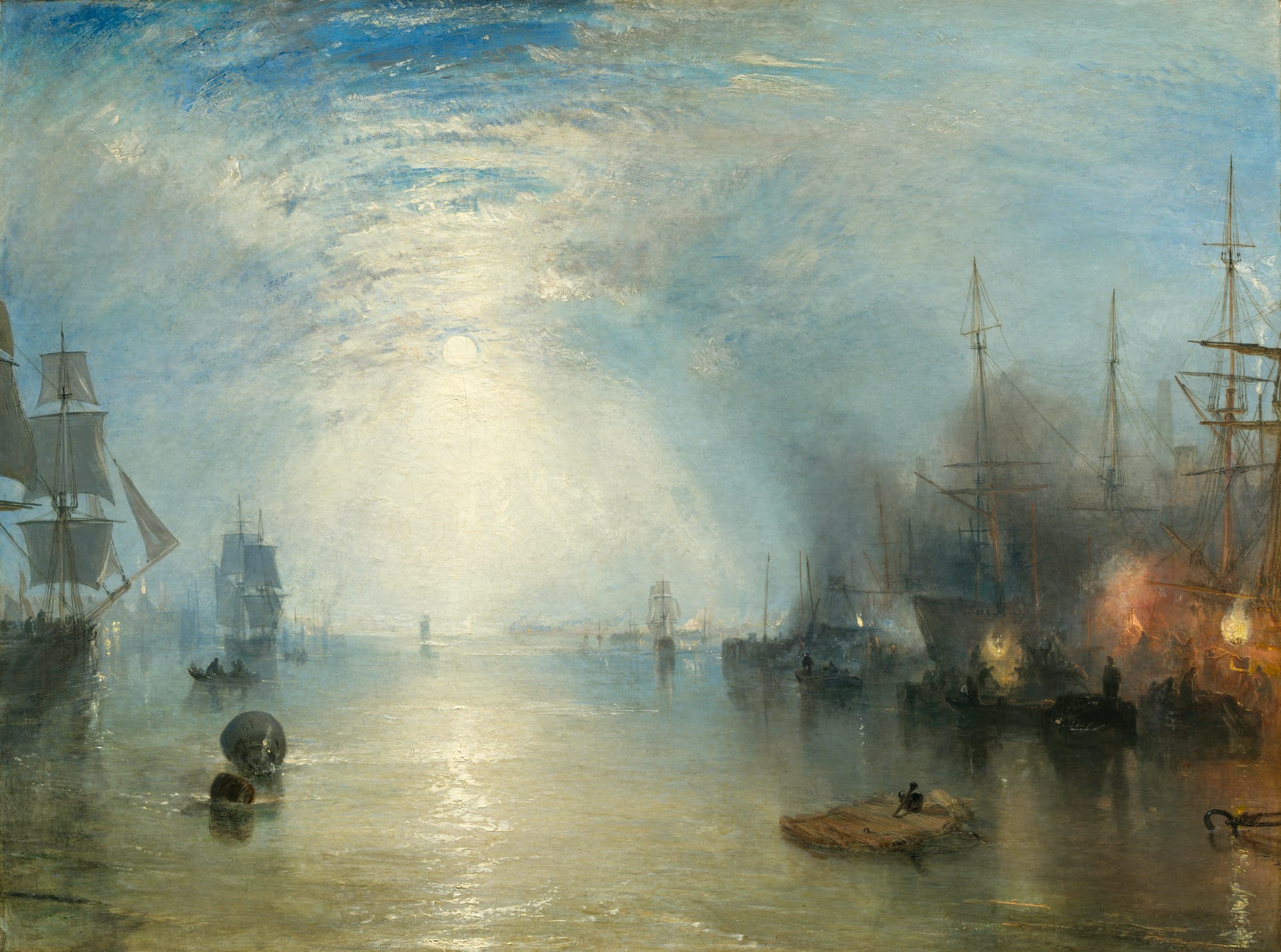
J.M.W. Turner, "Keelmen Heaving in Coals by Moonlight" (1835); National Gallery of Art, Washington D.C., Widener Collection (image courtesy Tate)
Turner & Constable: Rivals & Originals continues at Tate Britain (Millbank, London, England) through April 12, 2026. The exhibition was curated by Amy Concannon, with Nicole Cochrane and Bethany Husband.