Two starkly opposed Americas laid bare by deadly ICE shooting
The incident is threatening to inflame a deeply contentious debate over immigration enforcement.
20 hours ago
Anthony ZurcherNorth America correspondent
Watch: Politicians divided on Minneapolis shooting
The fatal shooting of a woman in Minneapolis by a federal law-enforcement officer is laying bare the sharp divides in US politics – and threatening to inflame an already contentious debate over immigration policy.
The incident took place in broad daylight. There are multiple videos taken by bystanders from various locations. And yet even the basic facts are being disputed.
Almost immediately after the shooting, two starkly different accounts began to take shape. Any ambiguities in the videos shared online were seized upon - different angles and different screengrabs were used to push a particular narrative.
And on the public stage, state and federal officials openly disagreed.
According to Homeland Security Secretary Kristi Noem, the driver – 37-year-old Renee Good – was to blame. As she drove away from ICE officers, she "weaponised her car" in a "domestic terror attack", Noem said.
US President Donald Trump blamed a "professional agitator" and a "radical left movement of violence and hate" in a Truth Social post.
National Democrats - and state and local officials in Minnesota - have painted a completely different picture.
Jacob Frey, the Democratic Mayor of Minneapolis, said a federal agent "recklessly" used lethal force. He also issued an expletive-laced demand for immigration enforcement officials to leave the city.
Minnesota Governor Tim Walz called the shooting "totally predictable" and "totally avoidable", arguing it was a direct consequence of the surge in federal immigration officers into Minneapolis and surrounding areas in recent days.
"We have been warning for weeks that the Trump administration's dangerous, sensationalised operations are a threat to our public safety," he said on Wednesday.

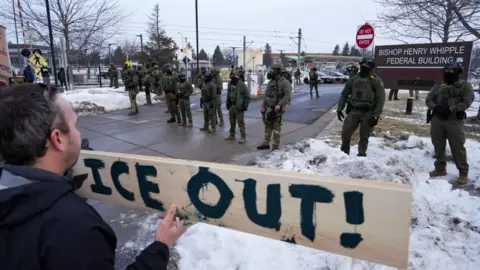 Getty Images
There have been demonstrations against ICE operations following the shooting
This clear division between the federal government and local officials was only further illustrated on Thursday morning, when the Minnesota Bureau of Criminal Apprehension announced that the justice department and the FBI were no longer co-operating with its investigation into the shooting.
Federal agencies, it said, would be solely responsible for handling the investigation into the use of lethal force by the ICE agent.
That Minnesota has become the epicentre of a growing conflict over immigration enforcement in recent months is both unsurprising - and ironic.
It is ironic because Good's death occurred just a few miles from where, in 2020, Minneapolis police killed George Floyd during an attempted arrest, setting off nationwide Black Lives Matters protests – including some, in Minneapolis, that turned violent.
Walz has put the state's National Guard on standby, and cautioned the hundreds of protesters who have taken to the streets not to resort to violence.
Minnesota's central role in this latest flare-up is unsurprising because it marks the culmination of conflict, controversy and scandal that had been building for months.
The recent surge in immigration enforcement comes after Trump derided the state's large Somali immigrant population - most of whom are US citizens - after members of the community were convicted of widespread fraud in the distribution of federal Covid aid.
"Hundreds of thousands of Somalians are ripping off our country, and ripping apart that once great state," he said in November. "We're not going to put up with these kind of assaults on law and order by people who shouldn't even be in our country."
Under pressure, Walz abandoned his bid for re-election last week, as allegations mounted of corruption in state social services, including childcare and food aid.
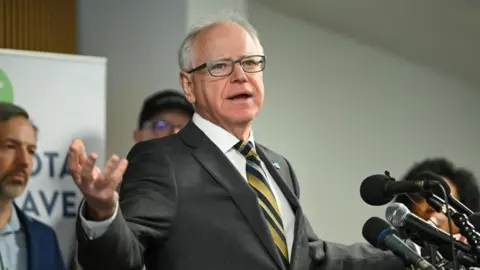 EPA
EPA
Governor Tim Walz abandoned his bid for re-election last week
The surge in immigration enforcement in the state is just the latest example of the Trump administration using federal officials to target communities suspected of having high rates of undocumented migrants. The use of force during this operation is far from an isolated incident, either.
The Minnesota incident was at least the ninth immigration-enforcement-related shooting since September – all involving individuals who were targeted while in their vehicles - according to the New York Times.
The intensity with which the immigration actions have been undertaken – in an expanding list of cities across the US – has led to protests and calls from Democratic officials for greater oversight, accountability and restraint among law enforcement agents.
The fatal Minneapolis shooting has already given these efforts new urgency among their advocates.
Trump administration officials, for their part, are pressing ahead – citing the mandate they say they received from voters in the 2024 presidential election as well as the evidence, in dramatically reduced undocumented entries into the US, that their efforts have proven effective.
They have also vigorously disputed the argument that the video of the Minneapolis shooting is evidence of a misuse of lethal force.
"The gaslighting is off the charts and I'm having none of it," Vice-President JD Vance wrote in a post on X. "This guy was doing his job. She tried to stop him from doing his job."
While he said the incident was tragic, he added that "it falls on this woman and all of the radicals who teach people that immigration is the one type of law that rioters are allowed to interfere with".
Walz, in his next public comments, was quick to counter.
"People in positions of power have already passed judgement, from the president to the vice-president to Kristi Noem, have stood and told you things that are verifiably false, verifiably inaccurate," he said. "They have determined the character of a 37-year-old mom that they didn't even know."
It appears that even video evidence is open to interpretation at this point. Each person sees the same images and draws decidedly different conclusions – ones that frequently, perhaps not surprisingly, reinforce their previously established positions.
The chasm in US politics seems as immutable as it is daunting.

Follow the twists and turns of Trump's second term with North America correspondent Anthony Zurcher's weekly US Politics Unspun newsletter. Readers in the UK can sign up here. Those outside the UK can sign up here.