Uranus and Neptune may be 'rock giants,' not 'ice giants,' new model of their cores suggests
A new computational model suggests that Uranus' and Neptune's cores may be less icy than their "ice giant" nickname suggests.
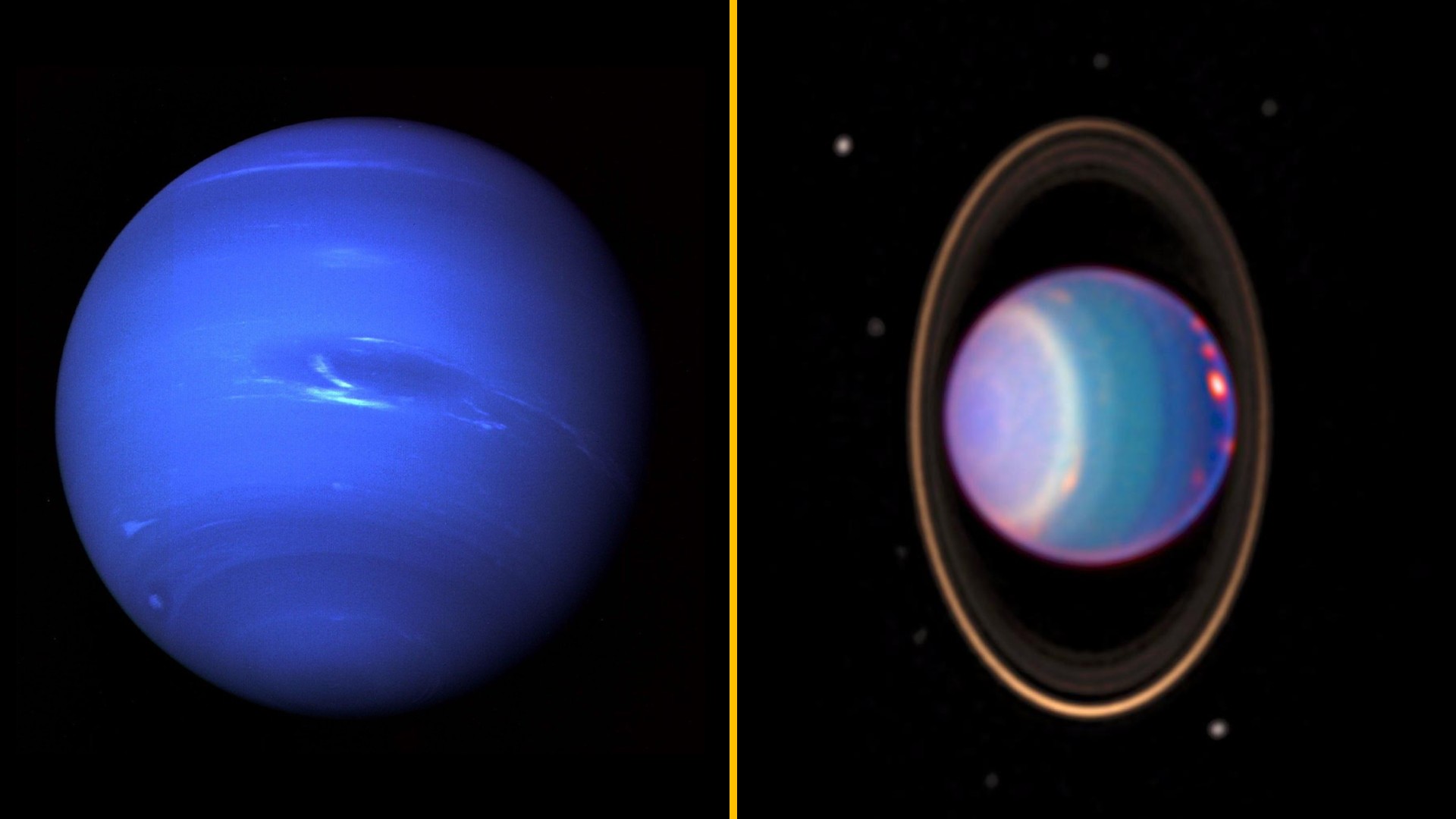
Neptune (left) and Uranus (right) might be rockier than they seem. (Image credit: NASA/JPL/STScI)
The interiors of Uranus and Neptune may be rockier than scientists previously thought, a new computational model suggests — challenging the idea that the planets should be called "ice giants."
The new study, published Dec. 10 in the journal Astronomy & Astrophysics, may also help to explain the planets' puzzling magnetic fields.
Far out planets
Morf and his supervisor, Ravit Helled, developed a new hybrid model in an attempt to better understand the interior of these cold planets. Models based on physics alone rely heavily on assumptions made by the modeler, while observational models can be too simplistic, Morf explained. "We combined both approaches to get interior models that are both unbiased and physically consistent," he said.
The pair started by considering how the density of each planet's core could vary with distance from the center of the planets and then adjusted the model to account for the planets' gravities. From this, they inferred the temperature and composition of the core and generated a new density profile. The team inputted the new density parameters back into the model and iterated this process until the model core fully matched current observational data.
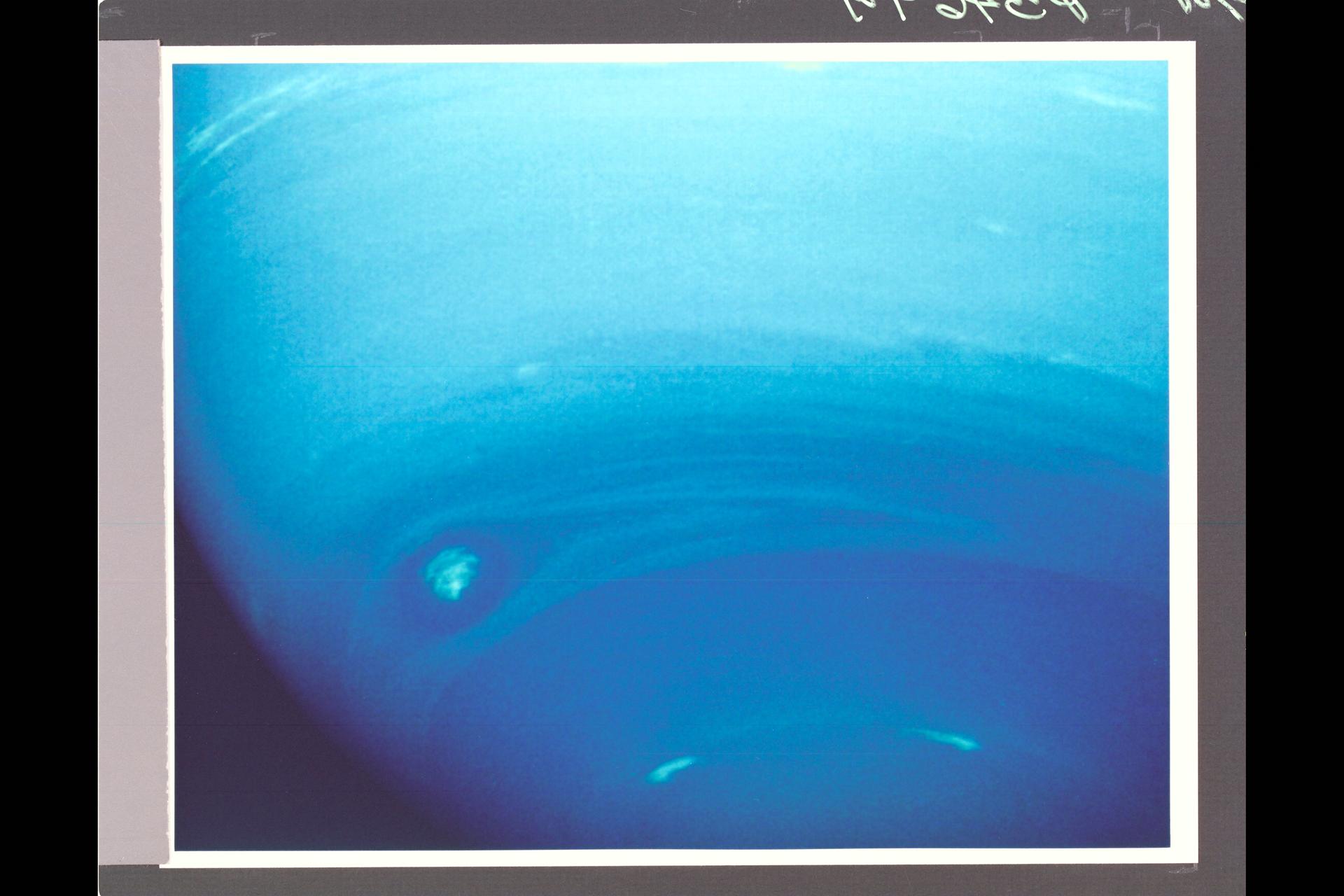
Voyager 2 took this snaphost of Neptune in 1989. Data on Uranus and Neptune taken during Voyager's flybys are still some of the best we have. (Image credit: NASA / Voyager 2)
This method generated eight total possible cores for both Uranus and Neptune, three of which had high rock-to-water ratios. This shows that the interiors of Uranus and Neptune are not limited to ice, as previously thought, the researchers said.
Get the world’s most fascinating discoveries delivered straight to your inbox.
All of the modeled cores had convective regions where pure water exists in its ionic phase. This is where extreme temperatures and pressures cause water molecules to break apart into charged protons (H+) and hydroxide ions (OH-). The team thinks such layers may be the source of the planets' multiple magnetic fields, which cause Uranus and Neptune to have more than two poles. The model also suggests that Uranus' magnetic field is generated closer to its center than Neptune's is.