US strikes in Venezuela: Did Trump have authority to capture Maduro? What the law says
US forces conducted a large-scale strike in Venezuela, capturing President Nicolás Maduro and his wife, Cilia Flores, following pre-dawn attacks on Caracas. Maduro faces terrorism and drug charges in New York, with the US accusing him of leading a narco-terrorist organization. The operation's legality is debated, with experts citing potential violations of international law.
-
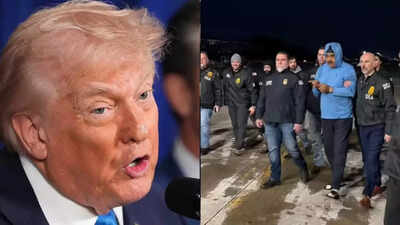
US President Donald Trump announced on Saturday that US forces had carried out a “large-scale strike” in Venezuela, capturing President Nicolás Maduro and his wife, Cilia Flores, following pre-dawn attacks on Caracas that killed at least 40 people and triggered widespread panic across the capital.After reports of multiple explosions and low-flying aircraft, Venezuelan government forces deployed nationwide and the country entered a state of national emergency. Maduro and his wife have now been indicted in New York on terrorism and drug charges, with Trump accusing Maduro of running a “narco terrorist organisation.” A photo released by Trump on his social media platform Truth Social showed Maduro in handcuffs, wearing a blacked-out mask.
Maduro Predicted Own Fall? Venezuela President Offers Trump Oil In Final Interview Before 'KIDNAP'
Attorney General Pam Bondi posted an unsealed indictment charging Maduro with narco-terrorism, cocaine importation conspiracies, and possession of machine guns, offences that carry severe prison sentences when combined with drug trafficking charges.However, the legality of the strike carried out by US forces, codenamed Operation ‘Absolute Resolve’, has sparked intense debate. Critics including international law experts have noted that the US strikes in Venezuela could potentially violate the UN Charter and constitute a “crime of aggression.”
Legality of the operation in question
US attack on Venezuela and capture of President Nicolas Maduro has sparked widespread debate over its legality, with experts suggesting the US may have violated both domestic and international law. Secretary of State Marco Rubio described the operation as “primarily an act of law enforcement, rather than the military action over which Congress has a greater purview,” but critics argue that an armed incursion into a sovereign nation raises serious legal questions.
Trump downplayed these concerns in an interview on Fox & Friends Weekend, saying Democrats critical of the operation “should say, ‘Great job,’” rather than questioning its constitutionality.Representative Jim Himes, top Democrat on the House Intelligence Committee, called on the administration to “immediately brief Congress on its plan to ensure stability in the region and its legal justification for this decision.”Also read: Nicolas Maduro captured: Who is in charge of Venezuela now? Trump says US will 'run' the country
International law concerns
Experts quoted by The Guardian argued that the strike likely violated the UN Charter, signed in 1945 to prevent conflict on the scale of the Second World War. Article 2(4) of the charter prohibits the use of military force against other states and obliges nations to respect sovereignty. Geoffrey Robertson KC, former president of the UN war crimes court in Sierra Leone, called the raid “contrary to article 2(4)” and described it as a “crime of aggression… the supreme crime” under international law.Art 2 (4) of the UN Charter provides that ‘all Members shall refrain in their international relations from the threat or use of force against the territorial integrity or political independence of any state, or in any other manner inconsistent with the purposes of the United Nations’.Elvira Domínguez-Redondo, professor of international law at Kingston University, called the operation “a crime of aggression and unlawful use of force against another country.”