Sydney Festival is upon us for another year. Here is everything you need to know - reviews, previews and interviews - to plan your festival experience.
**DANCEGarabariSydney Opera House, Northern Broadwalk****January 9 to 10
****Reviewed by CHANTAL NGUYEN
**★★★★★
Garabari is a Sydney Festival highlight: welcoming, joyous, and promising everyone a good time in a stunning locale.
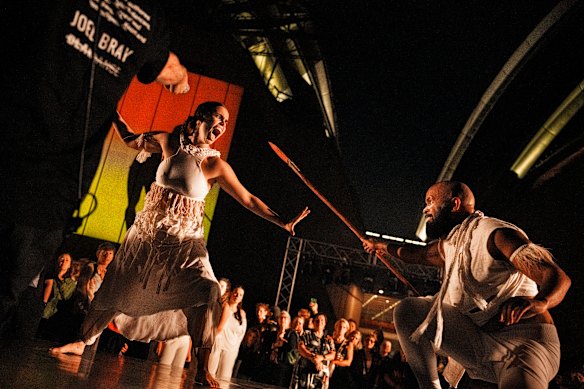
It’s staged outside on the Sydney Opera House’s magnificent Northern Broadwalk: the outdoor area behind the sails, featuring the panoramic money-views of Sydney Harbour.
As the crowd file in, they’re greeted jovially by Wiradjuri choreographer Joel Bray, who explains the interactive set-up as if inviting you to his house party. “The dancers would love to talk to you,” he beams. “And there is a bar.” “Ooooh!” the audience gasp appreciatively.
Garabari is a celebration of shared rhythm and community. Credit: Stephen WIlson Barker
Five minutes later I’m standing in the Broadwalk, prosecco in hand. The area is ambient with smoke ruffled by the coastal breeze, and set up with three outdoor stages. Bray’s dancers wend through the space, stopping to chat with audience members or greet each other. The atmosphere is relaxed and excited: people are exclaiming how good it is to be outside.
Garabari is Wiradjuri for “corroboree”: Bray’s premise is to have audiences experience the joyful immersion of corroboree. It’s the fine arts, ancient cultural sharing, and sociopolitical reconciliation wrapped in an ingeniously accessible, all round good-vibes package. Isn’t that exactly the kind of audience connection modern dance is always striving to achieve?
The premise is to have audiences experience the joyful immersion of corroboreeCredit: Stephen Wilson Barker
People are recognising each other and catching up. A delightful communal vibe permeates — albeit with a Sydney Festival flavour. “William Yang! So good to see you!” an awestruck voice gasps at octogenarian photography icon Yang, standing unobtrusively stage-side clasping a giant camera.
Next, I stumble on a knot of First Nations dance personalities surveying the crowd. “I’m just here to check out my ethnic competition!” jokes one. “But Joel is the golden child!” comes the rejoinder.
The dancing and music (Byron Scullin’s catchy beats) crescendo, and the audience follows the performers from stage to stage with visible glee. Night descends and dancing projections (Katie Sfetkidis’ designs) light up the Opera House. Children, the elderly, and everyone in between move to the beat, guided by the dancers.
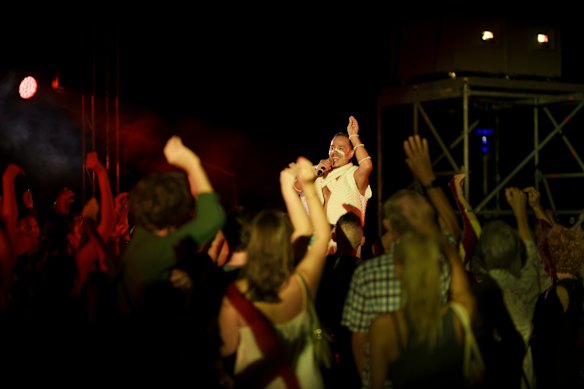
One dancer takes the mic and tells the creation story of the Murrumbidgee River. “I wanna tell you a story!” he begins, and the crowd roars its approval as if at a rock concert.
By the end, everyone is dancing the night away in a celebration of shared rhythm and community. Surrounded by the beauty of the Harbour, the Opera House and Bridge, all under a perfect summer night sky: it’s hard to imagine anything better.
**THEATRE
****Dear Son
****Belvoir St Theatre, January 10
****Until January 25
****Reviewed by JOHN SHAND
**★★★★
How do you dramatise a book composed of letters? Isaac Drandic and John Harvey had many solutions in adapting Thomas Mayo’s Dear Son, which consists of letters Mayo asked fellow Aboriginal men to write to their sons or fathers. More solutions were probably added by Drandic in his role as director. (He also bravely acted, book in hand, as a replacement for the sick Luke Carroll.)
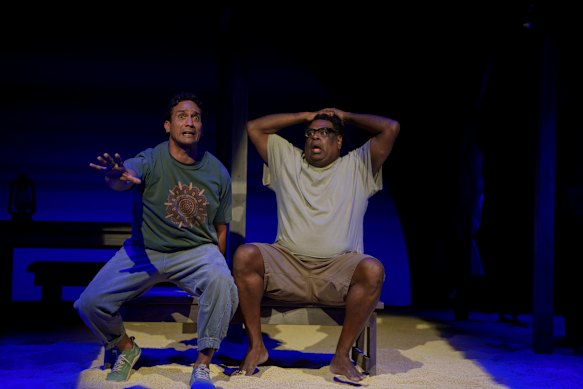
Drandic and Harvey located the play in an outback men’s shed, strikingly designed by Kevin O’Brien and lit by David Walters. While each letter had a protagonist, the text was passed around the cast of five, with described scenes enacted (three actors even becoming a growling a V8 car!), blocks of text delivered in unison (to potent effect), and dance and song.
Waangenga Blanco and Jimi Bani in Dear Son. Credit: Stephen Wilson Barker
The resultant play, produced by Queensland Theatre Co and State Theatre Company South Australia, and presented by Sydney Festival, runs for just 70 minutes, yet seemed longer, not because it dragged, but because it is crammed with mood swings. These range from broad humour to confessions and statements of love onto a sinister vignette set in Darwin’s notorious Don Dale Youth Detention Centre.
Given the book’s impact, I expected the play to be more harrowing, and perhaps it would be, were Carroll to join Jimi Bani, Waangenga Blanco, Kirk Page and Tibian Wyles, all of whom excelled.
Drandic, lacking the regular actors’ projection, handled Mayo’s letter to his son, which begins with regretting that when the son was nine and reached for his father’s hand in public, Mayo rejected the gesture, saying the son was too old for that. Wyles was the protagonist in Troy Cassar-Daley’s letter to his son, telling of the powerful love that conceived him.
Bani handled Yessie Mosby’s letter to his four sons, brimming with evocations of growing up on the Torres Strait’s Masig (Yorke Island). It was this piece that included the powerful dance sequence, choreographed by Blanco. Page took on Stan Grant’s letter to his boys about the suffering of his own father, who was visited in a dream by his ancestors as magpies, telling him it was not yet his time to die because he had a mission to save the Wiradjuri language.
The two funniest stories, Jack Latimore’s about trying to reach an uncle in Port Macquarie before he died, and Charlie King’s recounting of his father’s bicycle ride from Melbourne to Darwin (via the East Coast), were brilliantly delivered by Blanco and Bani, respectively. King’s, one of the finest contributions to book, ends with Bani expressing regret for not telling his father of his love and admiration before he died.
Setting aside grievances, embarrassment and rivalries to say the important things before it’s too late, and dealing with racism, are recurrent themes. The moving conclusion saw each actor address us as himself and speak of his own families. The collective warmth of heart vibrated through the theatre.
**DANCEGarrigarrang BaduSydney Opera House, Drama Theatre****January 9 to 10
****Reviewed by CHANTAL NGUYEN
**★★★
Warning: This review contains the name of an Indigenous person who is deceased.
Choreographed by Jannawi artistic director and former Bangarra dancer Peta Strachan, a Dharug woman from the Boorooberongal clan, Garrigarang Badu is a loving celebration of the Dharug nation and Dharug country — a vast area stretching from Sydney Harbour to the Blue Mountains, and running from Broken Bay down to the Southern Highlands.
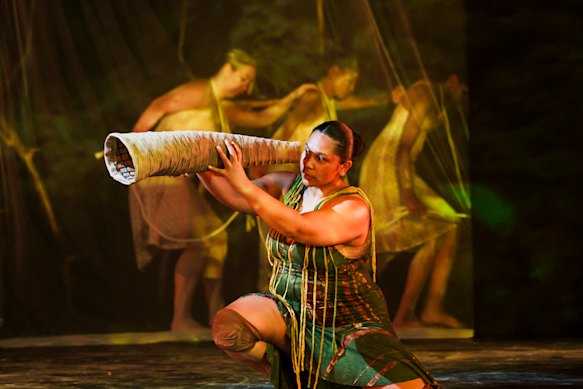
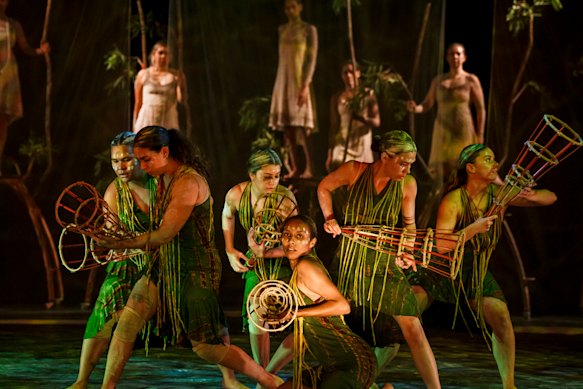
Garrigarang Badu is a loving celebration of the Dharug nation and Dharug country. Credit: Stephen Wilson Barker
It’s structured into vignettes set to 14 songs in the Dharug language, with the dancers moving through bush and water, at times carrying torches, nets, nawi (canoes), coolamons (storage vessels), dilly bags, and digging sticks.
In terms of production elements, there’s no faulting Garrigarrang Badu. The set and props (Govinda Webster and Pink Cactus Props) are gorgeous. Five squares of silk-like material grace the stage, fluttering in a breeze, holding Samuel James’s atmospheric projections of trees, stars, and smoke. Paul Osborne and Catapult Creative’s lighting is equally evocative, capturing the dappling of sunlight through leaves to a pivoting night sky, and the magic of moonlight shimmering on water. The music, composed by DYAGULA with language and vocals by Matthew Doyle and the late Dharug linguist Richard Green, is both a profound act of cultural sharing and will also be broadly appealing for non-Indigenous audiences.
The Jannawi dancers have travelled across country to perform. Credit: Stephen WIlson Barker
Surprisingly, the dance in Garrigarrang Badu is not as strong as these other elements, with a narrative structure that feels flatter — less varied in emotional peaks and troughs — than it perhaps should be. This makes the 100-minute runtime pass slowly. The piece builds to a lovely climax with the canoe scene, but it seems too little, too late.
The Jannawi dancers have travelled across country to perform, and showcase an impressive unity in these circumstances. Audiences should not go in expecting a stratospheric level of choreographic complexity or dance technique (the segments with a modern dance influence can be quite exposed, and sit at about late high school to early pre-professional level). But for those who have little exposure to First Nations dance, Garrigarrang Badu may be a valuable entry point.
**DANCEPost-Orientalist ExpressRoslyn Packer Theatre****January 8 to 10
****Reviewed by CHANTAL NGUYEN
**★★★★★
Korea is a known dance powerhouse – and from Korea, choreographer Eun-Me Ahn is a known force of nature. A darling of the international festival scene, her projects include everything from the 2002 FIFA World Cup opening ceremony to a duet with a live chicken. Her visually stunning satire Post-Orientalist Express rushes in like a rainbow in a whirlwind riding a dragon, and opens this year’s Sydney Festival.
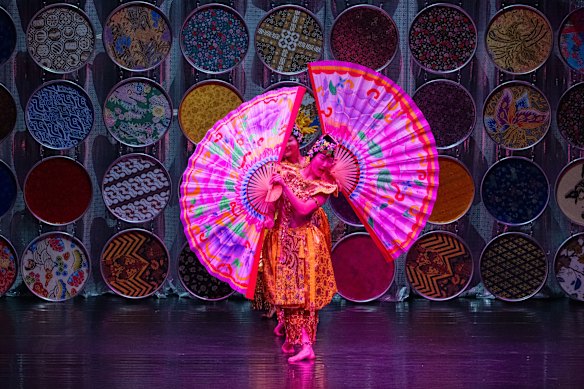
Blessed with more than 90 luminous costumes (Ahn’s designs), an extraordinary techno soundscape (Young-gyu Jang’s composition), and eight performers who can do everything from somersaults to biting satire and god-like serenity, Post-Orientalist Express is not so much a dance piece as an entire world, breathtaking in its panoramic energy.
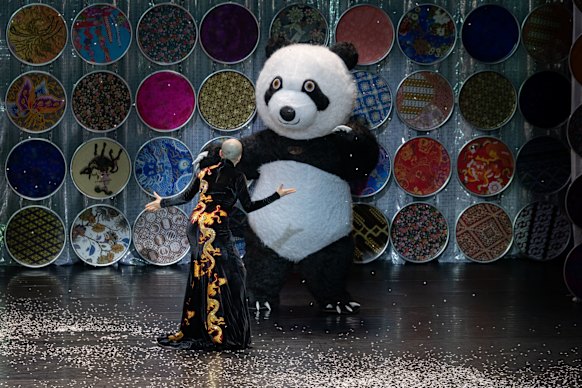
The tottering panda was an audience favourite. Credit:
Its through-line is a satirical commentary on Western exoticisation of “the Orient”. European dance critics describe Ahn as “the Pina Bausch of Asia”, but you walk out of this show thinking that really, Pina Bausch should just be called “the Eun-Me Ahn of Europe”.
You take your seats and realise the piece has already started: animations of paintings from Europe’s 19th century “Orientalist” school of art project onto the curtain (Taeseok Lee’s video design). Then come the dancers, gliding and pole-vaulting across the stage in Ahn’s delightful designs. There are boats that glide across lakes; a giant teapot full of mist; a gold dragon embroidered on black velvet; surreal structures of lace, tassels and balloons; sky-high platform boots; flashing mouthguards and glow sticks; and even a tottering panda.
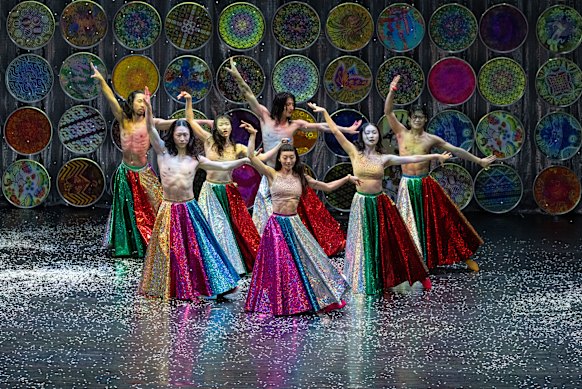
The endless energy of the seven dancers is a wonder. Credit:
Starting as a surreal, hypnotic series of hyper-stylised tableaux (perhaps representing the Western gaze), the dance gradually loosens up, crescendoing into an explosion of colour and life. There’s no interval to interrupt the galloping momentum. Ahn herself is a recurring narrative presence – like a fairy godmother, she flicks in and out with energetic solos so charming that the audience cheer.
The choreography never feels like camp mimicry. Credit:
Her seven swift-footed dancers are a wonder: effortlessly somersaulting and spinning in a cloud of serpentine athleticism, appearing more like a cast of dozens. Despite this prowess, they move with a refreshing humility, quiet dignity and self-deprecating humour. This stops the choreography from ever feeling like camp mimicry and proves that inaccessible pretension should never be confused with good modern dance.
The standing ovation at the end came quickly and was delightfully noisy – some audience members even made heart signs with their hands.
THEATRE Burgerz Carriageworks, January 8 Until January 18 Reviewed by HARRIET CUNNINGHAM
★★★★
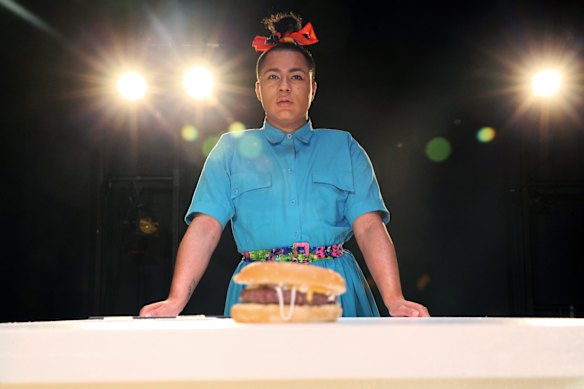
When is a burger not a burger? Does it have to be beef? Does it need cheese? Is it a burger if there are no pickles? Does the bun need to be thicker on the top or the bottom? And does it have to be round?
These are questions Travis Alabanza has asked of themselves, and now asks of us, in their by turns anarchic, hilarious and hugely affecting show Burgerz, which opens Australia’s first Trans Theatre Festival. (By the way, Alabanza says yes, the bun does need to be round, otherwise this show might be called Hotdogz.)
When is a burger not a burger? Travis Alabanza raises a few questions. Credit:
Burgerz is Alabanza’s response to their experience of a hate crime some 10 years ago, when, one morning on London’s Waterloo Bridge, a man shouted “tranny” and hurled a burger at Alabanza, splattering their dress with mayonnaise and mince.
Loading
It was nothing that a thick skin and some dry-cleaning fluid couldn’t fix, perhaps, but for Alabanza the real impact was that no one in this busy street reacted. No one helped. Everyone looked away and walked on by.
Track 8 at Carriageworks is full of people ready to help on the first night of Burgerz. When Alabanza emerges from a large packing case dressed in blue overalls on a blisteringly hot night they are greeted by a crowd of fellow travellers. When they call for a volunteer, hands shoot up. But when they ask for a volunteer who is a white cis-male, all goes quiet.
Thank goodness for Andy, an economist from Norway who accepts the invitation and spends most of the show on stage wearing a bright orange apron. Andy becomes sous chef and straight man for a sometimes brutal interrogation into the making of a burger.
There are plenty of laughs: big squirts and little squirts, meat grinding and buns. There are also tough conversations. Can we talk race? Yes, we can and will. The most impactful moments are when Alabanza drops the cabaret persona and speaks candidly about the despair, the hurt and the confusion of their everyday existence. Andy becomes an Everyman, a silent witness, while the burger becomes a metaphor for the senseless brutality of the norm.
The concept of Burgerz is inspired and the delivery unflinching. On opening night the outcome was robbed of some of its impact by stifling heat, unco-operative microphones and the unprovokable Andy, but it will build as Alabanza gets the measure of a Sydney crowd.
For the most part, Alabanza laps up the volatile chaos of audience participation. They have an impressive string of comebacks for all occasions and handle the top spin of cultural difference with ease. They are gentle but insistent in their attempts to get a reaction from Andy, to the point that it sometimes turns into an uncomfortable battle of wills.
But, in the end, the burger gets made and we learn. About Alabanza, about burgers and about ourselves.