Why Gen Z is reviving the gentle art of letter writing
SOURCE:Sydney Morning Herald|BY:Lauren Ironmonger
Pen pals and “snail mail” clubs are growing in popularity as young people seek reprieve from the endless churn of online algorithms. Ironically, TikTok is leading the trend.
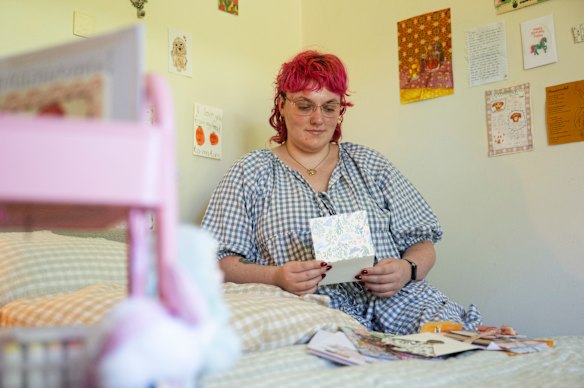
When Poppy Bradley, 25, was diagnosed with a chronic illness three years ago, she had to find new ways to stay connected.
“Before I got sick, I lived in a co-op of 40 students, went clubbing, went to art exhibitions and was very social, always going to a party,” she says.
Poppy Bradley, 25, who lives with a chronic illness, has about 10 pen pals.Credit: Janie Barrett
Bradley has ME/CFS (myalgic encephalomyelitis/chronic fatigue syndrome), a disabling chronic illness. She lost friends after her diagnosis and can’t socialise like she used to.
Writing letters to others around the world, a practice she’d picked up in high school, was the answer for Bradley, who has five regular pen pals and another five she writes to on special occasions, from places such as England, Finland and the United States.
Loading
A growing number of Gen Z and Millennials such as Bradley are finding offline ways to stay connected.
Social media platform Pinterest’s 2026 trend forecast report predicts a “letter-writing renaissance” among Gen Z and Millennials, while TikTok is rife with young “snail mail” enthusiasts sharing their dispatches or looking for pen pals.
“Pen-palling and snail mail represent a lot of things that ME/CFS took from me. It’s a way to express myself to people who care about my experiences, a way for me to learn about others and experience the world, all from my bed,” says Bradley.
“It feels physical, not just a text message or Instagram post, but something I can hold and remind myself that people care.”
Analogue culture
The art of pen-palling has a long history. Thought to have started in the 1930s with a student exchange (mail correspondence, obviously, stretches back far further than this) pen-palling has long been a way to forge connection across borders, cultures and even prison walls.
However, the rise of digital forms of communication in recent decades has not boded well for snail mail. Recently, Denmark called time on its 400-year-old postal service, citing a steep decline in sending letters.
In August, Australia Post chief executive Paul Graham told AAP that letter volumes had collapsed into “permanent decline”, and they would eventually cease delivering them altogether.
Still, Julie Delbridge, president of International Pen Friends, an Australian letter-writing organisation founded in 1967, says more young people are embracing the practice.
“It’s often encouraged by their parents who had pen pals years ago, and even by their grandparents. So we have about three generations of some families in our club,” she says.
What makes pen friends so special?
“It’s always about the thrill and anticipation of receiving something in the mail from a faraway country,” she says. “People tend to share a lot ... it can even be a bit like journaling. They spend the time to describe things in a much different way than if they’re texting. It’s a more connected kind of communication, and more deep and soulful.”
Trend forecaster Tully Walter sees Gen Z’s yearning for deeper forms of connection as a byproduct of our hyper-online world.
“Young people are growing up inside systems where communication is constant, but it’s weightless and disposable. Messages arrive instantly, disappear just as fast, and often feel performative rather than intentional,” she says.
“A letter can’t be skimmed or forwarded. It carries handwriting, which also carries mistakes or personality. It’s proof that someone slowed down for you.”
She connects this to young people’s growing affinity to analogue culture such as vinyl and CDs, film cameras, journaling and magazines.
Somewhat paradoxically, many aspiring letter writers are finding pen pals or sharing the joys of analogue correspondence through TikTok.
‘It’s creating something I wish I had as a child’
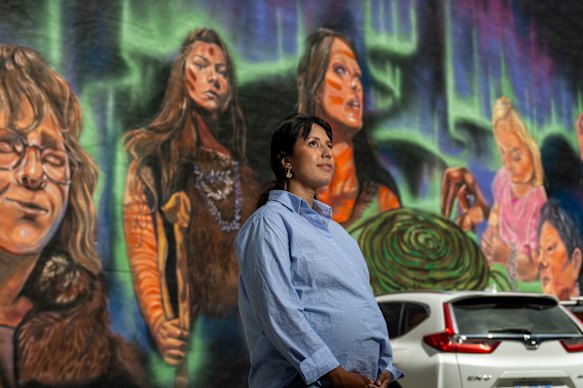
Wiradjuri artist Brandi Salmon, in front of a new mural she’s painted in Hobart, Tasmania, that’s a celebration of Palawa women.Credit: Matt Newton
In addition to pen pals, snail mail clubs – typically artist-led, subscription-based clubs – are growing in popularity.
Brandi Salmon, 29, a Wiradjuri artist living in Hobart, launched Aunty’s Dispatch last year as an accessible way to connect with new audiences (subscriptions are priced at $13). The contents of each mail out varies, but tends to include a personal letter, art print, story behind the art and sometimes a Dreamtime story or Blak history lesson.
Salmon’s relationship with subscribers is intended to be reciprocal, something which has proved valuable in connecting with other Aboriginal people here and abroad.
“One lady messaged me and she was like, ‘I’m a non-Indigenous lady with an adopted Aboriginal daughter who has no connection to family or anything’. And she said that my letter was her daughter’s way of connecting in some way,” she says.
Loading
Of Salmon’s almost 300 subscribers, she says about half are Aboriginal.
“A lot of us are still super-disconnected. We didn’t get to grow up in our own Country, we don’t have our language, we just look Aboriginal, but then we have the culture and connections behind it,” she says.
“So in a way, it’s creating something I wish I had as a child.”
Walter likens the growth of snail mail clubs to the rising popularity of online communities – such as celebrity-led book clubs like that of singer Dua Lipa and newsletters in the Substack platform – and to a resistance to AI art.
“This is a move from endless, algorithm-driven scroll, towards curated and trust-backed relationships,” says Walter. “So it’s not just being fed content without consent.”
‘I want people to feel like they’re talking to a friend’
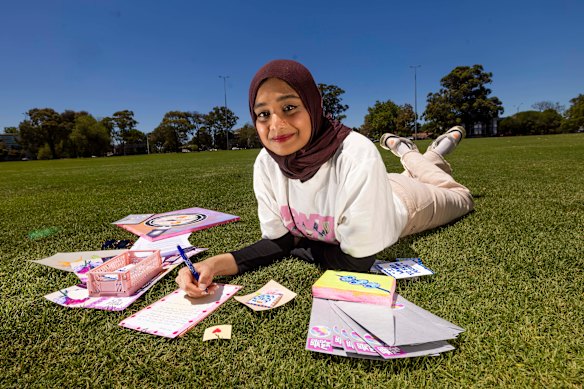
Melbourne artist Persa wants subscribers to get the same “dopamine hit” they might get from scrolling online to receiving mail.Credit: Wayne Taylor
Melbourne artist Persa has always loved handwritten letters.
Last year, she took a break from the corporate world to focus on creative projects, and started The Slow Zine Club, a monthly dispatch that includes a handwritten letter, zine, activity card and postcard featuring her art.
Loading
“We are obviously more inclined towards watching short form videos, and they’re not the best for the nervous system, you know. So creating Slow Zine was sort of an antidote,” she says.
“In our hyper-consumerist culture you need to constantly consume to get that dopamine hit. Generally, I want people to get that dopamine hit from consuming art or making it themselves.”
Like Salmon, the club is designed to be intimate and bidirectional.
“I want people to feel like they’re talking to a friend. So it does include sometimes a bit of vulnerability, mostly describing the emotional headspace I am in,” says Persa, whose first dispatch included a letter about her journey to becoming an artist.
Persa is learning to be okay with the slow growth of her mail club, which is still in its infancy, compared to a platform such as TikTok which can privilege founders with thousands more subscribers.
“I’ve just got 15 subscribers, and sometimes it makes me feel like an imposter because people have thousands out there. But when you know that these are real people who are actually really touched by what you write and what you send to them, that’s like technically having 15 pen pals.”
Make the most of your health, relationships, fitness and nutrition with ourLive Well newsletter**.** Get it in your inbox every Monday**.**