Why Trump’s jackboots and AI’s trillions won’t shake giddy investors
The financial markets have passed two crucial tests barely a week into the new year.
Opinion
January 12, 2026 — 5.01am
January 12, 2026 — 5.01am
Anyone fretting about how fragile global financial markets might be in 2026 got an early and robust response from investors who have lost none of their giddiness.
Just days into the new year, US President Donald Trump staged a de facto coup by sending his forces to capture Venezuela’s president in a lightning military strike.

A protester outside the US embassy in Madrid holds a caricature of President Donald Trump drinking Venezuelan oil.Credit: AFP
The military action promises to transform the security of America’s oil supplies, but risks have multiplied after Trump gleefully opened this geopolitical Pandora’s box.
Not even Trump’s threat to seize control of Greenland, potentially unravelling NATO and the rules-based order that has maintained global stability since World War II, could prevent US sharemarkets from hitting record highs last week.
The VIX index, a widely watched measure of expected market volatility, remains low.
Part of the reason investors are happy to shrug off events that would normally send markets into meltdown is their fascination with AI’s overwhelming dominance of any investment conversation across the globe.
AI will need a lot more than hot air – and soaring chip sales – to sustain its insane 2025 run into this year.
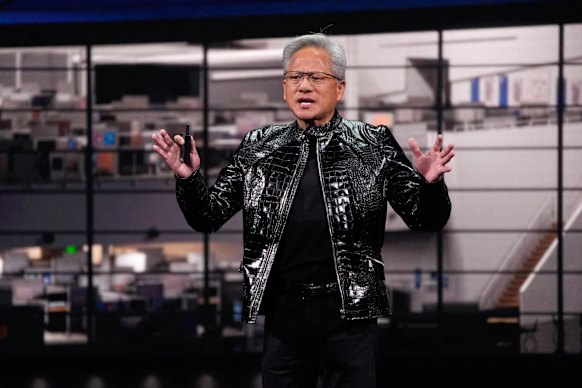
With this in mind, the next big test was the appearance of Nvidia founder Jensen Huang at the CES convention in Las Vegas – the biggest name at the biggest event on the tech calendar. He came up with the right words to allay fears that the trillion-dollar-plus bet on AI might not pay off.
AI’s high priest had suitably big numbers to assure everyone. Every layer of the computing world’s architecture – which has had $US10 trillion invested in it over the past decade, according to Huang – is being re-invented by AI.
But the potential is much bigger than this, he says.
“A couple of hundred billion dollars in [venture capital] funding each year is going into modernising and inventing this new world. What it means is a hundred trillion dollars of industry, several per cent of which is [research and development] budget, is shifting over to artificial intelligence,” he says.