Why Victoria’s usually pristine beaches are being invaded by bluebottles
Thousands of stingers have been washing up on Victorian shores. Here’s what to do if you get stung.
Victoria’s usually pristine beaches have been invaded.
No, not by exuberant British backpackers basking in the Australian sunshine. But rather by gelatinous, alien-looking bluebottle jellyfish, washing up en masse with stingers at the ready.
Surf lifesaver Henry Kiss said the shoreline he patrols at Portsea was covered in thousands of bluebottles on Tuesday.

Portsea surf lifesaver Henry Kiss says bluebottle jellyfish have already washed up on Victorian shores in significant numbers twice this summer. Credit: Penny Stephens
“In any one-metre stretch that day, we probably saw 50 or 60,” Kiss said.
“If you’re walking along the beach, and you see a lot of very brightly coloured, moist bluebottles, that means they’re fresh, and the likelihood of them being in the water is high.”
It was the second time in a week so many jellies had washed up on the beach – a strange phenomenon that usually only happens on the Mornington Peninsula every three or four years.
But bluebottles have been washing up all along Victoria’s coastline this summer, with reports of high numbers from Warrnambool to Wonthaggi. In particular, beaches in Melbourne’s south-east like Frankston and along the Mornington Peninsula have been hotspots.
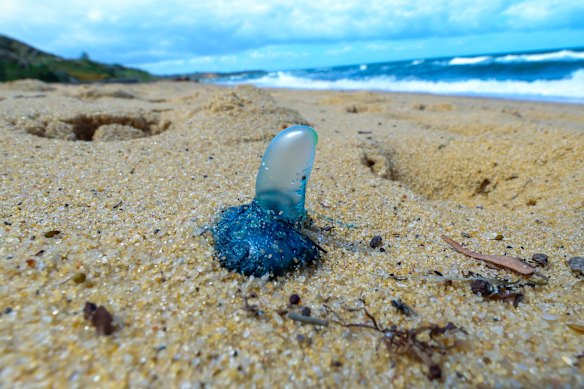
A bluebottle washed up on Sandringham beach last week.Credit: Joe Armao
Bluebottles usually live together in vast swaths out in the middle of the Tasman, somewhere between Sydney and New Zealand. But sometimes wind pushes a big group towards Bass Strait, before funnelling them into Port Phillip Bay.
With no means of propulsion, bluebottles rely on the sail atop their gas-filled float (called a pneumatophore) to move with the winds. Half of the species has a left-facing sail, while the other half faces right – likely an evolutionary tactic to ensure the entire population doesn’t get stranded when the wind blows fiercely.
The beaches along the Mornington Peninsula were clear of the bluebottles on Sunday, owing to the north-easterly winds, which tend to blow any jellyfish that make it into the bay offshore.