Will Indian markets soar in 2026? Experts weigh in on risks and rewards
Indian equities are poised for a cautious yet potentially rewarding 2026, with the Sensex and Nifty projected to gain between 8% and 14%. While near-term volatility is expected due to domestic liquidity and currency pressures, a rebound in earnings for FY27 is anticipated to sustain valuations. Investors are advised to deploy capital systematically, with large caps being the preferred segment.
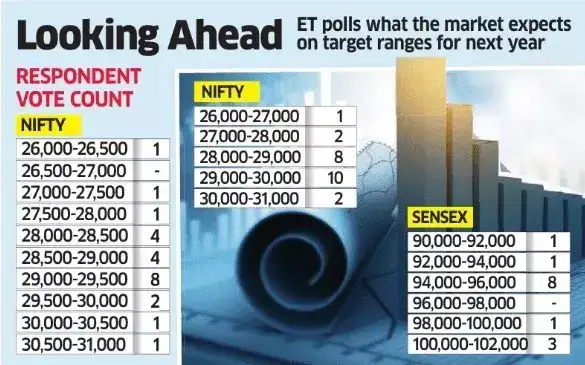
Mumbai: Indian equities may offer a better payoff in 2026 compared with the year that's ending, yet the outlook is marked by caution and indecision, as investors will weigh global uncertainties against a more favourable risk-reward balance. The Sensex and Nifty are likely to gain between 8% and 14%, according to most of the stock market participants polled by ET.
The Sensex ended at 84,675 and the Nifty closed at 25,939 on Tuesday, the penultimate trading day of 2025. The Nifty gained 9.7% and the Sensex rose 8.4% in the year up to December 30.
More than half the poll participants, which included fund managers and brokers, said the Nifty could advance to 28,000-29,500 levels, while the Sensex may touch 94,000-96,000 levels.
"We expect a volatile start to 2026, with near-term downside risks driven by tight domestic liquidity, elevated bond yields and currency pressures, which could cap flows and keep markets fragile until external uncertainties, notably the US trade deal, ease," said Seshadri Sen, head of research and strategy, Emkay Global Financial Services. Beyond this, the outlook will likely improve, with earnings expected to rebound in FY27, which is critical to sustaining valuations, Sen said.
Of the market participants polled, 77% were of the view that the Indian stock market is currently fairly valued, while 87% said the risk-reward favours Indian equities. This is in contrast to last year, when a larger section of participants were uncomfortable with stock market valuations in the face of slowing earnings growth.
 Agencies
Earnings Growth likely to Help
This was especially true of midcaps and small-caps.
"Valuations are now more reasonable -neither cheap nor excessive-suggesting that returns will be increasingly earnings-driven," said Neelesh Surana, chief investment officer, Mirae Asset Investment Managers. "While FY26 earnings growth is expected to remain modest, the setup for FY27 appears materially stronger, aided by a favourable base, improving demand and a likely recovery across both large- and midcap segments."
Investors sitting on cash should deploy their capital over a period, rather than waiting for a better time to start investing or investing a lump sum, said 87% of the 31 poll participants.
A staggered or systematic deployment of capital phased over the next three to 12 months is the most recommended strategy by over 50% participants, followed by an equity-focused and a multi-asset allocation suggestion.