World’s smallest autonomous robots are 'smaller than a grain of salt,' cost one penny apiece — researchers expect new micron-scale fully-programmable robots to be used in medicine, microscale manufacturing, and other areas
Fully programmable, autonomous robots 'smaller than a grain of salt' have been developed by research teams from the University of Pennsylvania and the University of Michigan.
Fully programmable, autonomous robots “smaller than a grain of salt” have been developed in a collaborative effort between research teams from the University of Pennsylvania and the University of Michigan. Claimed to be the world’s smallest of their kind, these nanoscale robots are expected to find applications in medicine, microscale manufacturing, and other areas. Remarkably, the researchers contend that these robots will cost only one penny each to manufacture.
Penn Engineering was responsible for the physical structure and features of these microscopic robots, while Michigan scientists gave the robots their ‘brains.’ The Michigan lab involved in this collaboration also holds the record for creating the world’s smallest computer.
Barely visible robots move using ion propulsion
Let’s look at Penn Engineering’s work first. Scientists there designed the physical aspects of the tiny robots, each measuring about 200 x 300 x 50 micrometers. This is similar to the scales of many microorganisms, and as such, they face different physical challenges than the robots with which we are most familiar.
With the challenges of drag and viscosity that such tiny robots will face, it was decided to make them ‘swimmers.’ However, to keep them small, the scientists designed an entirely new propulsion system so that moving parts (such as limbs) wouldn’t be needed for locomotion.
Interestingly, these robots generate an electric field that “nudges ions in the surrounding solution,” allowing them to “swim.” Adjusting this ion field can help robots move in complex and/or coordinated patterns. Having no moving parts also makes them highly durable; for example, they can be picked up with a micropipette without being damaged.
Another challenge of their tiny size was the power supply. The design that was adopted uses solar power, with the solar cells making up the majority mass of the robot body. Even though solar was maximized, it yields only 75 nanowatts of power, underscoring the importance of efficiency.
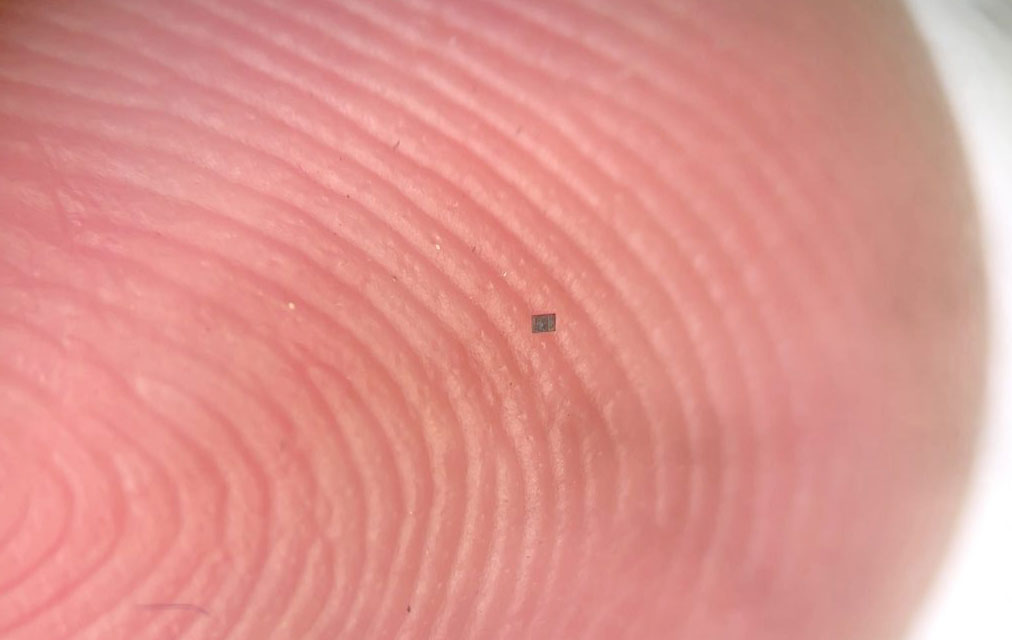
(Image credit: Penn Engineering)
Communicating with light and a waggle dance
To be fully programmable, autonomous robots, these tiny machines need on-board processing, and this is where the expertise of the University of Michigan was applied.