Xreal 1S glasses review: a worthy splurge for handheld gamers
Xreal's 1S AR glasses offer an elevated take on wearable tech with exceptional performance for video games. Read Polygon's Xreal 1S review for more.

Published 21 hours ago
Big screen, small package
Xreal’s 1S glasses will make a wearable believer out of you
 Image: Xreal
It’s no secret that games are an expensive hobby, especially now. Most of us aren’t looking for yet another ecosystem to invest in — we just want to enjoy the games and gear we already like in a more immersive way. That’s where Xreal’s 1S AR glasses come in. Essentially, they give you a massive, big-screen experience no matter where you are — no splashy home theater setup required.
At $449, the Xreal 1S glasses aren’t exactly cheap, but they have an undeniable and immediate wow factor right out of the box. Plug them in via a USB-C port, and all of a sudden your phone, laptop, or handheld gaming device has a jaw-dropping 171-inch virtual screen. You can adjust the size, position, and distance of that virtual screen freely, and use the glasses as either an extended monitor, a second display, or a mirror of your primary one. The opacity of the lenses can be tweaked with a couple button taps on the right arm, making your digital display more translucent to better see the world around you. It’s a pretty nifty trick, whether you’re the one wearing the glasses or watching someone else do it.
I took the Xreal 1S glasses for a spin during a recent flight from New York to Nashville, connecting them to my Samsung phone to burn through a couple episodes of Mad Men. There was no tedious connection process or software to download — I just plugged the glasses in via the USB-C slot and was presented with a full-screen version of my phone. (It actually took longer to connect my usual set of bluetooth earbuds.) It was a fantastic way to pass the time on a flight — and far more engaging than simply staring at my phone. If you spend a lot of time traveling for work or leisure, these are a total game-changer. Just be prepared for some curious looks.
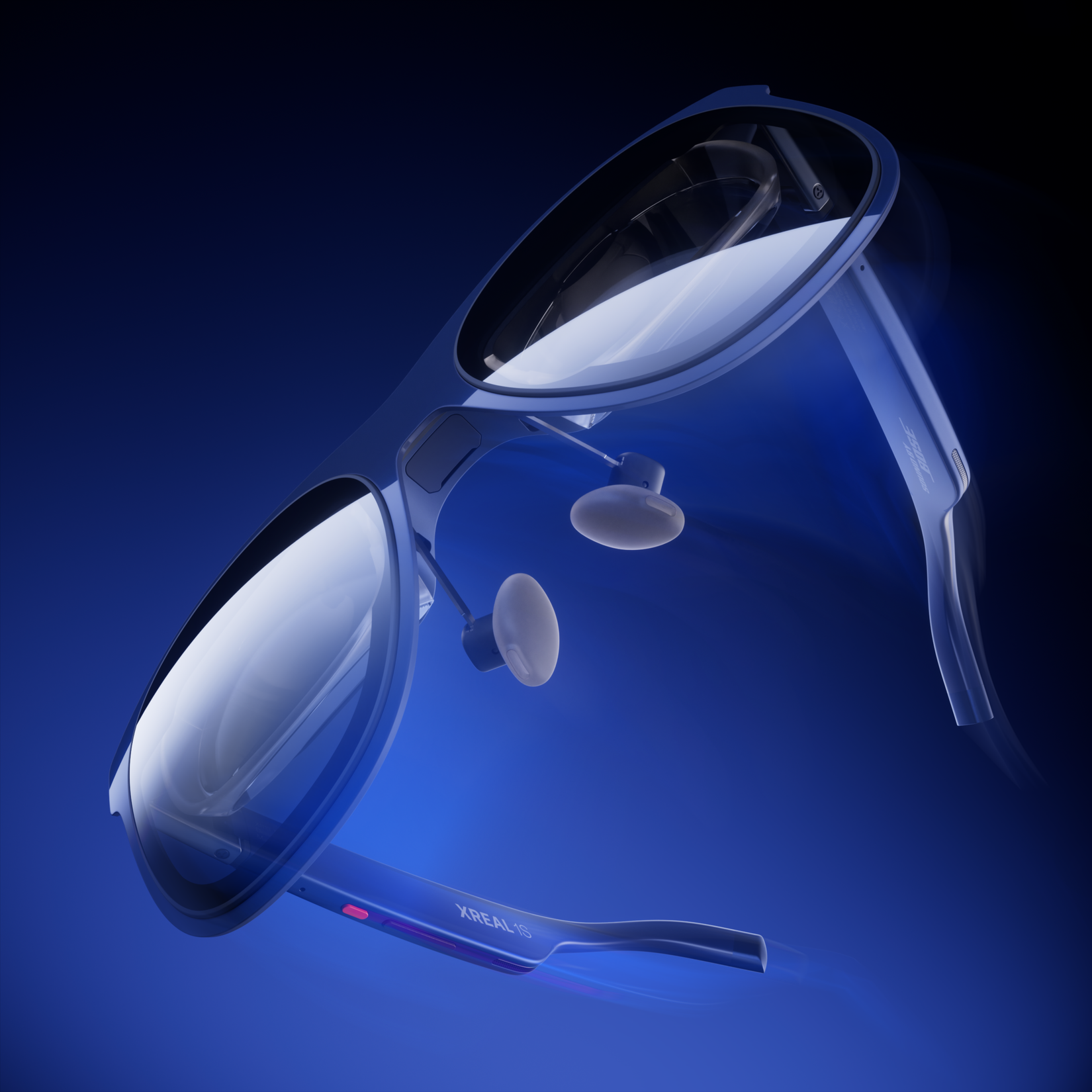Image: Xreal
I wear glasses regularly, and the Xreals didn’t feel all that different for 30- to 60-minute stretches. They’re a bit heavier, of course, but not dramatically so. Overall, they feel well-balanced and don’t pinch my nose or temples. I didn’t adjust anything out of the box, but you can if you’re so inclined: The arms shift to three different vertical positions, there are three sets of nose pads included, and you can add prescription lenses. Another fun little perk? They’re powered by whatever device you’re connected to, no extra charging necessary.
I also tested the Xreal 1S glasses with the Steam Deck and Nintendo Switch 2, and playing games like Hollow Knight: Silksong and Donkey Kong Bananza on a vast virtual screen is every bit as impressive as watching movies and TV. The display is remarkably sharp and nimble, with no discernible blurring or lag, despite the large scale of the image. If anything, I found myself a little distracted and even overwhelmed by the level of detail in its visuals. I repeatedly veered off-road in my first few minutes revisiting Mario Kart World because I was too busy gawping at all the cute little flourishes I’d never noticed before.
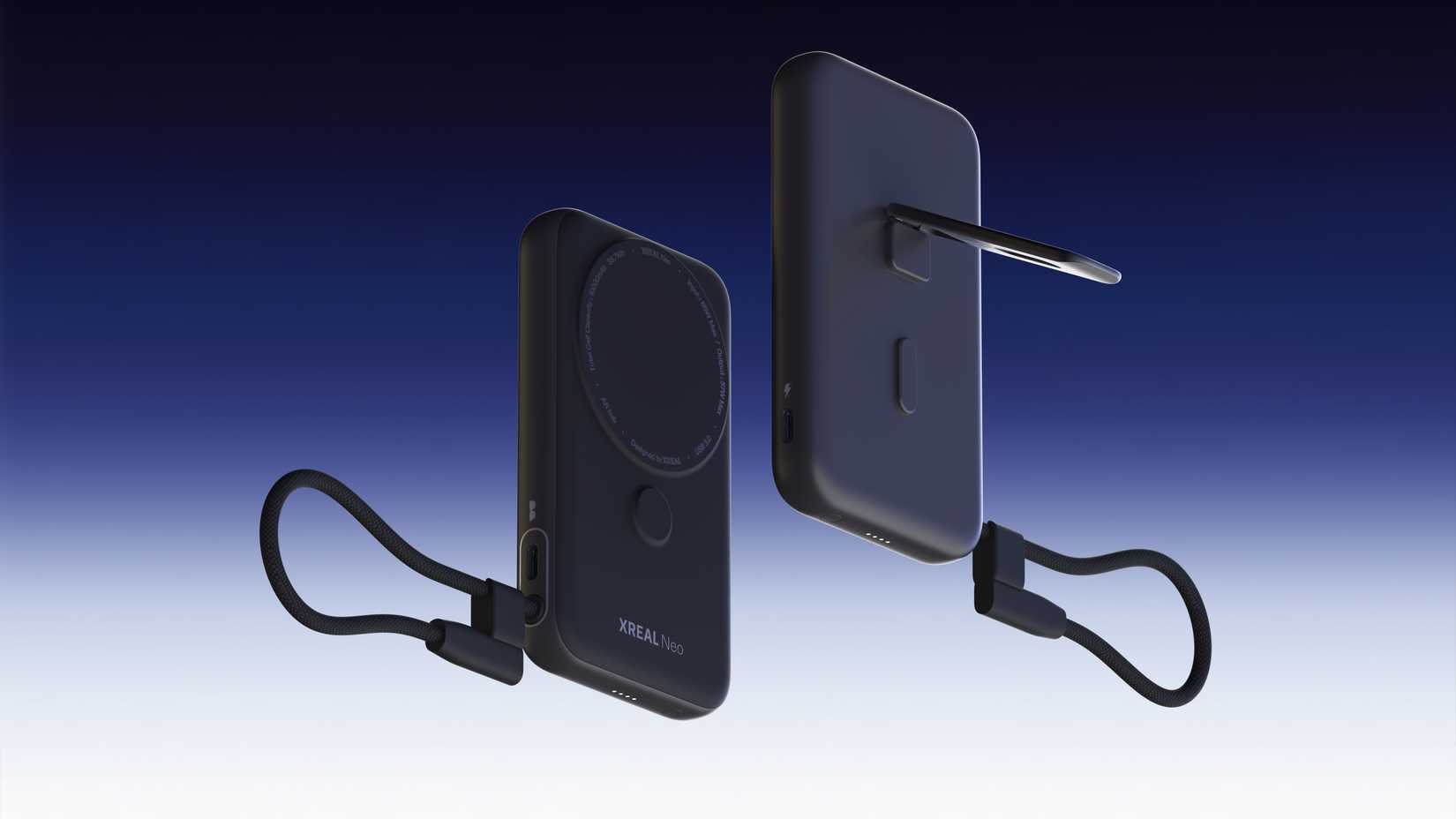Image: Xreal
For PC handhelds like Steam Deck and the ROG Ally, the Xreal 1S glasses are a straightforward plug-and-play experience. Using the Switch 2 requires a pass-through device — the $99 Xreal Neo, a little brick the size of a deck of cards that also works as a 10,000 mAh power bank for your phone, laptop, or handheld. (Nintendo officially prevents the USB-C port from outputting video on Switch 2, but the Neo is a clever little workaround.) I found the Xreal 1S + Neo + Switch 2 combo a little unwieldy for plane travel, though I did spend a fair few hours burrowed under my duvet with this setup, and would highly recommend it.
There’s more to these glasses than just that big, bodacious screen. The Xreal 1S can be used to watch videos and play games in 3D, with just a few button presses. The Real 3D feature requires no special apps and comes without any DRM restrictions — it’s all powered by the onboard spatial computing chip. I don’t know how the technology works, nor do I care — just think of it as a much fancier version of the Nintendo 3DS’s parallax 3D effect. You can adjust it on the fly to give as much or little depth as you want. It doesn’t work perfectly with everything, but when it does the effect is wildly cool — especially with artsy 2D side-scrollers like Silksong and revamped retro titles like Square Enix’s recent Dragon Quest remakes.
I’ve never been a huge wearables person — I had a torrid couple weeks with the PSVR 2 after its launch, and it’s been banished to the hall closet ever since. But I find myself inventing excuses to use my Xreals far more often than I’d expected. (How does The Sopranos look in ultra-big-screen? Great! What’s bedtime Balatro like in 3D? Frickin’ fantastic!) I realize that nobody on the planet really “needs” AR glasses, but I should warn you that if you get the Xreals anywhere near your face, you will absolutely want them. Xreal 1S and Xreal Neo are available starting today for $449 and $99, respectively.
Xreal 1S and Xreal Neo were reviewed using demo units provided by Xreal. You can find additional information about Polygon’s ethics policy here.