Zelda: Breath of the Wild’s Great Plateau reinvented the series
The opening to the most consequential and successful Legend of Zelda game shows Nintendo at its peak
Most Zelda games, at least those in the 3D era, start the same way: with a mini-adventure in a contained environment that walks you through essential mechanics and controls, presenting the overall shape of the game in microcosm. Think of The Legend of Zelda: Ocarina of Time’s Kokiri Forest, a gentle tutorial that segues into a micro-dungeon within the Great Deku Tree. It’s idyllic and walled-in, giving a sense of safety and setting up the heart-stopping moment when Link steps out of the forest and onto the open wilds of Hyrule. By then, it’s taught you everything you need to know — not just about the controls, but about the mix of mystery, lyricism, precise combat, and involved spatial puzzling that lies before you.
It’s the opposite of a dramatic entrance, really. The lore has been laid out as if inherited from books of legend; Link is just a normal boy, and his world is cozy and circumscribed. The sense of adventure is built gradually, as the player relaxes into the experience.
The beginning of 2017’s The Legend of Zelda: Breath of the Wild — which we can now say is probably the most consequential Zelda game, and certainly the most successful — follows the same essential formula. But it does so in a much more radical and dramatic way, befitting a game that was a radical and dramatic departure from series norms. Like Kokiri Forest, Breath of the Wild’s Great Plateau is a self-contained adventure that also serves as a tutorial, but it’s a tutorial that explodes preconceived notions of what a tutorial can be and what the game is going to do. It’s a dramatic entrance for Nintendo’s complete reinvention of Zelda.
Image: Nintendo EPD/Nintendo via Polygon
The first stroke of genius from producer Eiji Aonuma, director Hidemaro Fujibayashi, and their team is to invert the isolation of the starting area. Instead of walling it in or tucking it away, they set it at the center of the game’s world and raise it up. Earlier Zelda games may have roamed far and wide, but they were still essentially a series of locks and keys; Breath of the Wild would be about true freedom of exploration. The Great Plateau introduces this concept in a contained way without betraying it.
This Link, an amnesiac waking in a cave, is under no illusions about the scale of the adventure he’s about to undertake. From the mouth of the cave, he can see all of Hyrule spread before him, from the cursed castle to the smouldering Death Mountain. He can see the lights of Shrines and Sheikah Towers winking at him from wild forests and rolling fields. And there’s nothing stopping him from going to any of these places — nothing except the sheer cliffs that surround the Plateau, and spell certain death if he steps off them without a paraglider.
The cliffs and the paraglider are an artfully disguised lock and key — just about the only one in the entire game. The Great Plateau’s mysterious old man won’t give Link the glider until he completes four Shrines that teach him four powers: Stasis, Magnesis, Cryonis, and the Remote Bomb. Here is the developers’ next stroke of genius — and bravery. Once Link has these tools, he has everything he needs to complete the whole adventure. Although he can grow stronger, find better armor and equipment, and even learn powerful Champion Abilities, there is no further gating in Breath of the Wild. Once you’ve completed the tutorial, you have a functionally complete hero character who is theoretically capable of besting any challenge in the world of Hyrule — a breathtaking vote of confidence by the developers in the ingenuity and flexibility of both their players and their own creation.
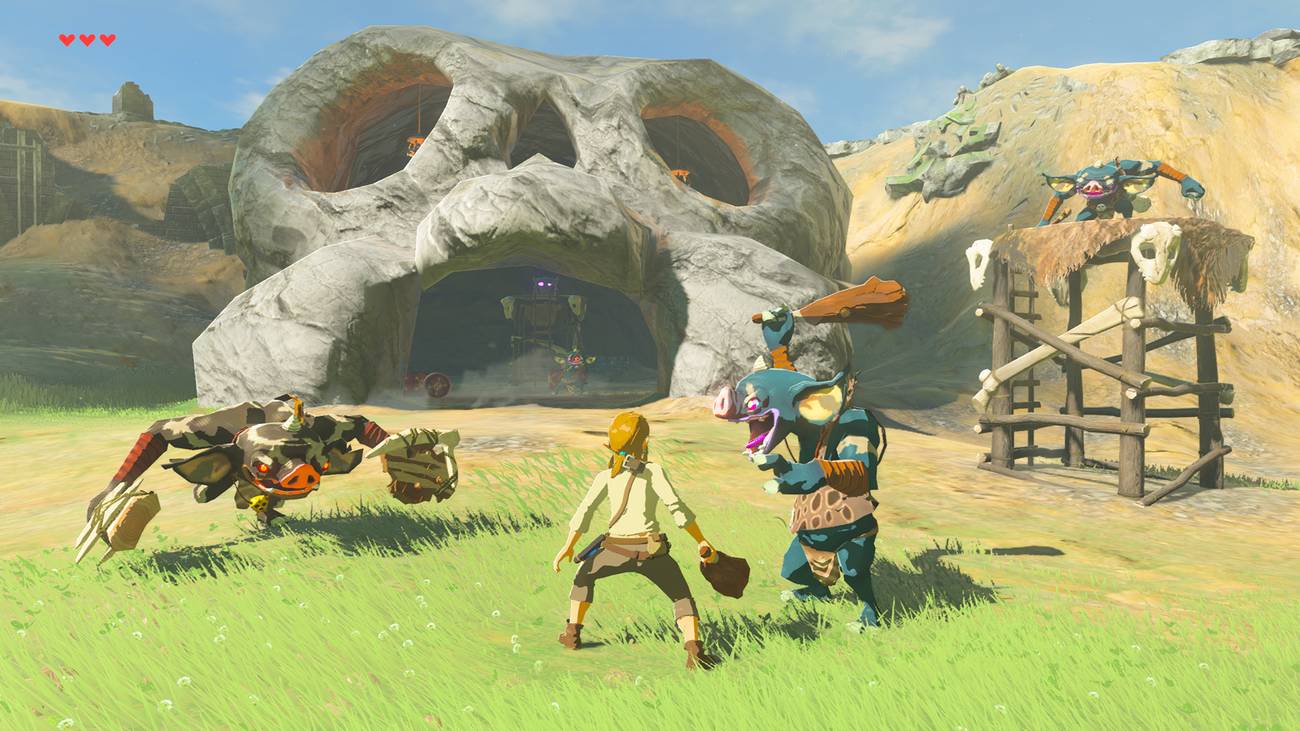Image: Nintendo EPD/Nintendo
The journey Link undertakes to acquire those powers on the Plateau is striking for the variety and majesty it packs into an hour or two, while introducing the player to an interconnected web of emergent, survival-style systems that are all new to the Zelda series: cooking, weather, stamina management, material physics. A boulder sits invitingly above a couple of Bokoblins idling in a dell. What would happen if you pushed it? One of the shrines sits atop a freezing peak. Winter clothing or a warming recipe would help, but how can you find them?
The designers leave clues, but don’t push the player too forcefully toward one action or solution. To preserve the freedom of the game’s world, it’s vital that players discover it organically, even at the tutorial stage. The Great Plateau can be hard (have you tried it on Master Mode?) and even inscrutable in some places. A hard tutorial is regarded as a sin by some game designers, but in this instance, it gives the game life.
The final dramatic touch is the setting. The Great Plateau is no romantic idyll like Kokiri Forest, or The Wind Waker’s Outset Island, or Skyward Sword’s Skyloft. It’s a mystical, lonely, windswept place. The ruin of the Temple of Time stands over it with pointed iconography; it’s like a haunted relic of what Zelda games used to be. The remains of terrifying ancient robots lie strewn between crumbling walls, and they still possess their death-ray gaze. There’s nobody here apart from a few rogue monsters and the mysterious old man — and even he might not really be here at all.
In Breath of the Wild’s sequel Tears of the Kingdom, the Great Plateau returns as a forbidding mid-game zone, an unruly fortress of danger and mystery looming high above Hyrule’s plains, which Link must arduously arduously climb up to, rather than float down from. What other tutorial area could play this double role? The Great Plateau reduces all the ferocity, beauty, and untamed adventure of these amazing games to their essence. It’s one of the all-time great game openings.